The latest Verizon 6G test is putting next-generation wireless technology back in the spotlight after reports that Verizon and Ericsson completed an outdoor 6G call using spectrum in the 7GHz band. The demonstration is an early technical milestone for an industry still developing the standards, hardware and infrastructure that will eventually define 6G.
Light Reading’s report describes the outdoor call, while Yahoo Finance reports that the companies are accelerating their 6G development work. The news also drew attention from investors, with TipRanks reporting a rally in Verizon and Ericsson shares.
The important distinction is that a successful research demonstration is not the same as a commercially ready network. It shows that companies are testing the next generation of wireless technology in real-world conditions, but does not by itself establish final network speeds, consumer availability or a launch date.
Background and Context: Why the Industry Is Already Working on 6G
Wireless standards typically develop over long timelines. Network operators and equipment makers research the next generation well before consumers can use it, because spectrum decisions, technical standards, equipment development and infrastructure deployment all take years.
5G continues to underpin mobile broadband, fixed wireless access and connected-device services. The industry is now investigating what should come next, including how future networks might support more demanding applications, greater capacity and new forms of connectivity.
Verizon and Ericsson have a direct interest in that transition. Verizon operates mobile networks, while Ericsson supplies telecommunications equipment and network technology. Early collaboration allows operators and equipment makers to test concepts before standards and commercial deployment plans are finalized.
The 7GHz band is particularly relevant because spectrum in this range may offer a balance between capacity and coverage compared with some higher-frequency bands. Its ultimate role in 6G will depend on technical research, regulatory decisions and international spectrum coordination.
Latest Update: What the Verizon-Ericsson 6G Test Actually Demonstrated
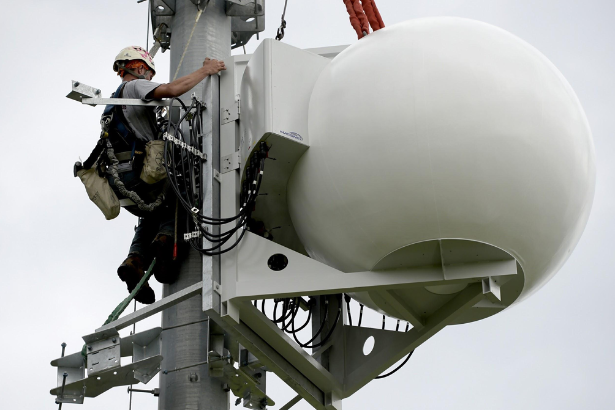
The most detailed account comes from Light Reading’s October 16 report. It describes a proof-of-concept test at a Verizon commercial network site in Concord, California.
Here are the key details reported by the publication:
- A real-world outdoor call: The companies demonstrated a call using pre-standard 6G equipment outside the laboratory.
- 7GHz spectrum: The test used spectrum in the 7GHz band, although the companies did not identify the exact frequencies used.
- A 400MHz carrier: Ericsson’s proof-of-concept base station used a pre-standard 6G technology stack with a 400MHz carrier.
- Indoor and outdoor measurements: Testing examined signal behavior across different distances and building materials, including how an outdoor signal penetrates indoor spaces.
- More testing ahead: Verizon and Ericsson said they would continue analyzing the results and use the findings to guide further research and network planning.
The field setup also included a mobile test structure designed to assess how signals behave across walls and windows. Light Reading reports that the base station and test device were separated by roughly 100 to 200 meters during the measurements.
These details matter because a wireless system that works in controlled laboratory conditions still needs to be evaluated against obstacles, interference, building materials and real deployment environments.
Why 7GHz is drawing attention
Spectrum around 7GHz is among the frequency ranges being studied for potential future commercial wireless use in the United States. The National Telecommunications and Information Administration has been examining the lower 7GHz range, including the 7125MHz to 7400MHz segment, according to Light Reading.
The distinction is important: the reported test does not establish that the companies used that exact segment, nor does it mean the spectrum is already cleared for commercial 6G services. Spectrum availability requires regulatory study and coordination with existing users.
The test is part of a wider industry effort
Verizon’s 6G research is not happening in isolation. The company has a 6G Innovation Forum involving technology and equipment partners, while other network operators are also testing prototype equipment.
Light Reading notes that T-Mobile has tested prototype 6G equipment with Ericsson and MediaTek under a temporary authorization. These parallel efforts illustrate the competitive push to understand future network performance before standards and commercial systems are finalized.
Expert Insights and Analysis: What This Means for 6G
1. Field testing is a more meaningful step than a lab demonstration
Laboratory testing is essential for developing new radio technologies, but field testing introduces conditions that are difficult to replicate perfectly in a controlled environment.
For Verizon and Ericsson, a call made outside the lab offers a chance to assess whether the system behaves as expected in an actual deployment setting. Measurements of throughput, latency, stability and signal penetration can help engineers identify what needs improvement.
The reported milestone is therefore valuable as a research result. It should not be interpreted as proof that 6G is ready to replace 5G.
2. Wider spectrum can offer capacity, but coverage remains a challenge
The 7GHz range is attractive for research because wider blocks of spectrum could support high-capacity wireless connections. But frequency alone does not determine network quality.
Radio propagation, antenna design, power limits, interference, building materials and network density all affect performance. Higher frequencies can present greater challenges when signals need to penetrate buildings or travel around obstacles.
That makes the companies’ outside-to-inside testing particularly relevant. Future 6G systems will need to balance high capacity with reliable coverage, not simply demonstrate a fast connection under ideal conditions.
3. 6G could extend beyond faster smartphone downloads
The longer-term industry vision includes more responsive and programmable connectivity, AI-native network services, immersive communications, industrial automation and robotics.
Those are potential use cases, not proven outcomes of this specific call test. Realizing them would require advances across radio technology, network software, device hardware, security and the supporting infrastructure.
For now, the test contributes to the technical groundwork that could eventually support those applications.
Broader Implications: Why Verizon and Ericsson Are Investing Early
The race toward 6G is both a technology contest and a strategic business decision.
For Verizon, early research can help shape future network architecture and inform decisions about spectrum, equipment and infrastructure investment. For Ericsson, demonstrating working technology can strengthen its position as operators plan the next generation of mobile networks.
The stakes extend across the telecommunications supply chain. Semiconductor designers, test-equipment makers, network software vendors and device manufacturers may all play a role as 6G requirements become clearer.
Regulation will be equally important. Even if a technical system works, commercial deployment depends on spectrum allocation, standards development, equipment availability and the economics of building and operating networks.
Investors should also separate a short-term stock reaction from a long-term business outcome. TipRanks reported that Verizon and Ericsson shares rose after the test news, but a single trading session cannot establish the future financial value of 6G investments.
For more reporting on telecom infrastructure, emerging wireless standards and technology markets, see the suggested internal link: The Tech Marketer’s technology coverage.
Related History: From 5G Advanced to 6G
The transition to a new generation of wireless technology is not a single event. It involves research, standards work, spectrum policy, equipment development and gradual deployment.
5G itself continues to evolve through improvements often described as 5G Advanced. Those developments can provide a bridge toward capabilities that researchers are exploring for 6G, including better sensing, more flexible network control and deeper integration of AI into network operations.
The Verizon-Ericsson demonstration fits into this longer process. It is a proof-of-concept exercise using pre-standard equipment, not a finalized 6G product operating under a completed global specification.
As standards mature, tests like this can help researchers identify which approaches work in practical conditions and which require further development.
What Happens Next?
The next milestones to watch are:
- Further field testing: Verizon and Ericsson are expected to continue analyzing coverage, throughput, latency and stability.
- Spectrum decisions: US regulators and spectrum agencies will continue examining which frequency ranges may be available for future commercial networks.
- Standards development: Industry groups will work toward defining the technical specifications that compatible 6G systems must meet.
- Prototype improvements: Equipment makers will refine radios, base stations and devices as the research develops.
- Commercial planning: Operators will eventually need to determine deployment timelines, infrastructure costs and viable services.
- More industry demonstrations: Similar tests from other operators and equipment suppliers will help reveal how competing technical approaches compare.
The immediate question is not when consumers can sign up for 6G. It is what the next round of tests reveals about the technology’s performance, particularly in environments where coverage is more difficult.
Conclusion
The Verizon 6G test with Ericsson is a meaningful step in early wireless research because it moves a pre-standard system out of the lab and into a real-world environment. The outdoor call and accompanying coverage measurements offer engineers practical information about how future networks might perform.
But the milestone needs to be kept in perspective. It does not establish final 6G speeds, confirm commercial readiness or provide a launch date. Spectrum policy, global standards, equipment development and further field testing remain essential.
For Verizon and Ericsson, the value lies in learning early and helping shape the next generation of wireless infrastructure. For consumers, 6G is still a developing technology, and 5G will remain central to mobile connectivity for years to come.
FAQ
1. What was the Verizon 6G test with Ericsson?
Verizon and Ericsson completed a reported pre-standard 6G field call using 7GHz-band spectrum at a commercial network site in Concord, California. The broader test also examined outdoor coverage and signal penetration into buildings.
2. Does the Verizon 6G test mean 6G is available now?
No. The test used proof-of-concept equipment and pre-standard technology. Commercial 6G services will require further research, finalized standards, suitable spectrum, compatible devices and network deployment.
3. Why is the 7GHz band important for 6G?
The 7GHz range is being studied for potential future wireless use because it may offer spectrum capacity for high-performance networks. Its eventual use will depend on propagation results, regulatory decisions and coordination with existing spectrum users.
4. How fast was Verizon’s 6G test?
The cited Light Reading report describes the use of a 400MHz carrier, but it does not provide a confirmed headline download speed for the outdoor call. Carrier bandwidth alone is not enough to calculate real-world user speeds.
5. When will 6G launch commercially?
The demonstration does not establish a launch date. Commercial availability will depend on standards development, spectrum allocation, equipment readiness and operators’ investment plans.
6. Why did Verizon and Ericsson shares rise after the test?
TipRanks reported that both stocks rose following the announcement. The test may have increased investor attention toward future network technology, but a short-term share-price move does not prove that the research will generate future profits.
7. How is 6G different from 5G?
6G research aims to improve wireless performance and potentially integrate connectivity more closely with AI, sensing and advanced applications. Its final technical features have not yet been fully standardized, so specific performance comparisons remain premature.
Sources & References
- Verizon and Ericsson make first 6G call outside in 7GHz band, Light Reading, October 16, 2026.
- Verizon, Ericsson accelerate 6G development with real-world test, Yahoo Finance.
- Verizon (VZ) and Ericsson (ERIC) stocks rally thanks to a real-world 6G test, TipRanks.
- National Telecommunications and Information Administration, for US spectrum policy and studies relevant to future wireless networks.