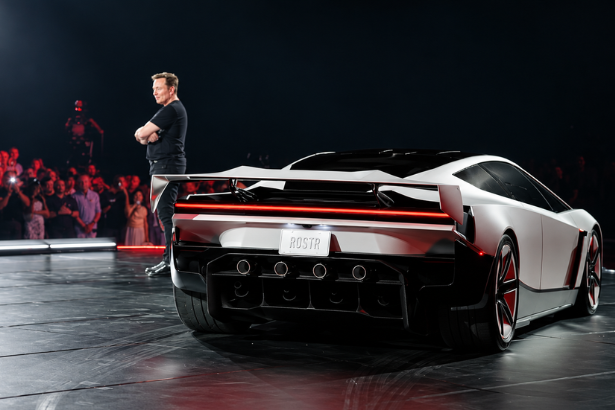
The Tesla flying car has moved from futuristic speculation to a dramatic prototype demonstration. On October 15, 2026, Elon Musk unveiled the redesigned Tesla Roadster at a SpaceX test facility in Texas, showing a vehicle that climbed an inverted ramp, performed an airborne maneuver, and landed using compressed-gas thrusters developed in collaboration with SpaceX.
The demonstration was designed to showcase the next-generation electric sports car’s unusual capabilities. Tesla also claimed acceleration from zero to 60 miles per hour in less than a second, an extraordinary performance figure that will require independent testing to verify. CNN’s report described the reveal as a new chapter in Musk’s longstanding ambition to push the boundaries of automotive engineering.
There is an important distinction, however: the demonstration does not establish that Tesla has developed a practical flying car for everyday transportation. The vehicle shown was a prototype performing controlled maneuvers at a test facility. Production, road legality, safety, and the real-world usefulness of its flight capabilities remain separate questions.
The announcement quickly drove searches for Tesla, Roadster, flying cars, and Elon Musk, according to the supplied Google Trends screenshot. The spike reflects intense public attention, but the commercial significance of the technology will depend on what Tesla can ultimately deliver.
Background and Context: Why the Tesla Roadster Matters
The Roadster occupies a special place in Tesla’s history. The original model helped establish the company as more than an experiment in electric mobility, demonstrating that an electric vehicle could deliver sports-car performance and appeal to enthusiasts.
Tesla introduced its second-generation Roadster concept in 2017, promising extraordinary acceleration and a much more ambitious performance package. The company initially targeted production for 2020, but the vehicle’s arrival was repeatedly delayed.
The October 2026 unveiling therefore carries more significance than an ordinary product reveal. It marks a return to a project that has remained in the public eye for nearly a decade.
The new prototype combines the familiar idea of a high-performance electric sports car with technology inspired by aerospace engineering. Instead of relying solely on electric motors, tires, and conventional aerodynamics, the demonstration incorporated suction and compressed-gas propulsion to produce unusual maneuvers.
According to Reuters’ coverage of the reveal, Tesla expects production to begin in 2028. That target is still a future commitment, not evidence that customer deliveries are imminent.

Reuters
+1
Latest Update: What Tesla Actually Demonstrated

The reveal centered on a sequence of carefully staged maneuvers that went well beyond what drivers expect from a conventional sports car.
A car that climbed an inverted ramp
During the presentation, the Roadster prototype accelerated up a large curved ramp and continued into an upside-down position.
A fan-based suction system was used to hold the vehicle against the ramp, according to reporting from Car and Driver.
The demonstration then showed the vehicle transitioning into an airborne maneuver. Cold-gas thrusters helped it rotate and return to the ground.
The distinction matters because suction, controlled ramp movement, and brief thruster-assisted flight are not the same as sustained flight between destinations. The demonstration showed a dramatic controlled maneuver, not a conventional aircraft operating system.
SpaceX technology enters the automotive conversation
The prototype’s thrusters were developed in collaboration with SpaceX, Musk’s aerospace company. Cold-gas propulsion releases pressurized gas to generate thrust, a principle used in spacecraft attitude-control systems.
Applying that concept to a road vehicle presents a different engineering challenge. A car must remain predictable around people, buildings, other vehicles, and changing road conditions. It also needs reliable braking, stable handling, crash protection, and compliance with road-safety regulations.
Tesla’s presentation highlighted the spectacle of applying aerospace-inspired technology to a sports car. It did not, by itself, establish how the system would perform under ordinary driving conditions.
The sub-second acceleration claim
Tesla also promoted a zero-to-60 mph time of less than one second.
For context, 60 mph is approximately 96.6 km/h. Reaching that speed in under a second would place the claimed performance in an extraordinary category, making independent measurement particularly important.
The demonstration and company claims should not be treated as a verified production specification. Real-world performance depends on factors such as traction, vehicle mass, propulsion configuration, battery output, and the conditions under which testing takes place.
What Tesla has and has not established
| Feature | What is known from the reveal | What remains unverified |
|---|---|---|
| Airborne maneuvers | A prototype performed a brief airborne maneuver at a test facility | Sustained, controlled flight between destinations |
| Thrusters | SpaceX-developed cold-gas technology was part of the demonstration | Long-term reliability and practical everyday use |
| Acceleration | Tesla claimed zero to 60 mph in less than one second | Independent verification under standardized conditions |
| Production | Tesla has indicated a 2028 production target | Final production configuration and delivery timing |
| Road legality | The reveal did not establish that every demonstrated feature is road legal | Certification and approval of each configuration |
The key takeaway is that Tesla has shown a striking prototype, but the distance between a successful demonstration and a commercially viable product remains substantial.
Expert Analysis: Is Tesla Building a Real Flying Car?
The phrase “flying car” attracts attention because it suggests a vehicle that can replace both a car and an aircraft. The Roadster demonstration points toward a more specific, and potentially more limited, concept: a high-performance electric vehicle with propulsion technology capable of producing brief airborne maneuvers.
That distinction is central to understanding the engineering.
1. Brief flight is not the same as practical transportation
A vehicle that can lift off momentarily has not necessarily solved the problems associated with flying between locations.
A practical flying car would need to address controlled takeoff and landing, flight stability, navigation, emergency procedures, operating noise, energy requirements, and rules governing airspace. If it is also expected to drive on public roads, it must satisfy the relevant vehicle regulations.
Tesla’s demonstration did not establish that the Roadster can perform those tasks as an everyday transport system.
The technology may still have value as an experimental propulsion platform, but its broader applications will depend on engineering evidence that has not yet been publicly established.
2. Cold-gas thrusters bring aerospace trade-offs
Cold-gas propulsion has a straightforward principle: pressurized gas is expelled through a nozzle, generating a reaction force in the opposite direction.
Its advantages can include a relatively simple propulsion mechanism and rapid control responses. Its limitations include the need to store pressurized gas and the finite amount of thrust available from a given gas supply.
For a road car, that creates questions about weight, packaging, operating duration, maintenance, and safety. A system that performs well during a short demonstration may not offer the same advantages during repeated everyday use.
The Roadster’s eventual production configuration will need to show how Tesla intends to manage these trade-offs.
3. The acceleration claim needs independent testing
A sub-second zero-to-60 mph time would be an exceptional achievement. But a credible performance comparison requires standardized measurement, documented test conditions, and clarity about whether the result applies to a prototype or a customer-ready vehicle.
A short demonstration can communicate ambition. Independent testing establishes whether the claimed performance is repeatable.
Until that evidence is available, the acceleration figure should be described as Tesla’s claim rather than a confirmed production capability.
Broader Implications: What the Tesla Flying Car Means for the EV Industry
Tesla’s Roadster reveal arrives at a time when electric vehicles are competing on more than range and charging speed. Automakers increasingly use software, advanced powertrains, driver-assistance systems, and distinctive product experiences to differentiate their vehicles.
The Roadster takes that strategy to an unusual extreme.
A halo car for Tesla
In the automotive industry, a halo car is a high-profile model designed to attract attention and reinforce a brand’s technological reputation, even if it sells in relatively small numbers.
The Roadster could serve that role for Tesla. Its unusual engineering, dramatic demonstration, and connection to SpaceX generate attention that extends beyond the niche market for electric sports cars.
Reuters reported that Musk has characterized the Roadster as having limited financial importance to Tesla compared with the company’s broader business. That framing suggests the vehicle’s value may lie partly in publicity and technological ambition rather than sales volume alone.
Reuters
+1
The challenge of turning spectacle into a product
A prototype can be engineered around a narrow set of demonstration conditions. A production vehicle must work consistently across weather, road surfaces, temperature ranges, maintenance cycles, and customer use cases.
That transition involves manufacturing scale, quality control, durability testing, service infrastructure, and regulatory compliance.
For the Roadster, the challenge is especially pronounced because the most attention-grabbing features are also the ones that raise the biggest questions about practicality and safety.
Competition and the future of electric performance
Other electric sports cars compete on acceleration, handling, charging performance, range, and design. The Roadster’s proposed use of thrusters introduces a different kind of performance story.
But novelty alone does not guarantee an advantage. Buyers will ultimately need to weigh actual performance, reliability, price, usability, and support.
If the unusual propulsion system remains limited to a specialized configuration, its influence on the wider EV market may be more symbolic than transformative.
Suggested internal link: The Tech Marketer. For publication, replace this homepage link with an existing article on electric vehicles, automotive AI, or emerging mobility technologies if available.
Related History: From the Original Roadster to the Flying Prototype

The original Tesla Roadster
The first Roadster helped demonstrate that electric propulsion could power an exciting sports car. It became an important early chapter in Tesla’s evolution from a specialist electric-vehicle company into a major automotive brand.

The 2017 Roadster announcement
Tesla’s second-generation concept promised extreme performance, but its production schedule repeatedly slipped. The 2026 unveiling renews interest in a project that has been anticipated for years.
Reuters
+1

The 2026 prototype
The latest demonstration added SpaceX-inspired thrusters and brief airborne maneuvers to the Roadster’s performance narrative. Whether those features translate into the final customer vehicle remains to be seen.
The progression illustrates how Tesla’s Roadster concept has evolved from an electric sports car into a vehicle intended to showcase an unusually ambitious mix of automotive and aerospace engineering.
It also highlights a recurring lesson in technology: a compelling demonstration can generate attention immediately, while delivering a reliable commercial product takes much longer.
What Happens Next?
The next major milestone is the transition from demonstration prototype to production-ready vehicle.
Tesla has indicated a 2028 production target, but the remaining development work and the final specifications will determine what customers can actually buy.
Reuters
+1
Several developments will be worth watching:
- Final specifications: Tesla needs to clarify which propulsion and flight-related features will be available in each version.
- Independent performance tests: Standardized acceleration testing would help establish whether the sub-second claim is repeatable.
- Safety and certification: The company will need to explain how the vehicle and any specialized propulsion equipment satisfy applicable requirements.
- Pricing and reservations: Reservation terms, final prices, and delivery schedules will matter to potential buyers.
- Production timing: The 2028 target should be treated as a plan until Tesla confirms production readiness and customer deliveries.
For now, the Roadster is best understood as a technology demonstration with a proposed path toward production, not as proof that practical flying cars have arrived.
Conclusion
Tesla’s new Roadster has delivered one of the most unusual electric-vehicle demonstrations in recent memory. Its use of SpaceX-inspired thrusters, brief airborne maneuvers, and claimed sub-second acceleration has captured public attention and reignited interest in the long-delayed sports car.
Yet the most important questions remain unanswered. The demonstration does not establish sustained flight capability, independently verified performance, or the practicality of the system for ordinary driving.
The Roadster’s significance will ultimately depend on whether Tesla can turn the spectacle into a safe, reliable, manufacturable vehicle. Until then, the flying-car label describes the ambition behind the reveal more than a proven new form of transportation.
FAQ: Tesla Flying Car and the New Roadster
1. Did Tesla unveil a flying car?
Tesla unveiled its redesigned Roadster on October 15, 2026. During the demonstration, a prototype used thrusters to perform a brief airborne maneuver. That does not establish that it can operate as a conventional flying car.
2. How does the Tesla Roadster fly?
The demonstration used cold-gas thrusters developed in collaboration with SpaceX. A fan-based suction system also helped the prototype travel along an inverted ramp before its airborne maneuver.
3. Can the Tesla flying car fly long distances?
The demonstration did not establish sustained flight or long-distance aerial travel. Those capabilities should not be assumed from a brief controlled maneuver.
4. How fast is the new Tesla Roadster?
Tesla claimed the vehicle can accelerate from zero to 60 mph in less than one second. Independent testing is needed to establish the repeatability of that figure and whether it applies to the final production model.
5. When will the new Tesla Roadster go into production?
Tesla has indicated a 2028 production target. The schedule remains subject to development, manufacturing, and other requirements.
6. How much will the new Tesla Roadster cost?
The final pricing and configuration details need to be confirmed against Tesla’s current official ordering information. Reservation amounts and prototype claims should not be mistaken for a final purchase price.
7. Is the Tesla Roadster street legal?
The demonstration does not establish that every configuration or propulsion feature will be approved for public-road use. The final vehicle’s certification and permitted uses will depend on the relevant regulations.
8. Why is Tesla trending on Google?
The supplied Google Trends screenshot shows a sharp increase in searches for Tesla alongside news coverage of the Roadster reveal. The chart indicates relative search interest, not the exact number of searches or proof of public acceptance.
Sources & References
1. CNN: Tesla unveils what it says is a flying car. Reporting on the unveiling, the demonstration, and the company’s claims.
2. CBS News: With Tesla Roadster debut, Elon Musk shows ‘flying cars are real’. Coverage of the prototype demonstration and Musk’s statements.
3. Fox Business: Tesla’s new Roadster makes a flying debut, hitting 60 MPH in under a second. Reporting on the thruster-assisted demonstration and acceleration claim.
4. Reuters: Tesla’s new Roadster turns in air with SpaceX thrusters, won’t land until 2028. Reporting on the production timeline, vehicle ambitions, and industry context.
5. TechCrunch: Tesla reveals SpaceX-powered Roadster that flies and falls with style. Technology-focused analysis of the prototype and its propulsion system.