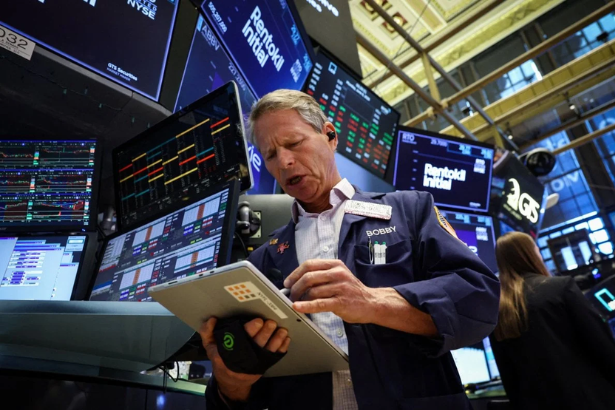
Stock market today July 14 2026 opens against one of the most complex multi-variable backdrops of the entire year. Stocks fell sharply on Monday as President Trump reinstated what he called a blockade on Iranian shipping through the Strait of Hormuz, sending Brent crude above $82 per barrel and triggering a tech-led sell-off that closed the Nasdaq Composite down 1.55 percent. The S&P 500 lost 0.79 percent to finish at 7,515.34, the Dow declined 0.26 percent to 52,498.64, and chip stocks absorbed the sharpest damage, with newly listed SK Hynix falling 9 percent from its debut price, Micron down 4 percent, AMD down 4 percent, and Intel dropping 6 percent. Tuesday, July 14 brings the June CPI report at 8:30 a.m. ET, Federal Reserve Chairman Kevin Warsh’s first congressional testimony on monetary policy, and the unofficial start of earnings season with JPMorgan, Goldman Sachs, Bank of America, Citigroup, and Wells Fargo all reporting before the bell.
Monday’s Close: The Numbers That Defined the Session
The final numbers from Monday July 13 tell the story of a market that absorbed multiple simultaneous shocks and sold off in a decisive but not catastrophic way.
The S&P 500 slid 0.79 percent to finish at 7,515.34, while the Nasdaq Composite fell 1.55 percent to close at 25,873.18. The Dow Jones Industrial Average declined 138.37 points, or 0.26 percent, to settle at 52,498.64. Among the 11 major sectors of the S&P 500, technology shares suffered the biggest percentage loss while energy led the gainers, the clearest possible signal of what drove the session.
Declining issues outnumbered advancers by a 1.57-to-1 ratio on the NYSE. On the Nasdaq, 1,620 stocks rose and 3,060 fell, with declining issues outnumbering advancers by a 1.89-to-1 ratio. The ratio data confirms this was a broad-based sell-off in equities rather than a narrow index movement driven by a handful of mega-cap weights.
The Iran Hormuz Announcement: What Rattled Markets
The specific Trump announcement that drove Monday’s session deserves examination in its precise language.
Stocks fell on Monday after President Trump announced he was reinstating what he called a blockade on Iranian shipping through the Strait of Hormuz. “We are reinstating the IRANIAN BLOCKADE, so named because it is only stopping Iran’s ships or customers from entering or leaving,” Trump wrote in a post on Truth Social. He added that the United States would be “THE GUARDIAN OF THE HORMUZ STRAIT” and would charge a 20 percent fee on all cargo shipped through it for safety and security services.
The IRGC separately stated that “the Strait of Hormuz will be closed until further notice” and would not allow vessels to transit until “the end of the American interventions in this area.” The U.S. disputed that the strait was actually closed and insisted commercial shipping continued uninterrupted. The gap between Iranian rhetoric and American operational statements created its own uncertainty premium in oil and equity markets. On Monday evening, President Trump formally notified Congress that fighting between the US and Iran had resumed, and the US plans to begin enforcing the Hormuz blockade on Tuesday afternoon.
Oil Above $82: The Inflation Transmission Risk
The oil price reaction to Monday’s announcement was immediate and significant, and its implications extend well beyond the energy sector.
Oil prices jumped, with Brent crude nearing $82 per barrel, after Trump’s Truth Social announcement. Earlier, Brent had jumped above $82 briefly after the IRGC’s closure announcement. The Strait of Hormuz carries approximately 20 percent of global crude oil and LNG supply, and any genuine sustained disruption to flows would transmit through energy prices into broader inflation almost immediately.
The resumption of hostilities revived inflation worries just as markets prepared to receive two critical inflation readings. The Consumer Price Index for June is due Tuesday morning. The Producer Price Index follows Wednesday. Economists polled by Dow Jones expected the June CPI headline to show a 0.2 percent decline on the month but a year-over-year increase of 3.8 percent. Fed rate-hike bets have been climbing in bond markets, with the CME FedWatch tool last pricing in a quarter-point hike as soon as September.
Sustained increases in oil prices typically feed through to higher fuel and transport costs, potentially increasing inflation while benefiting energy producers. Sectors including airlines, transportation, and consumer discretionary companies could face additional headwinds if oil remains elevated.
Chip Stocks: The Biggest Losers of Monday’s Session
The semiconductor sell-off on Monday was sharp, broad, and carries both geopolitical and valuation dimensions.
Semiconductor names were under particular pressure. U.S.-listed shares of SK Hynix fell 9 percent, giving back a significant portion of the 13 percent gain on its Nasdaq debut Friday. Shares of Micron Technology closed down 4 percent, while Sandisk shed 12 percent. Seagate Technology fell 5 percent. Advanced Micro Devices slipped 4 percent, while Intel pulled back 6 percent.
The selling in Asian semiconductor shares was even more dramatic before U.S. markets opened. SK Hynix shares fell almost 14 percent in South Korea despite the company’s successful Nasdaq listing last week, and the decline contributed to a drop of more than 5 percent in South Korea’s KOSPI index, which prompted the Korea Exchange to temporarily suspend trading. Much of the selling appeared to reflect profit-taking and investor caution ahead of earnings season rather than weakening demand for AI hardware, according to multiple analyst notes circulating Monday.
Ben Fulton, CEO of WEBs Investments, said the market is “range-bound until you get a true solution in the Middle East” on the geopolitical side, while adding that he still believes the AI trade is ultimately “alive and well” despite the chip stock pressure.
AI Stocks Under Pressure: A Broader Pattern
The chip sell-off on Monday is part of a broader pattern of AI-related stock pressure that began building in the days before the Hormuz escalation.
One analyst was asked on air whether rising corporate bond issuance to fund AI capital expenditure could become a problem. “I wonder if the market is going to really start to revolt a little bit at the deluge of corporate issuance to fund this AI capex that has been called into question for a couple of years now,” the analyst said. That concern, that the scale of AI infrastructure investment commitments by hyperscalers may be approaching a market saturation point for equity and bond investors simultaneously, is separate from the geopolitical shock and represents a longer-term valuation pressure on the sector.
The Van Eck Semiconductor ETF (SMH) has soared approximately 70 percent year to date, making the profit-taking motivation in the context of geopolitical uncertainty straightforward. The earnings week ahead, particularly Taiwan Semiconductor Manufacturing Company’s results, will provide the clearest signal yet about whether AI hardware demand is sustaining or showing early signs of deceleration.
Bank Earnings: Tuesday’s Other Big Story
While the Iran-oil-inflation nexus dominated Monday’s session, the market is simultaneously positioned for a potentially historic bank earnings week.
Investors look forward to the unofficial kick-off of earnings season this week, led by big bank results from JPMorgan Chase, Goldman Sachs, Bank of America, Citigroup, Wells Fargo, and Morgan Stanley. Analysts are expecting the big Wall Street banks to post one of their strongest quarters ever. S&P Capital IQ consensus estimates show aggregate Q2 S&P 500 earnings growth of 20.9 percent year over year, while LSEG data has that figure at 23.7 percent.
Citi analyst Asiya Merchant separately raised the price target on Apple to $365 from $315, noting the tech giant’s ability to implement selective price increases to offset margin pressures and its loyal customer base as mitigating factors against broader consumer weakness. Apple is set to report its own earnings on July 30.
Federal Reserve Chairman Kevin Warsh: His First Congressional Testimony
The other major Tuesday event arrives at 10 a.m. ET when Fed Chairman Kevin Warsh appears before the House Financial Services Committee.
Federal Reserve Chairman Kevin Warsh is slated to appear before the House Financial Services Committee Tuesday, offering testimony on the central bank’s semi-annual monetary policy report. Warsh has communicated less publicly than his predecessors Jerome Powell, Janet Yellen, and Ben Bernanke. His testimony will be the clearest direct signal of the Fed’s current thinking on the competing pressures of higher oil prices, elevated year-over-year inflation, and the question of whether a rate hike remains on the table for the July 28-29 meeting.
Bond traders have been increasing their bets that the Fed will hike at the July meeting ahead of the CPI report. Minutes from the June Fed meeting had already demonstrated a hawkish bias, with the committee highlighting upside inflation risks while noting that labor market concerns had eased.
Latest Update: Tuesday’s Calendar and What to Watch
The stock market today July 14 2026 schedule is one of the most event-dense single trading days of the year.
At 8:30 a.m. ET: June CPI report. Economists expect a 0.2 percent monthly decline but a 3.8 percent year-over-year increase. At 8:30 a.m. ET: JPMorgan, Goldman Sachs, Bank of America, Citigroup, Wells Fargo all report Q2 earnings. At 10:00 a.m. ET: Federal Reserve Chairman Kevin Warsh testifies before the House Financial Services Committee. During the afternoon: The U.S. plans to begin enforcing the Strait of Hormuz blockade, which may generate additional market-moving news. Tuesday afternoon’s enforcement of the blockade is the most unpredictable variable on the calendar.
For full coverage of Monday’s session and Tuesday’s setup, follow CNBC, AP News, and Yahoo Finance.
Broader Implications: Three Simultaneous Market Forces in One Week
The stock market today July 14 2026 environment is defined by three forces that are all moving simultaneously and in directions that interact with each other in complex ways.
Force one is geopolitical: the Iran-Hormuz situation creates oil price pressure, which creates inflation pressure, which creates Fed rate-hike pressure, which creates equity valuation pressure. Force two is earnings: the Q2 bank and tech earnings arriving this week could either validate or undercut the elevated multiple at which the S&P 500 trades after a first half that saw it near record highs. Force three is AI capital expenditure: the market is beginning to ask whether the unprecedented corporate bond and equity issuance funding AI infrastructure investment has reached a point where the financing cost begins to weigh on the same companies driving the trade.
Any one of these three forces would be significant in isolation. All three arriving simultaneously in a single trading week makes the coming days potentially decisive for whether the market’s first-half momentum continues into the second half of 2026.
For more financial markets and stock market coverage, visit The Tech Marketer.
What Happens Next
The June CPI report arrives Tuesday morning at 8:30 a.m. ET. Bank earnings from the five biggest names on Wall Street report simultaneously. Fed Chairman Warsh testifies at 10 a.m. ET. The U.S. Hormuz blockade enforcement begins Tuesday afternoon. PPI arrives Wednesday. TSMC earnings Wednesday will be the most significant AI demand signal of the quarter. BlackRock and Morgan Stanley report Wednesday. Netflix and UnitedHealth report later in the week.
FAQ
Why did the stock market fall on Monday July 13, 2026?
The S&P 500 fell 0.79 percent and the Nasdaq dropped 1.55 percent on Monday July 13 after President Trump announced the reinstatement of a blockade on Iranian shipping through the Strait of Hormuz. The announcement sent Brent crude above $82 per barrel, revived inflation concerns ahead of Tuesday’s CPI report, and triggered a broad sell-off in semiconductor stocks led by SK Hynix, AMD, Intel, and Micron.
What happened to chip stocks on July 13, 2026?
Semiconductor stocks led Monday’s market decline. SK Hynix’s U.S.-listed shares fell 9 percent from its Friday debut price, Micron Technology dropped 4 percent, Sandisk shed 12 percent, Seagate fell 5 percent, AMD fell 4 percent, and Intel dropped 6 percent. The sell-off was attributed to a combination of profit-taking following a strong first half, geopolitical oil price uncertainty, and growing questions about AI capital expenditure sustainability.
What is the June 2026 CPI report expected to show?
Economists polled by Dow Jones expected the June 2026 Consumer Price Index to show a 0.2 percent monthly decline but a year-over-year increase of approximately 3.8 percent. The report arrives Tuesday July 14 at 8:30 a.m. ET. Bond traders have been increasing their bets on a Federal Reserve rate hike at the July 28-29 meeting ahead of the reading, and the CPI data will be the primary input into those expectations.
Which bank earnings are being reported this week?
JPMorgan Chase, Goldman Sachs, Bank of America, Citigroup, and Wells Fargo all report second-quarter earnings on Tuesday July 14 before the market opens. Morgan Stanley and BlackRock report Wednesday. Analysts expect Q2 S&P 500 earnings growth of approximately 20 to 24 percent year over year, which would represent the second consecutive quarter of above-20 percent growth and one of the strongest bank earnings seasons in recent history.
What is the Strait of Hormuz blockade and why does it affect markets?
The Strait of Hormuz is the narrow waterway between Iran and the Arabian Peninsula through which approximately 20 percent of global crude oil and liquefied natural gas supply transits. President Trump announced on Monday July 13 that the U.S. was reinstating a blockade on Iranian shipping and would charge a 20 percent fee on all cargo crossing the strait. Iran’s IRGC simultaneously declared the strait closed, though the U.S. disputed this. Any sustained disruption to Hormuz traffic would drive oil prices sharply higher, feeding through to fuel costs, transport costs, and broader inflation.
Sources and References
- CNBC live blog (original submission, confirmed via search): https://www.cnbc.com/2026/07/13/stock-market-today-live-updates.html
- AP News (original submission, blocked): https://apnews.com/article/stocks-markets-iran-trump-ai-2d6744b09c68b5473d0bc8584b89e60e
- Yahoo Finance (fully accessed): https://finance.yahoo.com/markets/live/stock-market-today-monday-july-13-dow-sp-nasdaq-113249278.html