Introduction
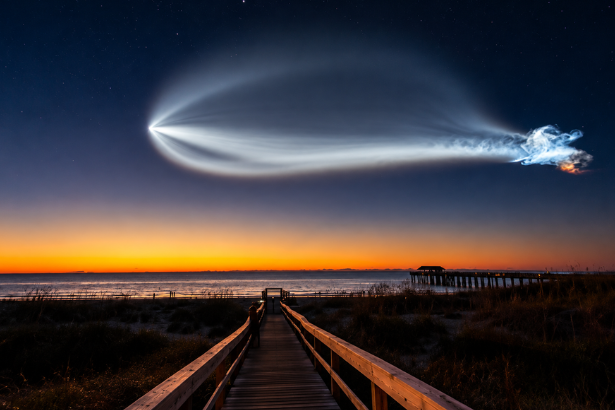
The latest SpaceX rocket launch Falcon 9 mission gave skywatchers more than a glimpse of a rocket climbing toward space. Early on October 13, 2026, the launch of SpaceX’s CRS-35 cargo mission created a glowing, jellyfish-shaped plume that people photographed across parts of Florida and other regions.
The unusual display appeared shortly before sunrise, when sunlight could illuminate exhaust high above a landscape that was still relatively dark. Images shared by witnesses showed a bright central glow with wispy extensions, prompting people to ask what the strange cloud was.
Behind the viral photographs was a routine but important spaceflight operation. The Falcon 9 carried a Dragon cargo spacecraft loaded with scientific experiments, equipment, and supplies for the International Space Station (ISS). NASA confirmed that the spacecraft lifted off from Cape Canaveral Space Force Station at 6:33 a.m. Eastern Daylight Time. NASA’s mission report details the launch and cargo delivery.
Background and Context: What Was the SpaceX CRS-35 Mission?
CRS-35 is the 35th mission in SpaceX’s Commercial Resupply Services program for NASA. These missions transport equipment, research materials, and supplies to the orbiting laboratory, supporting both day-to-day station operations and experiments that can benefit people on Earth.
According to SpaceX’s official CRS-35 mission page, the Falcon 9 launched from Space Launch Complex 40 at Cape Canaveral Space Force Station in Florida. The Dragon spacecraft was making its fourth flight to the station, while the rocket’s first-stage booster was flying for the eighth time.
NASA reported that the vehicle carried more than 6,300 pounds of supplies and hardware, including new scientific experiments and the final pair of International Space Station Roll-Out Solar Arrays.
The mission therefore had two stories: the atmospheric display that caught the public’s attention and the practical work of keeping a research laboratory in orbit supplied.
Latest Update: Why Did the Falcon 9 Launch Create a “Space Jellyfish”?
The phenomenon often called a “space jellyfish” is not a giant jellyfish-shaped cloud drifting naturally through the sky. It is an optical effect associated with a rocket’s exhaust plume at high altitude.
The timing of a launch is crucial. Around dawn, a rocket can climb into sunlight while observers on the ground remain in darkness or twilight. Sunlight catches the expanding exhaust plume, making it glow against the darker sky. The shape changes as the plume spreads, producing a bright head and long, wispy features that can resemble tentacles.
FOX 13 Tampa Bay’s photo report documented the striking display after the CRS-35 launch. The station noted that the visibility and appearance depend on launch trajectory, lighting, and atmospheric conditions. The effect is not guaranteed for every launch.
In a separate report, FOX 13 also cited an explanation from the Museum of Science and Industry in Tampa: exhaust particles can reach high altitudes, where they interact with sunlight before sunrise. That helps explain why a launch can look dramatically different to observers on the ground than it does in daylight.
The phenomenon can be visible far from the launch site. That does not mean the rocket is flying directly over every location where the plume is seen. High-altitude exhaust and favorable lighting can make the display visible across a broad region.
Expert Insights and Analysis: A Rocket Plume Is Not a Natural Cloud
The nickname “space jellyfish” describes the shape, not the physical nature of the display. The glow is linked to rocket exhaust spreading at high altitude and catching sunlight, rather than an ordinary weather cloud forming through the usual processes in the lower atmosphere.
The distinction matters because unusual dawn and dusk displays can prompt understandable questions about what people are seeing. The most useful clues are the timing of the launch, the direction of the plume, and whether the display appears shortly after a rocket ascends.
Atmospheric conditions also influence the result. The plume’s shape and brightness can change with altitude, the rocket’s trajectory, the amount and distribution of exhaust, and the angle of sunlight. Two launches using the same rocket can produce very different views.
The photographs are compelling, but they are not evidence on their own of a malfunction or an unexpected event. For the October 13 display, news reports linked the phenomenon to the scheduled CRS-35 mission.
Broader Implications: The Science Behind the Spectacle
The public often encounters spaceflight through dramatic images: a rocket lifting off, a booster returning to Earth, or a luminous plume stretching across the sky. Yet the larger significance of CRS-35 was the research and equipment traveling inside Dragon.
NASA said the mission included experiments related to health and biology, along with hardware and supplies for the ISS. Its research cargo included work involving lab-grown brain models, crop disease, astronaut health assessment, and antibiotic-resistant bacteria. These experiments use the station’s microgravity environment to investigate questions that are difficult to study in the same way on Earth.
The cargo also included the final pair of Roll-Out Solar Arrays for the space station. These arrays are part of efforts to support the station’s electrical power needs.
This is the broader story behind the viral pictures: reusable launch vehicles and cargo spacecraft are not only creating spectacular views, they are part of the transportation system that supports continuing research in orbit.
For readers interested in the intersection of engineering, commercial spaceflight, and science, The Tech Marketer could link this article internally to a related explainer on reusable rockets or the commercial space economy at The Tech Marketer.
Related History: The “Space Jellyfish” Is Not New
Similar glowing plumes have appeared after previous rocket launches, especially when launches occur near sunrise or sunset. The effect depends on the geometry of sunlight and the rocket’s high-altitude exhaust, so it can recur across different missions and locations.
That makes the CRS-35 display part of a wider pattern rather than a phenomenon unique to one SpaceX vehicle. The Falcon 9’s launch timing made the plume especially visible, but the appearance is not a special feature of the rocket’s design.
It is also useful to distinguish the plume from noctilucent clouds, a separate type of high-altitude cloud that can appear blue-white in twilight. While both can create striking views near the edge of daylight, a rocket-related plume is associated with a launch and its exhaust.
NASA has documented the CRS-35 mission as part of its ongoing commercial cargo program. Its mission overview provides official background on the spacecraft, launch, and research objectives.
What Happens Next?
After launch, Dragon follows a carefully planned sequence of orbital maneuvers to reach the International Space Station. SpaceX’s mission information projected an approximately 52-hour journey, with autonomous docking planned for October 15, 2026, at about 11 a.m. Eastern Time.
Once Dragon reaches the station, the crew can unload supplies and research equipment. Some experiments will be conducted aboard the ISS, while other materials and hardware support ongoing station operations.
For skywatchers, another “space jellyfish” display is possible during a future launch, but it cannot be promised in advance. The best conditions generally involve a launch near dawn or dusk, a plume high enough to catch sunlight, and a suitable viewing angle. Weather, the trajectory, and the timing of sunlight all influence what observers will see.
People who want to follow future missions can check the SpaceX launch schedule and NASA’s mission pages. Any viewing opportunity should be treated as conditional rather than guaranteed.
Conclusion
The October 13 SpaceX Falcon 9 launch created a vivid “space jellyfish” display because the rocket’s high-altitude exhaust caught sunlight while much of the ground remained in darkness. The result was a striking visual phenomenon that spread across social media and local news coverage.
But the spectacle was only one part of CRS-35. The mission carried more than 6,300 pounds of science, supplies, and hardware to support the International Space Station, including experiments that could contribute to research on human health and biology.
The display may have looked otherworldly, but its explanation rests on familiar physics: sunlight, atmospheric conditions, and an expanding rocket plume. The mission behind it shows how a moment of public wonder can coincide with the steady work of science in orbit.
FAQ
1. What caused the SpaceX rocket launch Falcon 9 “space jellyfish”?
The glowing shape appeared when sunlight illuminated the rocket’s expanding exhaust plume at high altitude while observers on the ground were still in darkness or twilight.
2. When did the CRS-35 Falcon 9 launch take place?
The CRS-35 mission launched on October 13, 2026, at 6:33 a.m. Eastern Daylight Time from Cape Canaveral Space Force Station in Florida.
3. What was SpaceX CRS-35 carrying?
NASA reported that Dragon carried more than 6,300 pounds of supplies and hardware, including scientific experiments and the final pair of Roll-Out Solar Arrays for the ISS.
4. Why could people see the plume far from Florida?
The plume formed high in the atmosphere, where it could catch sunlight while the ground remained relatively dark. That lighting geometry can make the display visible over a broad area.
5. Is a “space jellyfish” a real jellyfish or a normal cloud?
No. “Space jellyfish” is an informal nickname for the appearance of a rocket’s illuminated exhaust plume. It is not a living organism or an ordinary weather cloud.
6. Will every Falcon 9 launch create a space jellyfish?
No. The effect depends on launch timing, trajectory, altitude, sunlight, and atmospheric conditions. Many launches will not produce a display that is visible to people on the ground.
7. When was Dragon expected to reach the International Space Station?
SpaceX projected an approximately 52-hour trip, with autonomous docking planned for October 15, 2026, at about 11 a.m. Eastern Time. Check official mission updates for the latest status.
Sources & References
- NASA, “NASA Science, Cargo Launch on 35th SpaceX Resupply Mission to Station”
https://www.nasa.gov/news-release/nasa-science-cargo-launch-on-35th-spacex-resupply-mission-to-station/ - SpaceX, “CRS-35 Mission”
https://www.spacex.com/launches/crs35/ - FOX 13 Tampa Bay, “Photos: SpaceX CRS-35 launch creates ‘space jellyfish’ over Bay Area”
https://www.fox13news.com/news/photos-spacex-crs-35-launch-creates-space-jellyfish-over-bay-area - FOX 13 Tampa Bay, “Here is why a ‘jellyfish cloud’ appeared over Central Florida”
https://www.fox13news.com/news/here-is-why-jellyfish-cloud-appeared-over-central-florida - NASA, “NASA’s SpaceX CRS-35”
https://www.nasa.gov/mission/nasas-spacex-crs-35/ - NASA Science, “NASA’s SpaceX CRS-35 Mission to Launch Health Research”
https://science.nasa.gov/missions/station/nasas-spacex-crs-35-mission-to-launch-health-research/