

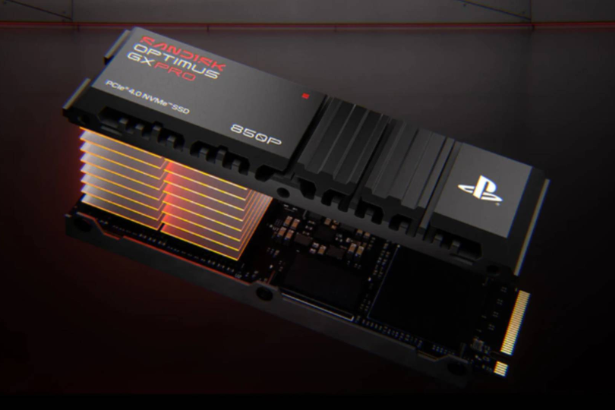
SanDisk PS5 SSD price points revealed this week have shocked PlayStation owners looking to expand their console’s storage. SanDisk’s newly rebranded Optimus GX Pro 850P line of officially licensed PS5 and PS5 Pro storage expansion drives launched with prices ranging from $380 for the base 1TB model up to a staggering $2,960 for the top-tier 8TB drive, more than three times the price of an entire PS5 Pro console. The launch lands squarely amid the global memory chip shortage that has already forced Sony, Microsoft, Nintendo, and Valve to raise console and hardware prices throughout 2025 and 2026.
The Optimus GX Pro 850P Lineup: Full Pricing Breakdown
SanDisk PS5 SSD Price new drives have been rebranded from the previous WD_Black naming convention. Designed with the PS5 and PS5 Pro in mind, the Optimus GX Pro 850P NVMe SSD is available in 1TB, 2TB, 4TB, and 8TB variants.
The full pricing structure spans a dramatic range: the base 1TB version costs $380, while the 2TB drive costs buyers $760, which is $100 more expensive than the standard PS5 with a disc drive. The 4TB version costs as much as $1,500, and the top-end 8TB model is priced at $2,960.
These current prices reflect what SanDisk describes as a sale discount. Without that discount, the original 1TB version would cost $474.99, just $200 cheaper than the PS5 itself, while the full price of the 8TB SSD reaches $3,699.99, an almost unbelievable figure for a single storage component.
The 8TB Model: Nearly 3x the Price of a PS5 Pro
The headline figure generating the most attention is the top-tier drive’s price relative to an entire console purchase, a comparison that crystallizes just how dramatically component costs have diverged from system pricing.
The top-end model is priced at a truly eye-watering $2,960. To put that into perspective, that’s more than 3x the price of a PS5 Pro in the US right now, which already includes a 2TB SSD straight out of the box. The 8TB SSD alone costs more than four and a half times the price of a standard PS5.
Even the smaller capacity options carry similarly jarring comparisons. Even the $760 2TB model is more than $100 more expensive than the standard PS5 with a disc drive, meaning a single storage upgrade now costs more than an entire gaming console with its own storage already included.
The “Discount” That Isn’t: Full Price vs Sale Price
The framing of SanDisk’s pricing as a discounted sale rather than standard retail pricing adds an additional layer of context to an already striking price point.
As Digital Foundry has noted, a sale price on SanDisk’s new $3,700 SSD that would bring it back down to the $600 ballpark figure its predecessor commanded in the last 12 months would represent a hilarious 84 percent discount. The framing underscores just how far the baseline price has moved before any discount is even applied.
The discounted pricing structure raises an obvious question about what “regular” pricing is even meant to signal in a market where the full retail price of $3,699.99 for the 8TB drive bears little resemblance to what equivalent storage cost just a year earlier.
What Changed From WD_Black to Optimus GX Pro
Beyond the dramatic pricing, the rebranding itself reflects a broader corporate transition that has occurred alongside the price increases, though the underlying hardware appears largely unchanged.
The Optimus GX Pro 850P is a PCIe 4.0 drive with read and write speeds of 7,300 and 6,300 MB/s and a heatsink design. These specs sound suspiciously similar, if not completely identical, to the WD_Black SN850X NVMe SSD that the 850P is seemingly replacing.
The 8TB model of the predecessor drive, the WD_Black SN850X, was on sale for under $600 just last year, a price point that makes the current $2,960 figure for what appears to be substantially the same hardware all the more striking. The transition from WD_Black branding to Optimus GX Pro appears to be primarily a naming and corporate identity change rather than a meaningful technical upgrade justifying the price increase.
A 370% Price Increase in One Year
The scale of the year-over-year price escalation for comparable storage capacity provides the clearest single data point illustrating the severity of the current memory market disruption.
A nearly identical 8TB drive from SanDisk cost around $640 a year ago, representing a price increase of 370% over that period. Such changes are directly related to the global memory shortage driven by the expansion of infrastructure for artificial intelligence.
The Optimus GX Pro 850P NVMe SSD is launching amid a global memory crisis, and the pricing should give PlayStation owners an idea of just how out of control what some in the industry have dubbed the “RAMpocalypse” has become throughout 2026.
The Broader RAMpocalypse: Why Gaming Hardware Keeps Getting More Expensive
SanDisk’s new SSD pricing fits into a much wider pattern affecting the entire consumer electronics and gaming hardware industry throughout the past year, driven by the same root cause across virtually every affected category.
Price rises are unfortunately all the rage in gaming hardware right now, with the volatile economic landscape and AI-driven scarcity of components shouldering the blame every time a new price increase is announced. The same memory and storage chip shortage that has pushed Apple toward “unavoidable” price increases on its own products, as CEO Tim Cook recently confirmed, is the underlying driver of SanDisk’s new SSD pricing as well.
Demand for high-bandwidth memory used in AI servers has pulled supply away from consumer electronics, a dynamic that affects RAM and storage chips across virtually every product category, from smartphones to laptops to gaming consoles and their accessories.
Sony, Microsoft, Nintendo, and Valve Have All Raised Prices
SanDisk’s dramatic SSD pricing did not emerge in isolation. Nearly every major gaming hardware manufacturer has implemented significant price increases throughout the current memory crisis.
A few months ago, Sony hiked up the price of the PS5, PS5 Pro, and the PS Portal, after Microsoft did the same with Xbox consoles twice in 2025. Nintendo resisted for longer than most, but last month it raised the price of the Switch 2 by $50 in the US, with the new $500 price set to take effect in September.
The most dramatic hike among console makers came from Valve, with Steam Deck lineup prices jacked up by as much as $300 for the 1TB OLED model in May. Sony justified its own PS5 price increase earlier this year by citing “prolonged pressure on the global economy,” a rationale that echoes across virtually every hardware manufacturer’s public statements during this period.
What This Means for PS5 Storage Shoppers
For PlayStation owners looking to expand their console’s storage capacity, the current pricing environment presents difficult choices that did not exist even a year ago.
Getting close to maxing out a PS5’s SSD now leaves owners with a few realistic choices: either start deleting some of those large RPGs and other space-consuming games, or get used to paying the kind of money SanDisk is now charging for its new officially licensed storage expansion drives. For many users, the calculation that once favored a straightforward storage upgrade now requires weighing whether the convenience is worth a price tag approaching or exceeding the cost of additional hardware entirely.
Shoppers specifically considering a storage upgrade should also factor in that the current “sale” pricing, while still expensive, represents the more favorable end of what SanDisk is currently offering, with full retail prices running considerably higher across the entire product line.
Latest Updates
SanDisk’s Optimus GX Pro 850P lineup was confirmed on June 17, 2026. Engadget confirmed the complete pricing structure across all four capacities, the comparison to the WD_Black SN850X predecessor drive, and the broader context of price increases from Sony, Microsoft, Nintendo, and Valve throughout 2025 and 2026. Mezha confirmed the full retail pricing before discount, including the $3,699.99 full price for the 8TB model, the 370% year-over-year price increase for comparable 8TB storage, and the connection to the broader global memory shortage driven by AI infrastructure expansion. Polygon’s coverage placed the pricing in the context of broader PlayStation storage options and consumer reaction.
Full sources: Polygon | Engadget | Mezha
Broader Implications
SanDisk’s new PS5 SSD pricing is one of the clearest single examples yet of how thoroughly the AI-driven memory chip shortage has permeated consumer electronics pricing across every product category, not just flagship devices like smartphones and computers but accessories and peripherals as well. A storage upgrade that cost $640 a year ago now costs $2,960, a 370% increase that has nothing to do with the underlying drive’s performance and everything to do with global semiconductor supply dynamics that PlayStation owners have no ability to influence.
The pattern connecting SanDisk’s pricing to Sony’s, Microsoft’s, Nintendo’s, and Valve’s own console price increases, and further to Apple’s recent admission that its own price increases are “unavoidable,” illustrates how comprehensively the current memory crisis is reshaping consumer technology pricing across the entire industry simultaneously. No major hardware category appears insulated from the underlying cost pressure.
For consumers, the practical reality is that storage expansion, once a relatively modest convenience purchase, has become a genuinely significant financial decision, with high-capacity options now costing more than entire gaming consoles. Until memory chip supply rebalances, likely tied to how quickly AI infrastructure demand stabilizes relative to manufacturing capacity, this pricing environment shows no clear signs of reversing.
For more gaming hardware and consumer technology coverage, visit The Tech Marketer.
Frequently Asked Questions
1. How much does SanDisk’s new 8TB PS5 SSD cost?
SanDisk’s new Optimus GX Pro 850P 8TB drive costs $2,960 at the current sale price, with the full retail price listed at $3,699.99. This is more than three times the price of an entire PS5 Pro console, which includes its own 2TB SSD.
2. What is the price range for SanDisk’s new Optimus GX Pro 850P SSD line?
The lineup spans four capacities: 1TB for $380, 2TB for $760, 4TB for $1,500, and 8TB for $2,960, all at current sale pricing. Full retail prices before discount are higher across the board, with the 1TB model at $474.99 and the 8TB model at $3,699.99.
3. Why are SanDisk’s new PS5 SSDs so much more expensive than before?
The price increase is tied to the global memory chip shortage driven by AI infrastructure expansion. A nearly identical 8TB SanDisk drive cost approximately $640 a year ago, representing a 370% price increase over twelve months as memory chip manufacturers redirect production capacity toward AI server components.
4. What is the difference between the Optimus GX Pro 850P and the WD_Black SN850X?
The Optimus GX Pro 850P appears to be a rebranded version of the previous WD_Black SN850X NVMe SSD, with nearly identical specifications including PCIe 4.0 connectivity, 7,300/6,300 MB/s read/write speeds, and a heatsink design. The primary change appears to be branding rather than meaningful hardware improvements.
5. Have other gaming console makers raised prices due to the memory shortage?
Yes. Sony raised prices on the PS5, PS5 Pro, and PS Portal earlier in 2026. Microsoft raised Xbox console prices twice in 2025. Nintendo raised the Switch 2 price by $50, effective September 2026. Valve raised Steam Deck prices by as much as $300 for the 1TB OLED model in May 2026.
Sources and References
- Polygon: PlayStation 5 SSD Add-Ons Get Shocking New Prices
- Engadget: SanDisk’s New 8TB PS5 SSD Costs More Than Three Times As Much As The PS5 Pro
- Mezha: SanDisk Launches New SSDs for PlayStation 5 Priced at Up to US$3,000