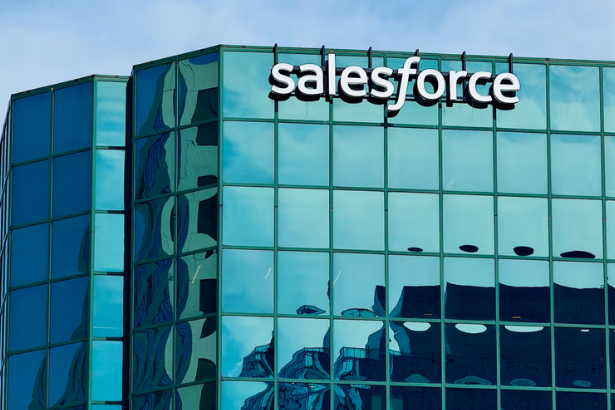
Salesforce stock has fallen sharply this year, but Wall Street is looking for evidence that Agentforce and other AI products can reignite growth before the company’s latest earnings report.
Salesforce stock is heading into one of its most closely watched earnings reports of the year with investors caught between two very different stories.
On one side, Salesforce remains an enormous software business generating billions in revenue and substantial free cash flow. On the other, the stock has been punished by fears that artificial intelligence could weaken demand for traditional enterprise software.
The market now wants proof that Salesforce’s own AI strategy can become a growth engine rather than simply defend its existing business.
Salesforce is scheduled to report second-quarter fiscal 2027 results after the market closes Wednesday, with analysts expecting revenue of about $11.33 billion and adjusted earnings per share of $3.28, according to estimates cited by Investopedia.
Background and Context
Salesforce has spent the past two years trying to reposition itself around AI.
Its Agentforce platform is at the center of that strategy. The company is selling AI-powered agents designed to automate tasks across sales, customer service and marketing, effectively turning its existing CRM infrastructure into a platform for autonomous software workers.
The opportunity is enormous.
But Wall Street has become less interested in AI announcements and more interested in whether those products translate into measurable revenue growth.
That distinction explains much of the pressure on CRM stock.
Investopedia reported that Salesforce shares had lost more than one-fifth of their value since the beginning of 2026, as software stocks broadly came under pressure from concerns that AI could allow customers to build more of their own tools and reduce spending on traditional software.
At the same time, Salesforce remains highly profitable.
Trefis estimates the company generates free cash flow equivalent to roughly 8.8% of its market value, while its operating margin over the previous 12 months stood at about 22%.
That creates the central debate around Salesforce stock:
Is the market correctly pricing in a structural slowdown, or has it become too pessimistic about a cash-generating software giant entering a new AI cycle?
Latest Update: Salesforce Stock Heads Into Earnings
The immediate catalyst is Salesforce’s upcoming fiscal second-quarter earnings report.
Options pricing cited by Investopedia suggests traders expect CRM shares could move as much as 7% in either direction by the end of the week following the report. Based on the then-current share price, that would put the potential range roughly between $191 and $220.
That is an unusually wide expected move for a company of Salesforce’s size.
It reflects the uncertainty surrounding the earnings report.
Investors are not simply looking for another quarter of profitability. They want evidence that Salesforce can accelerate growth while AI changes the economics of enterprise software.
Analysts cited by Investopedia expect:
- Revenue: approximately $11.33 billion
- Year-over-year revenue growth: approximately 11%
- Adjusted EPS: approximately $3.28
- Prior-year comparable EPS: $2.91
The revenue number may therefore matter less than what Salesforce says about the trajectory beyond the quarter.
Wall Street Still Sees Upside
Despite the stock’s decline, analyst sentiment has not collapsed.
Investopedia reports that 12 of 18 analysts tracked by Visible Alpha rate Salesforce a buy, five are neutral and only one has a sell rating. The average price target of $252 implied more than 20% upside from the share price at the time of the report.
JPMorgan has also resumed coverage with an overweight rating and a $250 price target, arguing that concerns about AI disruption may be overstated and that Salesforce’s core business could accelerate during the second half of the fiscal year.
That bullish case depends heavily on execution.
The AI Question Hanging Over Salesforce Stock
AI is simultaneously Salesforce’s biggest opportunity and its biggest perceived threat.
The bearish argument is straightforward.
If generative AI makes it dramatically easier for companies to build internal applications, some businesses may need fewer traditional software subscriptions.
That could weaken the economic moat around enterprise SaaS.
But Salesforce is making the opposite bet.
Instead of fighting AI, the company is attempting to become the infrastructure through which businesses deploy it.
Agentforce is the centerpiece.
Trefis says Agentforce has already surpassed $1 billion in annual recurring revenue, while Salesforce reported processing 28.6 trillion tokens in its latest quarter, up 152% from the previous quarter.
Those numbers suggest adoption is moving quickly.
The harder question is whether that adoption can become broad-based financial growth.
Agentforce Has to Prove Itself Beyond the Hype
The AI market has entered a different phase.
In 2024 and 2025, simply having a credible generative AI strategy was enough to excite investors.
That is no longer sufficient.
Companies now need to demonstrate:
- Paying customers
- Recurring revenue
- Higher software usage
- Improved margins
- Stronger retention
- Expanding contract values
Agentforce therefore faces a higher standard.
Salesforce needs to demonstrate that customers are not merely experimenting with AI agents.
They need to show that businesses are deploying them at scale and paying Salesforce more as a result.
That is where the upcoming earnings report becomes important.
Salesforce Has Another Problem: Growth Has to Reaccelerate
Trefis identifies second-half revenue acceleration as the key test for the Salesforce investment thesis.
Management has indicated that AI and data products could help drive organic revenue acceleration during the second half of fiscal 2027.
But there are warning signs.
Trefis notes that contract bookings have not meaningfully exceeded guidance during the previous two quarters, while parts of the older Salesforce portfolio, including Tableau and Commerce Cloud, remain areas of concern.
This creates a two-speed Salesforce.
The newer AI businesses are growing rapidly.
The legacy software engine is not accelerating at the same pace.
For Salesforce stock to regain momentum, investors will likely want to see the two sides begin reinforcing each other.
Salesforce’s Cash Flow Gives Bulls a Safety Net
The bullish case does not depend entirely on rapid growth.
Salesforce has become a powerful cash-generation machine.
Trefis puts Salesforce’s trailing 12-month revenue at about $42.83 billion and its operating margin at approximately 22%.
That financial strength gives Salesforce options.
It can invest aggressively in AI.
It can repurchase shares.
It can improve margins.
It can acquire technology.
Or it can simply wait for enterprise AI adoption to mature.
That flexibility is one reason some investors view the current CRM valuation as an opportunity rather than a warning.
But the Market Is Asking a Tougher Question
The problem is that strong cash flow alone may not be enough to rerate Salesforce stock.
Investors are paying attention to the company’s growth rate.
If Salesforce remains a $40-plus billion software company growing around 10% while AI threatens to commoditize parts of the SaaS market, the market could continue assigning it a lower valuation multiple.
That is essentially the bear case.
The company can remain profitable and still become a less valuable growth stock.
The bull case requires something different.
Salesforce needs to show that AI can lift growth without destroying margins.
Expert Insights and Analysis
The Earnings Report Is Really an AI Adoption Report
The headline revenue and EPS figures will receive the most attention immediately after the earnings release.
But for longer-term investors, the more important information may be hidden elsewhere.
Watch for management commentary around:
Agentforce revenue. Is the $1 billion-plus recurring revenue figure accelerating?
Data Cloud. Is Salesforce successfully combining customer data with AI products?
Bookings. Are customers committing to larger contracts?
Guidance. Does management raise its expectations for the second half?
Margins. Can Salesforce continue expanding profitability while investing in AI?
Those indicators will tell investors more about the company’s trajectory than a single quarterly EPS beat.
The $250 Price Target Shows What Bulls Are Betting On
JPMorgan’s $250 target is effectively a bet that the market is underestimating Salesforce’s ability to defend its core business while monetizing AI.
Investopedia reports that JPMorgan believes AI disruption could be limited to a relatively small portion of Salesforce’s business.
That is an important distinction.
The question is not whether AI changes Salesforce.
It already has.
The question is whether Salesforce can change faster than its customers and competitors.
Broader Implications
Enterprise Software Is Entering Its AI Pricing Era
Salesforce’s situation reflects a much larger shift across enterprise technology.
For decades, SaaS companies sold software seats.
AI introduces a different model.
Companies can increasingly sell outcomes, automated tasks and digital labor instead of simply selling access to applications.
That creates both opportunity and risk.
If one AI agent can perform the work previously handled by several software users, the traditional per-seat pricing model could come under pressure.
Salesforce is responding by building a platform around agents rather than treating AI as another feature.
The CRM Market Could Look Very Different in Five Years
Salesforce’s rivals are pursuing similar strategies.
Microsoft has Copilot.
Oracle is integrating AI into its enterprise applications.
ServiceNow is building AI agents into workflows.
Adobe is adding generative AI throughout its creative and marketing ecosystem.
The eventual winners may not simply be the companies with the best AI models.
They may be the companies with the best customer data, distribution networks and enterprise relationships.
That is where Salesforce still has a major advantage.
Cash Flow May Become More Important to Software Investors
The market’s treatment of Salesforce also illustrates a broader shift.
Investors once rewarded enterprise software companies primarily for growth.
Now they increasingly demand growth and profitability.
Salesforce’s ability to generate significant free cash flow gives it a cushion that many younger AI companies do not have.
For more coverage of enterprise AI, technology markets and the companies building the next generation of software, visit The Tech Marketer.
Related History and Comparable Technologies
Salesforce’s current challenge resembles previous technology transitions.
When cloud computing disrupted on-premises software, established vendors had to decide whether to defend their legacy products or migrate customers toward subscription-based services.
Salesforce was one of the biggest beneficiaries of that transition.
AI presents a more complicated version of the same problem.
The cloud transition primarily changed where software ran and how customers paid for it.
AI can change how much human work the software performs.
That is potentially far more disruptive.
Salesforce’s bet is that it can own both layers.
The company wants to remain the system of record while also becoming the system of action through AI agents.
What Happens Next
The first major event is the fiscal second-quarter earnings release.
Investors should watch five numbers and signals closely:
- Revenue growth
- Agentforce and Data Cloud momentum
- Remaining performance obligations and bookings
- Operating margin
- Full-year and second-half guidance
A strong report with raised guidance could reinforce the bullish case and potentially trigger a sharp move higher.
A revenue beat without stronger forward guidance could produce a more muted reaction.
A weak outlook would likely reinforce concerns that AI is disrupting Salesforce faster than its new products can replace the lost momentum.
The options market’s estimated move of up to 7% in either direction shows just how much uncertainty is already priced into the event.
Why “CRM Stock” Is Trending on Google
The supplied Google Trends screenshot shows a dramatic spike in searches for “crm stock”, followed by elevated search interest.
The timing aligns closely with attention surrounding Salesforce’s upcoming earnings report.
The news cards shown in the screenshot include Investopedia’s analysis of the potential post-earnings move, Yahoo Finance’s earnings preview and Trefis’ analysis of Salesforce as a cash-generating company trading at a discounted valuation.
That makes the trend especially relevant to investors trying to determine whether Salesforce stock has become a value opportunity or a value trap.
The trend itself should not be interpreted as a prediction of where CRM shares will trade.
It simply shows that search interest is rising around the company’s earnings, valuation and outlook.
Conclusion
Salesforce stock is approaching a crucial test.
The company remains enormously profitable, generates substantial cash and has built one of the world’s largest enterprise software platforms.
But investors are no longer willing to give Salesforce credit simply for being a dominant SaaS company.
They want evidence that AI will accelerate the business rather than undermine it.
Agentforce is the centerpiece of that argument.
With annual recurring revenue from Agentforce reportedly above $1 billion and AI usage expanding rapidly, Salesforce has demonstrated that customers are engaging with the technology.
Now comes the harder part.
Salesforce needs to turn that engagement into broader revenue acceleration.
If it succeeds, the recent decline in CRM stock could eventually look like an overreaction.
If growth remains sluggish, the market’s skepticism may prove justified.
Either way, the upcoming earnings report is about more than one quarter.
It is a referendum on whether Salesforce can remain one of enterprise software’s defining companies in the age of AI.
FAQ
Why is Salesforce stock trending?
Salesforce stock is trending as investors prepare for the company’s fiscal second-quarter earnings report and assess whether AI products such as Agentforce can accelerate growth. Options pricing cited by Investopedia indicates traders expect a potentially large move after the results.
What is the Salesforce stock forecast?
The available analyst estimates are generally bullish, although forecasts vary. Investopedia reported an average analyst price target of $252 and noted JPMorgan’s $250 target, both implying meaningful upside from the share price cited in the report.
What should investors watch in Salesforce earnings?
Investors should watch revenue growth, guidance, bookings, operating margins, Agentforce adoption and management’s expectations for second-half growth.
Is Salesforce’s AI strategy working?
There are signs of meaningful adoption. Trefis reports that Agentforce has surpassed $1 billion in annual recurring revenue, while Salesforce reported a sharp increase in token processing. However, investors still want evidence that AI adoption is translating into broad-based company growth.
Why has Salesforce stock fallen?
Salesforce stock has been pressured by broader weakness in software shares and concerns that AI could allow customers to build more software internally or reduce spending on traditional enterprise applications. Investopedia reported that Salesforce had lost more than one-fifth of its value since the start of 2026 at the time of its August 21 report.
Is Salesforce stock undervalued?
Some analysts and investment researchers believe it may be. Trefis argues that Salesforce is trading at a lower valuation multiple than its historical averages while generating substantial free cash flow. That is an investment thesis, not a guarantee of future performance.
Could Salesforce stock move sharply after earnings?
Yes. Options pricing cited by Investopedia indicated an expected move of up to approximately 7% in either direction by the end of the week following earnings.