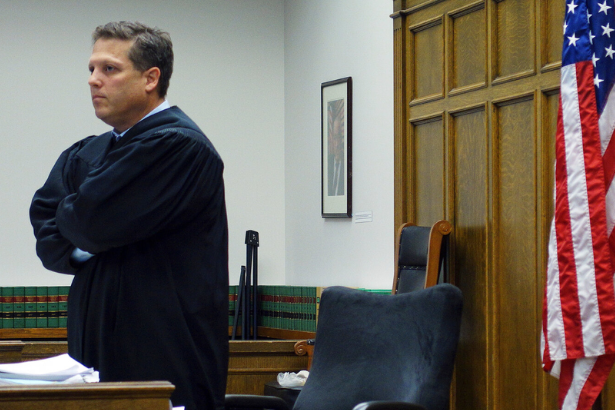
Roger Rogoff Seattle US attorney fired 2026 in what may become the defining separation of powers case of the Trump administration’s second term. At 7:40 a.m. on Wednesday July 15, the seven active judges of the United States District Court for the Western District of Washington unanimously swore in Roger Rogoff, a veteran federal prosecutor, former King County Superior Court judge, and former director of Washington’s Office of Independent Investigations, as U.S. attorney for the district under 28 U.S.C. § 546(d), the federal statute that allows district judges to fill a U.S. attorney vacancy when the president has not sent a Senate-confirmed nominee. Fifty-four minutes later, at 8:34 a.m., Rogoff received an email titled “A Message From the President” informing him he was fired. He has retained the national law firm HKM and is preparing to sue the Trump administration and the Department of Justice, challenging the president’s authority to remove a prosecutor installed by lawful judicial appointment.
The 54-Minute Tenure: A Minute-by-Minute Account
The speed of what happened on Wednesday morning in Seattle is the most striking single fact in this story.
At 7:40 a.m. Wednesday, federal judges in the Western District of Washington swore in Roger Rogoff as their pick for U.S. attorney. Fifty-four minutes later, President Donald Trump fired him. The termination arrived while Rogoff was waiting in a lobby at the federal courthouse. The White House informed Rogoff in writing: “The President of the United States has directed that I inform you that, pursuant to his authority under 28 U.S.C. 541(c) and Article II of the Constitution, you are hereby removed from the office of the United States Attorney for the Western District of Washington,” according to Justice Department spokeswoman Emily Covington.
When KOMO News asked Rogoff about having served as U.S. attorney for less than an hour, he replied: “Greatest hour in my life.” The quip masked what followed: a statement from his firm, HKM, that was considerably less lighthearted. “The rule of law requires that prosecutorial decisions remain free from political interference, and that lawful judicial appointments be respected,” Rogoff said. “I remain grateful for the confidence placed in me and proud of the career professionals who continue to serve the people of Western Washington.”
The Legal Framework: What 28 U.S.C. § 546 Actually Says
The statutory basis for the judges’ appointment, and the administration’s counter-argument, both deserve precise presentation.
Under federal law, U.S. attorneys are nominated by the president and confirmed by the Senate under 28 U.S.C. § 541(a). The attorney general can appoint an interim U.S. attorney for up to 120 days under U.S. Code § 546. When that 120-day term expires and the president has still not advanced a nominee to the Senate, § 546(d) allows the district’s judges to appoint a U.S. attorney to fill the vacancy until the position is properly filled through the presidential nomination and Senate confirmation process.
The Western District of Washington had been without a Senate-confirmed U.S. attorney for three years, with acting or interim officials serving instead. The administration’s earlier pick, Neil Floyd, a former immigration judge, had been serving under the 120-day interim authority, but that term expired on February 3. The administration made no move to formally nominate Floyd or advance his name to the Senate. That inaction is what triggered § 546(d), giving the district’s judges the statutory authority to act.
Chief U.S. District Judge David Estudillo informed Acting Attorney General Todd Blanche on July 8 in a letter that described the appointment as a routine gap-filling measure. He acknowledged the president’s nomination authority directly, writing: “The Court acknowledges the President’s authority to appoint, with the advice and consent of the Senate, a United States Attorney for this District under 28 U.S.C. § 541(a), and takes this action pursuant to Section 546(d) to ensure the vacancy is filled until a United States Attorney nominee is confirmed.”
The Administration’s Position: Article II and the Removal Power
The Trump administration has argued consistently since at least February 2026 that the president’s constitutional removal power under Article II supersedes the judicial appointment authority under § 546(d).
Acting Attorney General Todd Blanche publicly defended the firing in a social media post that did not dispute the judges’ statutory authority to appoint but asserted that the president’s removal power overrides it. “District court judges can appoint a temporary U.S. attorney, and POTUS can fire them. WDWA judges abandoned the time-honored process of consultation with the administration so that the selected U.S. attorney is qualified to serve in the administration. Roger Rogoff has been fired by the President,” Blanche wrote.
Blanche had pre-announced the administration’s intention months earlier. In March 2026, Blanche posted a social media warning to the Western Washington judges that he expected whomever they named would “suffer the same fate as” the handful of other recent judicial selections contrary to the president’s chief prosecutor choice. His social media statement in February 2026, “Judges don’t pick U.S. Attorneys, @POTUS does,” citing Article II, established the administration’s public legal position. That same statement was issued while Blanche appeared before the Senate Judiciary Committee on Wednesday for his confirmation hearing to formally assume the attorney general post permanently.
The administration’s constitutional argument is that the Article II vesting clause and the Take Care Clause give the president plenary removal authority over executive branch officers including U.S. attorneys, regardless of how they were installed.
Rogoff’s Position: The Appointment Was Lawful, the Firing Is Not
Rogoff’s legal team has a specific and stated position on why the firing is constitutionally and statutorily infirm.
“The president gets to choose his U.S. attorney, but only with the advice and consent of the Senate,” Rogoff said. “We have a situation that is untenable, not constitutional, and not legal.”
Rogoff also framed the issue in terms that distinguished his personal situation from the legal principle at stake. He said the firing was not about him but about the rule of law, adding that if Trump appointed someone who was confirmed by the U.S. Senate, he would “be cheering the rule of law.” He also told reporters that he was “pretty certain” he would be immediately fired, since the court had informed the Trump administration two weeks prior of his appointment. “When the judges appoint somebody constitutionally and statutorily, and they’re summarily dismissed without a conversation, without an examination, without any understanding of what they intend to do when they get into office, then yes, I think that firing is not appropriate and is most likely unlawful,” Rogoff said.
The core of his legal theory, as articulated to media and through HKM, is that when the president has failed to nominate a U.S. attorney and allowed the vacancy to persist beyond the 120-day interim window, the judicial appointment under § 546(d) creates a lawfully installed officer whom the president cannot simply dismiss without cause through a routine removal action.
Who Is Roger Rogoff
Understanding the person at the center of this dispute illuminates why the district’s judges selected him and why his legal challenge may be credible.
Rogoff is a graduate of the University of Washington School of Law who began his career in the King County Prosecuting Attorney’s Office handling sexual assault and domestic violence cases, eventually supervising those units. He then served as an assistant U.S. attorney in the Western District of Washington, working on violent crime, gang, and firearms matters. He was also employed as a lawyer at Microsoft before being appointed a King County Superior Court judge by Governor Jay Inslee in 2013. In 2022, Inslee appointed him as the first director of Washington’s Office of Independent Investigations, created to provide independent reviews of police deadly force incidents. He resigned that post earlier this year to join HKM, the law firm from which he will now likely be litigating against the administration. His combined experience amounts to 20 years in state prosecution and six years in federal prosecution.
Chief Judge Estudillo described him as reputed “amongst members of the Washington bar for diligence and fairness.”
The Pattern: Kinsella, Gorman, Habba, and the National Picture
The Seattle firing is not an isolated event. It is the most recent data point in a clear pattern.
The Trump administration has fired other court-appointed U.S. attorneys. Tessa Gorman in Western Washington was replaced by Floyd. Donald Kinsella was appointed by a panel of federal judges in February 2026 to fill a vacancy in the Northern District of New York, was sworn in the same day, and was fired by the White House within hours. Neither Gorman nor Kinsella litigated their dismissals. Rogoff has explicitly stated his team is considering all legal options and is “pretty certain” he will litigate.
The administration’s record was also complicated by the Alina Habba situation in New Jersey. In December 2025, an appeals court found that Alina Habba, Trump’s former personal attorney whom he had attempted to install as U.S. attorney for New Jersey, was serving unlawfully after judges declined to appoint her and instead selected their own candidate. That ruling, which found a Trump pick was serving unlawfully, set a precedent that cuts in the opposite direction from the administration’s position in Seattle.
The Significance: A Potentially Landmark Constitutional Case
Influential lawyers practicing in Western Washington, whose seven active district judges were all appointed by President Biden, had previously been strategizing about the need for the court to select someone willing to sue Trump if and when they were fired. That aggressive strategy, which they considered necessary, distinguishes the Seattle situation from earlier judicial appointment firings.
Bloomberg Law described the situation as “potentially the first legal battle over the executive branch’s termination authority for such prosecutors.” The question the courts would have to answer has never been definitively resolved: when a president allows a U.S. attorney vacancy to persist long enough that the district’s judges exercise their statutory authority under § 546(d) to fill it, can the president then remove that judicially appointed official as freely as a nominee who went through the Senate confirmation process?
Latest Update: Neil Floyd Remains, Rogoff Preparing Lawsuit
The Roger Rogoff Seattle US attorney fired 2026 situation leaves the Western District of Washington in the same functional state it was in before Wednesday’s events. Neil Floyd continues as first assistant U.S. attorney, a role that does not require Senate confirmation, according to Emily Langlie, spokesperson for the U.S. Attorney’s Office.
Rogoff is preparing to sue the Trump administration and the Department of Justice. “We’re considering all of our legal options,” Rogoff told Bloomberg Law. He told the Associated Press he is “pretty certain” he will pursue legal action.
For full coverage, follow KING5, Seattle Times, and NBC News.
Broader Implications: Who Controls the U.S. Attorney’s Office
The Roger Rogoff Seattle US attorney fired 2026 case presents a constitutional question that the courts have not definitively answered and that carries significant consequences for the independence of federal prosecution.
U.S. attorneys are the chief federal law enforcement officials in their districts. They decide which cases to prosecute, which investigations to prioritize, and how the federal government’s enforcement resources are deployed against crime in their communities. The question of whether the president can leave a U.S. attorney vacancy indefinitely, allow it to pass the statutory 120-day interim window, trigger the judicial appointment mechanism that Congress built into law, and then immediately remove that judicial appointment, is not merely a legal puzzle. It is a question about whether the judicial appointment safety valve Congress created in § 546(d) has any operational meaning.
If courts ultimately rule that the president can fire judicially appointed U.S. attorneys at will, the § 546(d) provision becomes a functional nullity, because any district whose judges appoint a prosecutor over the administration’s objection will simply have that prosecutor terminated within the hour. If courts rule otherwise, the president’s removal power in the U.S. attorney context would be meaningfully constrained by the congressional statute. That is the case Roger Rogoff is preparing to make.
For more political and legal news coverage, visit The Tech Marketer.
What Happens Next
Rogoff’s law firm HKM is preparing a legal challenge that, if filed, would likely be heard in the Western District of Washington. Any ruling from that court would be appealed, and the case could ultimately reach the Supreme Court if the constitutional question is not resolved at a lower level. Neil Floyd continues as first assistant U.S. attorney in the interim. The administration has not indicated any intention to formally nominate a candidate for Senate confirmation, which would render the entire dispute moot. Acting Attorney General Todd Blanche’s Senate confirmation hearing continued Wednesday.
FAQ
What happened with Roger Rogoff and the Seattle US attorney position?
Federal judges in the Western District of Washington swore in Roger Rogoff as U.S. attorney for the district at 7:40 a.m. on July 15, 2026, under the judicial appointment authority of 28 U.S.C. § 546(d). Fifty-four minutes later, President Trump fired him via an email titled “A Message From the President.” Rogoff has retained law firm HKM and is preparing to sue the Trump administration and the Department of Justice, challenging the legality of his removal.
Why did federal judges appoint Roger Rogoff as US attorney in Seattle?
The Western District of Washington had been without a Senate-confirmed U.S. attorney for three years. The Trump administration’s earlier pick, Neil Floyd, was serving under the 120-day interim authority of 28 U.S.C. § 546, but that term expired February 3 and the administration made no move to formally nominate Floyd or any other candidate for Senate confirmation. Federal law under § 546(d) allows district judges to appoint a U.S. attorney to fill a vacancy when the president has not advanced a nominee, triggering the unanimous appointment of Rogoff.
Does the president have the authority to fire a court-appointed US attorney?
This is the unresolved constitutional question at the center of the dispute. The Trump administration argues that Article II of the Constitution and the president’s plenary removal power allow the termination of any executive branch officer including a judicially appointed U.S. attorney. Rogoff and his legal team argue that when judges exercise their statutory appointment authority under § 546(d), the resulting appointment cannot be unilaterally revoked without violating both the statute and the Constitution. The question has not been definitively resolved by the Supreme Court.
Who is Roger Rogoff and what is his background?
Roger Rogoff is a veteran federal and state prosecutor with 20 years in state prosecution and six years in federal prosecution. He began his career in the King County Prosecuting Attorney’s Office handling sexual assault and domestic violence cases, then served as an assistant U.S. attorney in the Western District of Washington working on violent crime, gang, and firearms cases. He was appointed a King County Superior Court judge by Governor Jay Inslee in 2013 and later served as the first director of Washington’s Office of Independent Investigations, created to review police use of deadly force.
What is the precedent for Trump firing court-appointed US attorneys?
The Trump administration has a pattern of firing court-appointed U.S. attorneys. Donald Kinsella was appointed by federal judges in the Northern District of New York in February 2026 and fired the same day. Tessa Gorman was removed from the Western District of Washington. In December 2025, an appeals court ruled that Alina Habba, whom Trump had tried to install as U.S. attorney for New Jersey without Senate confirmation, was serving unlawfully after judges declined to appoint her. Unlike Kinsella and Gorman, Rogoff has stated he intends to litigate his removal.
Sources and References
- KING5 (original submission, blocked — confirmed via multiple sources): https://www.king5.com/article/news/local/judge-appointed-roger-rogoff-us-attorney-fired/281-7c4505a8-8de0-4558-b625-2ebbe582c4f8
- Seattle Times (original submission, redirect only — confirmed via Spokesman-Review and supplemental search): https://www.seattletimes.com/seattle-news/politics/judges-appoint-new-u-s-attorney-in-seattle-setting-up-trump-showdown/
- NBC News (original submission, blocked): https://www.nbcnews.com/politics/trump-administration/trump-immediately-fires-new-court-appointed-top-prosecutor-seattle-rcna587773