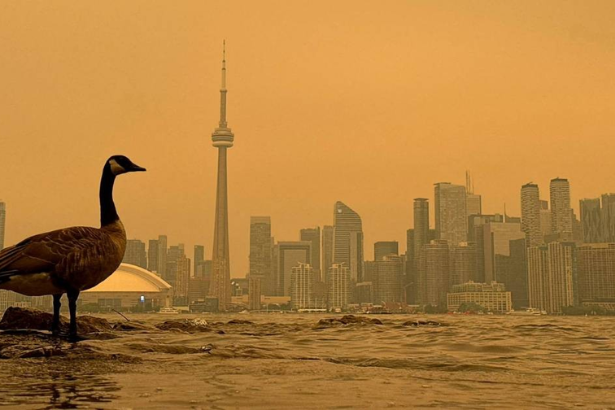
Canadian wildfire smoke air quality 2026 has produced one of the most severe air quality events North America has seen since the June 2023 smoke event, as more than 835 active wildfires burning primarily in west-central Ontario, Manitoba, and Saskatchewan send heavy smoke across both Canada and the United States simultaneously. Toronto ranked as the city with the worst air quality in the world on Wednesday morning July 15, according to IQAir, the Swiss air quality monitoring service, with a U.S. Air Quality Index reading of 184, classified as unhealthy for all populations, and Canada’s Environment Canada Air Quality Health Index at 10-plus, its highest category, described as “very high risk.” In the United States, the smoke has spread across the upper Midwest with extreme conditions over northern Wisconsin, heavy smoke over Duluth, Minnesota, and Marquette, Michigan, and Air Quality Alerts covering all of Wisconsin and Michigan as well as stretching toward New York City, Boston, and New England. Conditions are expected to persist through Thursday before rain arrives to clear the region Friday in the Midwest and Saturday in the Northeast.
Toronto: World’s Worst Air Quality, Heat Wave Doubles the Danger
The situation in Toronto on Wednesday morning was among the most significant environmental health events the city has experienced in recent memory, arriving in the worst possible context.
An orange haze washed over Toronto’s skyline on Wednesday as wildfire smoke drifted into the region. IQAir ranked Toronto as having the worst air quality across the globe, surpassing Kinshasa and Delhi, with a U.S. AQI reading of 184. Environment Canada reported an Air Quality Health Index reading of 10-plus, classified as “very high risk,” while forecasts suggested hazardous conditions could persist through Thursday night. CP24 + 2
Greg Evans, a professor at the University of Toronto in Chemical Engineering and Applied Chemistry, said it was the first time the city had been simultaneously hit with severe heat and wildfire smoke to his recollection. The double whammy matters because heat and smoke interact in ways that compound the health risk: higher temperatures increase the rate of breathing, meaning people inhale more particulate matter per hour, while the exertion of trying to stay cool in heat can push people toward outdoor activity at exactly the moment they should be limiting it. NewsNation
A heat alert remains in effect for Toronto with temperatures rising to 33 degrees Celsius, feeling closer to 36 with humidity. Maximum temperatures of 30 to 36 degrees Celsius are expected, with humidex values making conditions feel like 38 to 42 degrees Celsius, with the heat expected to continue into the evening and potentially into Thursday or Friday. CP24Global News
What the Smoke Is Doing to Human Health
The health guidance from Environment Canada and Toronto’s medical officers is unusually direct about the risks to all populations, not just vulnerable groups.
Howard Shapiro, Toronto’s Associate Medical Officer of Health, compared exposure to the smoke to passive smoking, warning that the fine particles contain a mixture of harmful chemicals capable of affecting anyone regardless of age or underlying health. Euronews
Environment Canada noted that smoke may cause mild symptoms including eye, nose, and throat irritation, headaches, or a mild cough, while more serious but less common symptoms include wheezing, chest pains, or severe cough. Dr. Jeffrey Siegel, a professor with the University of Toronto’s Department of Civil and Mineral Engineering, described the health impact to residents including otherwise healthy individuals as “very significant” and warned conditions would likely remain very unhealthy through Thursday. CP24
The City of Toronto confirmed that all outdoor CampTO field trips and registered outdoor programs have been cancelled, postponed, or moved indoors. Authorities cancelled outdoor children’s programmes and opened cooling centres. CP24Euronews
The Scale of the Canadian Wildfire Season
The smoke event is a direct consequence of a wildfire season that, while not matching the record-breaking pace of 2023 or 2025, has intensified sharply in July.
Some 835 active fires were burning in Canada on Wednesday, with 112 considered out of control. So far, 1.9 million hectares, or 4.7 million acres, have burned in 2026. Most of the fires are in the central provinces of Manitoba, Saskatchewan, and Ontario. NewsNationNewsNation
Some of the largest wildfires are burning in west-central Ontario, burning through thick forests and releasing an incredible amount of smoke. In addition to the Canadian fires, more than a dozen wildfires are burning in northern Minnesota near the Canadian border, growing with little or no containment and forcing mandatory evacuations, adding a U.S. source of smoke to the already enormous Canadian plume. abcnews
The Government of Canada said that wildfire season began more slowly in 2026 than in 2023 or 2025, but warned that fires were likely due to warmer than usual temperatures across the country. The 835 active fires on Wednesday represent a sharp acceleration from the season’s slower start. NewsNation
The U.S. Smoke Map: From Minnesota to New York City
The smoke is not contained to Canada. It is spreading across a vast swath of the eastern United States in a pattern that will affect tens of millions of Americans through the end of the week.
Very heavy smoke is over Duluth, Minnesota, and Marquette, Michigan on Wednesday morning, while extreme smoke is over northern Wisconsin. Air quality alerts are in place from Minnesota to New York City, including the entire states of Wisconsin and Michigan. abcnewsabcnews
Some heavy smoke will move over New York State and New England by mid-morning, potentially reaching New York City to Boston by 2 p.m. ET. By sunset on Wednesday, very heavy smoke may reach from Buffalo to New York City and Philadelphia, streaming through Green Bay, Milwaukee, Grand Rapids, Detroit, and Toronto. abcnewsabcnews
The Thursday outlook is the most severe portion of the American forecast. Conditions could be Mars-like and smelling like a campfire, with some of the worst air quality in the world on Thursday from Duluth to Green Bay and Marquette through much of northern Michigan. Cleveland, Columbus, Baltimore, and Washington D.C. will likely see heavy smoke on Thursday. abcnewsabcnews
Connecticut and New England: First Alert Weather Day
WFSB meteorologist Scot Haney declared a First Alert Weather Day for Connecticut on Wednesday specifically because of the wildfire smoke, adding texture to the state-by-state impact across New England.
The smoke, while having thinned somewhat from Tuesday’s levels, remained enough to warrant an Air Quality Alert statewide through at least noon on Wednesday July 16. Haney noted that the smoke is suppressing temperatures: instead of reaching the low 90s that would normally be expected in mid-July, the thick smoke layer is limiting solar radiation at the surface, keeping highs in the mid-to-upper 80s instead.
The Connecticut forecast calls for smoke to dissipate Friday under what should be a mostly sunny, pleasant-humidity day, with a weekend weather shift bringing a First Alert Weather Day for scattered downpours and stronger storms Saturday. The smoke window for New England is Wednesday and Thursday, with clearing expected Friday.
Protective Actions: What to Do If You Are in an Affected Area
The health guidance is consistent across Environment Canada, the U.S. EPA, and state health agencies.
Environment Canada advises keeping windows and doors closed as much as possible when indoors. When there is an extreme heat event occurring with poor air quality, Environment Canada says to prioritize keeping cool. For Americans in affected areas, the EPA’s AirNow.gov provides real-time AQI readings by ZIP code, and the EPA recommends running indoor air purifiers with HEPA filters when available and avoiding outdoor exercise on days when the AQI exceeds 150 for sensitive groups. CP24
N95 respirators provide meaningful protection against wildfire smoke particulate matter and are recommended over cloth or surgical masks in high-AQI conditions. Children, elderly individuals, pregnant women, and people with asthma, heart disease, diabetes, or other chronic conditions should follow their healthcare provider’s specific guidance and should avoid outdoor activity entirely on days when AQI exceeds 100 in their area.
When Will It Clear?
The forecast for smoke clearing varies by region and day, but rain is the primary mechanism that will eventually end this smoke event.
Rain on Friday over the upper Midwest and on Saturday for the Northeast should help disperse smoke. For the upper Midwest corridor from Duluth to Green Bay and northern Michigan, Thursday is forecast to be the worst day before Friday’s rain brings relief. For New York City, Philadelphia, and Boston, the smoke window is Wednesday through Friday, with clearing expected Saturday. abcnews
Environment Canada said conditions in Toronto may improve on Friday. Conditions in New York City are not expected to be as intense as they were in June 2023, when New York recorded its most dramatic smoke event in recorded history with an AQI above 400. CP24abcnews
Latest Update: 835 Fires Active, Smoke Expected Through Thursday
The Canadian wildfire smoke air quality 2026 event is active and worsening on Wednesday July 15 before expected improvement Friday. Toronto recorded the world’s worst air quality. Air Quality Alerts cover the full states of Wisconsin and Michigan. Heavy smoke is spreading toward New York City and New England. Thursday is forecast to be the worst U.S. day before rain arrives Friday.
For full coverage, follow ABC News, Yahoo News / CP24, and WFSB Channel 3.
Broader Implications: Wildfire Smoke Is the New Normal for North American Summers
The Canadian wildfire smoke air quality 2026 event is the latest evidence of what Dr. Jeffrey Siegel called “the new normal.” The frequency with which Canadian wildfire smoke reaches population centers across both Canada and the United States in quantities sufficient to generate world-leading AQI readings has increased dramatically since the late 2010s.
Wildfire smoke from northern Canada in recent years has also spread across wide swaths of the United States, spurring health warnings particularly for infants and vulnerable groups. The 2023 event, when New York City’s AQI exceeded 400 and images of an orange Manhattan skyline circulated globally, established public awareness of the phenomenon. Wednesday July 15, 2026 is a reminder that 2023 was not an anomaly but a data point in a trend. NewsNation
The convergence of the wildfire smoke with Toronto’s ongoing heat dome, the heat event covering southern Ontario, and the broader warming patterns across central Canada that accelerate fire weather creates the compounding risk that Dr. Evans described as unprecedented in his personal experience of the city. For public health authorities, emergency managers, and residents across the Great Lakes, Northeast, and New England, the 2026 wildfire smoke season is making a clear case that air quality preparedness needs to be treated as a routine part of summer emergency planning rather than an exceptional event response.
For more world news and environmental coverage, visit The Tech Marketer.
What Happens Next
Rain arrives Friday over the upper Midwest and Saturday over the Northeast, which should disperse the current smoke plume. The underlying wildfire situation in Ontario, Manitoba, and Saskatchewan, with 835 active fires and 1.9 million hectares burned, will continue to generate smoke throughout the remainder of the fire season. Further smoke events affecting the U.S. are possible as long as those fires remain active and wind patterns are unfavorable.
FAQ
Why is there so much wildfire smoke in the US and Canada in July 2026?
More than 835 active wildfires were burning across Canada on July 15, 2026, primarily in west-central Ontario, Manitoba, and Saskatchewan. The largest fires are burning through thick forests in Ontario and releasing enormous amounts of smoke, which winds are now directing south into the United States. More than a dozen wildfires are also burning in northern Minnesota near the Canadian border, adding a U.S. source to the smoke event.
Why did Toronto have the world’s worst air quality on July 15, 2026?
Wildfire smoke from northwestern Ontario blanketed Toronto on July 15, giving it a U.S. AQI reading of 184, classified as unhealthy, and an Environment Canada AQHI of 10-plus, the agency’s highest category. IQAir ranked Toronto as the city with the worst air quality globally, surpassing Kinshasa and Delhi. The situation was compounded by a simultaneous heat wave with temperatures feeling like 36 to 42 degrees Celsius with humidity.
Which US states have air quality alerts for wildfire smoke July 2026?
Air quality alerts are in effect from Minnesota to New York City, including the entire states of Wisconsin and Michigan. Very heavy smoke is over Duluth, Minnesota, and Marquette, Michigan, with extreme smoke over northern Wisconsin. Heavy smoke is spreading toward New York State, New England, and is expected to reach New York City and Philadelphia by Wednesday evening, with Cleveland, Columbus, Baltimore, and Washington D.C. experiencing heavy smoke on Thursday.
When will the wildfire smoke clear in the Midwest and Northeast?
Rain arriving Friday over the upper Midwest and Saturday over the Northeast is expected to disperse the current smoke plume. For the Duluth-Green Bay corridor, Thursday is forecast to be the worst day before Friday brings relief. For New York City and New England, smoke is expected through Friday with clearing Saturday. Toronto and Ontario are forecast to see improvement by Friday, according to Environment Canada.
What should I do to protect myself from wildfire smoke?
Keep windows and doors closed and run indoor air purifiers with HEPA filters if available. Avoid outdoor exercise when AQI exceeds 100 in your area. N95 respirators provide meaningful protection against smoke particulate matter. Children, elderly, pregnant women, and people with asthma, heart disease, or chronic conditions should avoid outdoor activity entirely on high-AQI days. Monitor real-time AQI at AirNow.gov and follow guidance from your state health agency and Environment Canada.
Sources and References
- ABC News (fully accessed): https://abcnews.com/US/canadian-wildfire-smoke-descends-us-spreading-great-lakes/story?id=134774391
- Yahoo News / CP24 (original submission, rate-limited — supplemented via CP24 and Reuters): https://www.yahoo.com/news/weather-news/articles/toronto-choked-wildfire-smoke-records-075155762.html
- WFSB Channel 3 (fully accessed): https://www.wfsb.com/2026/07/15/technical-discussion-another-first-alert-weather-day-poor-air-quality-wildfire-smoke/