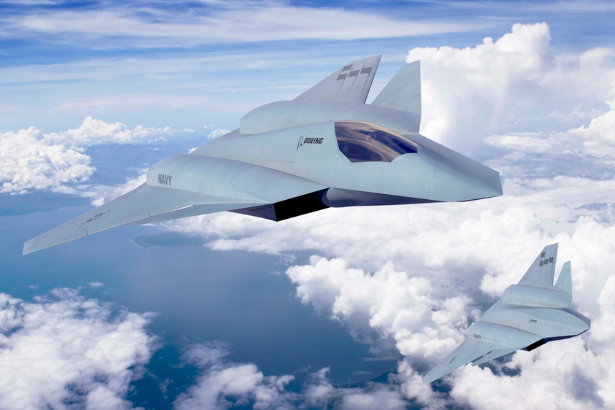
The Navy fighter jets landscape is entering a new phase after the U.S. Navy selected Boeing to develop the F/A-XX, its next-generation carrier-based fighter. The full-scale development agreement is valued at more than $20 billion and covers multiple test aircraft for ground, airworthiness, systems and weapons-integration testing.
The selection places Boeing ahead of Northrop Grumman after Lockheed Martin exited the competition in 2025. The F/A-XX is intended to eventually replace the Navy’s F/A-18E/F Super Hornet and EA-18G Growler beginning in the 2030s.
Background and Context
The F/A-XX program has been under development for years as the Navy looks beyond the F/A-18 Super Hornet and toward a future carrier air wing.
Unlike the Air Force’s F-47 program, the Navy’s F/A-XX is being developed around the requirements of carrier aviation. The Navy has said the aircraft will use a separate airframe rather than adopting the joint-aircraft approach used by the F-35 program.
The program has also faced uncertainty.
After Boeing won the Air Force’s next-generation F-47 fighter competition in March 2025, questions emerged about whether the Navy’s F/A-XX program would proceed at the same pace. Breaking Defense reported that the White House had argued in July 2025 that moving forward with the Navy aircraft could put pressure on the F-47 effort, while Congress and Navy officials continued to support F/A-XX.
That debate has now ended with a contract award.
Latest Update: Boeing Wins the F/A-XX Competition
A $20 Billion-Plus Development Program
The Navy’s award covers the full-scale development phase of F/A-XX and is valued at more than $20 billion.
According to the Department of War announcement, the contract includes multiple test aircraft that will be used for ground testing, airworthiness evaluation, systems testing and weapons integration. The Navy expects the aircraft to begin flying in the 2030s.
The award therefore represents more than a conventional aircraft procurement announcement. It marks the beginning of the detailed engineering and testing phase for a fighter expected to remain part of the Navy’s carrier aviation architecture for decades.
Boeing Beat Northrop Grumman
Boeing and Northrop Grumman were the final competitors after Lockheed Martin withdrew from the competition.
The Wall Street Journal reported that Boeing’s selection will eventually put its aircraft in the role currently performed by the carrier-launched F/A-18 Super Hornet.
Northrop said it had offered what it described as a highly survivable, digitally advanced sixth-generation fighter and that it looked forward to receiving additional information about the selection.
[Read the Wall Street Journal report on Boeing’s F/A-XX selection]
Boeing Now Has Both Major U.S. Sixth-Generation Fighter Programs
The F/A-XX award follows Boeing’s 2025 selection for the Air Force’s F-47.
That gives Boeing development responsibility for both the Navy’s and Air Force’s next-generation crewed fighter programs. Breaking Defense describes the two awards as making Boeing the sole U.S. supplier of these two sixth-generation fighter programs.
The distinction matters because the two aircraft are not simply versions of the same platform. The Navy has indicated that F/A-XX will use its own airframe and is being designed around naval aviation requirements.
Expert Insights and Analysis
The F/A-XX program is important because future carrier aviation is being designed around a wider network of crewed and uncrewed systems rather than a fighter operating entirely by itself.
The Navy’s next-generation fighter is expected to operate alongside the F-35C and a future Collaborative Combat Aircraft. The Navy has also emphasized the importance of range and survivability as it prepares for operations in increasingly contested environments.
The exact technical specifications remain largely classified or undisclosed.
Public reporting indicates that the aircraft is expected to have greater range than current Navy fighters and serve as a stealth-oriented component of the future carrier air wing.
That means the most important details are still to come.
The development phase will provide opportunities for the Navy to evaluate the aircraft’s design, test systems and integrate weapons before production decisions become more extensive.
Broader Implications
A New Chapter for Naval Aviation
The F/A-XX is intended to eventually replace two existing aircraft families: the F/A-18E/F Super Hornet and EA-18G Growler.
That makes the program relevant beyond a single fighter.
The Super Hornet provides the Navy with its principal carrier-based strike-fighter capability, while the Growler performs specialized electronic-warfare missions. How the future carrier air wing divides these roles will become clearer as F/A-XX development progresses.
Boeing’s Defense Business Gains Another Major Program
For Boeing, the award adds another major defense program to a portfolio that has faced significant challenges in recent years.
The Wall Street Journal characterized the F/A-XX contract as the latest in a series of wins for Boeing’s military business.
At the same time, the size and complexity of the program create a substantial execution requirement. Boeing’s defense leadership has said the company invested in facilities intended to support multiple next-generation aircraft programs simultaneously.
For broader coverage of aerospace, AI and advanced technology, an internal link to The Tech Marketer’s defense technology coverage would fit naturally here.
The Industrial Base Question
Running the F-47 and F/A-XX programs in parallel will require Boeing and its suppliers to manage two highly complex development efforts.
Boeing defense chief Steve Parker said the company had planned for the programs to proceed concurrently and had invested accordingly.
The practical test will come during development, when engineering milestones, testing requirements, production capacity and supply-chain demands begin to interact.
Related History and Comparable Technologies
The F/A-XX is part of a broader transition from fourth-generation and fourth-generation-plus fighters toward sixth-generation combat aircraft.
The Navy’s current Super Hornet fleet represents an evolution of the original F/A-18 family. The F-35C, meanwhile, introduced fifth-generation stealth and sensor capabilities to carrier aviation.
F/A-XX is intended to move the Navy beyond those platforms.
It will operate alongside the F-35C rather than immediately replacing it, according to current program descriptions. The Navy is also developing uncrewed aircraft that could work with crewed fighters, creating a more distributed carrier air-wing architecture.
This makes F/A-XX less about a single replacement aircraft and more about how the Navy intends to structure combat aviation in the 2030s and beyond.
What Happens Next
The next major stage is detailed development and testing.
The $20 billion-plus award includes multiple test aircraft. Those aircraft will support ground testing, airworthiness work, systems integration and weapons testing before the program reaches later production stages.
The Navy expects F/A-XX to begin flying in the 2030s.
Several questions will remain open during development:
- How quickly Boeing can move from design into flight testing.
- How the aircraft’s range and survivability requirements translate into the final configuration.
- How F/A-XX will work with the F-35C and future uncrewed aircraft.
- How the Navy balances development costs with eventual fleet size.
- How Boeing manages F/A-XX alongside the Air Force’s F-47 program.
The answers will emerge gradually as the program moves through engineering and testing milestones.
Conclusion
The Navy fighter jets story has entered a new chapter with Boeing’s selection for the F/A-XX program.
The more than $20 billion full-scale development contract puts Boeing at the center of the Navy’s next-generation carrier fighter effort. The aircraft is expected to begin flying in the 2030s and eventually replace the F/A-18E/F Super Hornet and EA-18G Growler.
The award also gives Boeing responsibility for both major U.S. sixth-generation crewed fighter programs after its selection for the Air Force’s F-47.
For the Navy, the next phase is about turning a largely classified future-fighter concept into a testable aircraft and eventually integrating it into a carrier air wing built around crewed fighters, stealth, sensors and uncrewed systems.
FAQ
1. What is the F/A-XX Navy fighter?
F/A-XX is the U.S. Navy’s next-generation carrier-based fighter program. It is intended to eventually replace the F/A-18E/F Super Hornet and EA-18G Growler beginning in the 2030s.
2. Who won the F/A-XX contract?
Boeing was selected by the U.S. Navy over Northrop Grumman. Lockheed Martin had previously exited the competition.
3. How much is the F/A-XX contract worth?
The full-scale development agreement is valued at more than $20 billion. It includes multiple test aircraft and testing for airworthiness, systems and weapons integration.
4. When will the F/A-XX fighter fly?
The Department of War and reporting on the contract say the F/A-XX is expected to begin flying in the 2030s.
5. What aircraft will F/A-XX replace?
The Navy plans for F/A-XX to eventually replace the F/A-18E/F Super Hornet and EA-18G Growler.
6. Is F/A-XX the same aircraft as the Air Force F-47?
No. The Navy has said its next-generation fighter will use a separate airframe from the Air Force’s F-47, despite both programs being associated with the broader Next Generation Air Dominance effort.
7. What does the contract mean for Boeing?
It gives Boeing development responsibility for both the Navy’s F/A-XX and the Air Force’s F-47, placing the company at the center of the two U.S. sixth-generation crewed fighter programs.