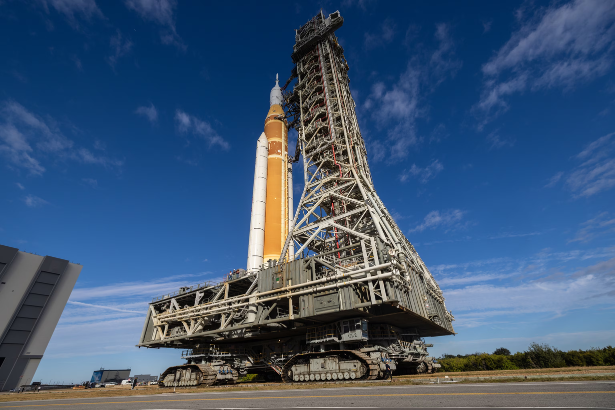
NASA moves closer to its first crewed Moon mission in more than 50 years as the Artemis II rocket reaches the launch pad.
Introduction
NASA Artemis rocket launch preparations entered a decisive phase this week as the Artemis II Space Launch System was rolled to the launch pad, signaling that the Moon-bound mission is shifting from planning to execution.
What the Artemis Program Is All About
The Artemis program is NASA’s long-term strategy to return humans to the Moon and establish a sustainable lunar presence. After the uncrewed Artemis I mission validated the Space Launch System and Orion spacecraft in 2022, Artemis II represents the next leap forward.
Artemis II will be the first crewed mission of the Artemis era, carrying astronauts around the Moon in a high-speed lunar flyby. The mission is managed by NASA and serves as a critical proving flight before astronauts attempt a lunar landing later in the decade.
At the center of the mission is the Space Launch System, the most powerful rocket NASA has ever built, paired with the Orion crew capsule designed for deep-space human travel.
What Just Happened
NASA confirmed that the Artemis II rocket has reached Launch Complex 39B at Kennedy Space Center, completing a carefully choreographed rollout from the Vehicle Assembly Building. According to NASA officials, this milestone enables final integrated testing, propellant loading rehearsals, and launch readiness reviews.
The rollout places Artemis II firmly on track for its targeted 2026 launch window. Once launched, the mission will send four astronauts on a multi-day journey around the Moon, testing life-support systems, navigation, communications, and heat-shield performance during high-speed Earth reentry.
CNN emphasizes that Artemis II is not a landing mission. Instead, it is designed to validate crew safety and spacecraft performance before NASA commits astronauts to the lunar surface.
Why This Matters
Spaceflight analysts view the Artemis II rollout as one of the most consequential NASA milestones since the final Space Shuttle mission. Unlike Apollo, Artemis is structured as a sustained exploration campaign rather than a series of short-term political goals.
Engineers note that Artemis II incorporates upgrades informed by Artemis I data, including refinements to Orion’s heat shield, avionics, and life-support systems. The mission’s success would significantly reduce risk for Artemis III, which aims to land astronauts near the Moon’s south pole.
Experts also highlight the symbolism of using Launch Complex 39B, the same historic pad that supported Apollo and Shuttle missions, reinforcing Artemis as a continuation of American human spaceflight heritage.
What This Means for the Future
For Space Exploration
Artemis II demonstrates that NASA is transitioning from experimental testing to operational deep-space missions. A successful flight would restore routine human capability beyond low Earth orbit.
For Industry and Partners
The mission underscores the growing role of commercial and international partners. Artemis relies on a complex supply chain that includes aerospace primes, technology startups, and future lunar lander providers.
For Policy and Geopolitics
Artemis also functions as a geopolitical signal. By committing to a long-term lunar presence, the United States positions itself at the center of future Moon-based science, resource utilization, and space governance frameworks.
How Artemis II Compares to Apollo
The Artemis II mission draws direct lineage from Apollo 8, the first crewed mission to orbit the Moon in 1968. Like Apollo 8, Artemis II focuses on proving navigation, communications, and human endurance beyond Earth orbit.
However, Artemis differs in scale and intent. Apollo was a race. Artemis is an infrastructure program, laying groundwork for lunar bases, sustained exploration, and eventual human missions to Mars.
What Comes Next
With the rocket now at the pad, NASA will conduct a series of integrated tests, including wet dress rehearsals and countdown simulations. Any technical issues discovered during these steps could adjust the launch timeline, but NASA leadership remains confident in a 2026 flight.
Following Artemis II, NASA plans Artemis III, which would return astronauts to the lunar surface for the first time since 1972, followed by longer-duration missions that test habitation and surface operations.
Why This Launch Pad Moment Matters
The NASA Artemis rocket launch milestone for Artemis II marks a pivotal moment in modern spaceflight. By moving the rocket to the launch pad, NASA has crossed from preparation into commitment.
If Artemis II succeeds, it will validate the systems required for humanity’s sustained return to the Moon and set the stage for the next era of deep-space exploration. This mission is not just about going back. It is about staying.
FAQ
What is the NASA Artemis rocket launch for Artemis II?
It is the first crewed mission of the Artemis program, sending astronauts around the Moon without landing.
When will Artemis II launch?
NASA is targeting a launch window in 2026, pending final testing and readiness reviews.
Will Artemis II land on the Moon?
No. Artemis II is a lunar flyby mission designed to test crewed deep-space systems.
Why is Artemis II important?
It validates astronaut safety and spacecraft performance before future lunar landings.
What comes after Artemis II?
Artemis III, which aims to land astronauts on the Moon later this decade.