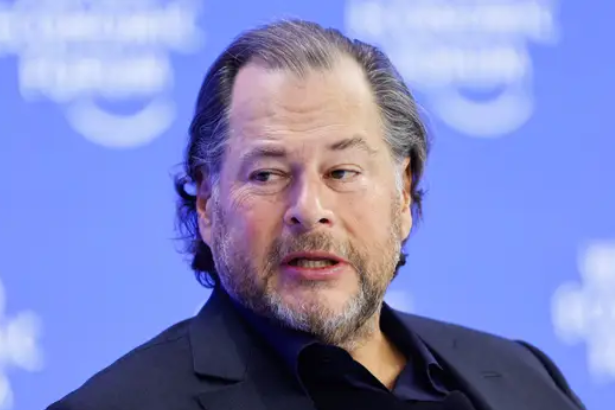
Marc Benioff Salesforce Anthropic 2026 is the enterprise AI story of the week. The Salesforce CEO disclosed on the All-In podcast, published Friday May 16, that his company expects to spend approximately $300 million on Anthropic tokens this year — almost entirely on coding. He called coding agents “awesome,” called Anthropic “a rocket ship that will not stop,” and added that the spending would make everything at Salesforce cheaper to build. The disclosure is the most detailed public accounting yet of what frontier AI adoption actually costs at scale for a major enterprise software company — and what it is replacing.
The $300 Million Number — and What It Actually Means
Benioff was precise about the projection: “These coding agents are awesome. Anthropic is awesome. I am going to probably use $300 million of Anthropic this year at Salesforce. Coding, everything’s going to be cheaper to make. It’s more efficient.”
A $300 million annual token bill from a single customer would make Salesforce one of Anthropic’s largest commercial accounts, though neither company has confirmed the figure in official disclosures. Tokens are the units of text that large language models process when generating output, and AI companies bill enterprise customers based on the volume consumed.
The scale of the number carries meaning beyond the headline. At $300 million annually, AI token spending is no longer a line item in Salesforce’s innovation budget. It is infrastructure spending — comparable in organizational weight to cloud compute, data center costs, or software licensing. When a company spends $300 million a year on a single vendor’s API, that vendor becomes as foundational to operations as AWS or Salesforce’s own platform stack.
Why Anthropic — Not OpenAI
The most overlooked detail in the Marc Benioff Salesforce Anthropic 2026 story is why Anthropic specifically became Salesforce’s AI partner at this scale.
Benioff has said Microsoft blocked Salesforce from investing in OpenAI, pushing the company toward Anthropic instead. That origin story matters because it frames the entire Salesforce-Anthropic relationship as a partnership born from competitive exclusion rather than pure vendor evaluation. Microsoft’s OpenAI exclusivity — enforced through its investment terms — redirected one of enterprise software’s largest companies into the arms of Anthropic. Anthropic has since passed OpenAI in US business adoption, with its share of combined OpenAI-plus-Anthropic business subscription spend going from roughly 10% in early 2025 to over 65% by February 2026.
The relationship runs on two tracks simultaneously. Salesforce has invested more than $300 million in Anthropic and holds approximately a 1% stake. That means Salesforce is both a major customer paying Anthropic for token usage and a financial investor with a stake in Anthropic’s IPO upside. The company is not simply paying a vendor. It is backing a model provider financially while building product experiences around that provider’s technology.
The Engineering Hiring Freeze: What Benioff Actually Said
The Marc Benioff Salesforce Anthropic 2026 story cannot be separated from Salesforce’s decision to stop hiring software engineers — a decision that directly funds the Anthropic spending.
The company announced in January 2025 that it would not be hiring any more software engineers that year, citing productivity gains of over 30% from AI tools. By June 2025, Benioff reported that AI was doing 30 to 50% of the work across the company. By September, Salesforce had cut 4,000 customer support roles — from 9,000 to 5,000 headcount — replacing them with AI agents.
Benioff was careful to clarify the framing in the podcast. While Salesforce has paused additional software engineering hiring, he clarified that the company does not believe AI can fully replace human engineers yet. Over 15,000 Salesforce engineers are currently working alongside AI tools. He described them as evolving into supervisory roles — overseeing AI-generated coding workflows rather than writing every line themselves.
The economics are direct: workforce cost reductions fund AI token expenditure. The savings from not hiring engineers — at Salesforce’s salary structure, each senior engineer represents $300,000 to $500,000 in fully-loaded annual cost — flow directly into the Anthropic token budget. Benioff is essentially swapping headcount for compute.
The Intermediary Layer Strategy: Benioff’s Cost Control Plan
The most strategically interesting detail from Benioff’s podcast appearance is not the $300 million headline. It is what he said about how Salesforce plans to manage that cost.
Benioff described an “intermediary layer” that could route simpler work to cheaper models and reserve Claude for harder reasoning jobs. He argued that not every token a company employee generates needs to go to a frontier model like Anthropic’s Claude.
At a projected annual spend of $300 million, even modest routing improvements could save Salesforce tens of millions of dollars. Claude Opus 4.7, released this month, is priced at $5 per million input tokens and $25 per million output tokens. Smaller models from Anthropic’s own Haiku line, or from open-weight competitors like Meta’s Llama and DeepSeek, cost a fraction of that.
The intermediary routing approach is not new in AI infrastructure thinking. What is new is its endorsement by the CEO of the world’s largest enterprise applications vendor. When Benioff articulates a specific cost management strategy publicly, it signals that Salesforce is building proprietary routing infrastructure rather than relying on Anthropic to offer it. That is a significant product investment in AI cost optimization.
Agentforce: $800 Million ARR and the Revenue Story Nobody Is Telling
The Marc Benioff Salesforce Anthropic 2026 story has a commercial dimension that the token spending headlines consistently underreport.
Salesforce’s Agentforce business — its dedicated AI agent product line — reached $800 million in annual recurring revenue as of the most recent earnings, up 169% year-on-year with 29,000 deals closed. Benioff has said Agentforce has already crossed approximately $800 million in annual recurring revenue.
The Agentforce number is the evidence that Salesforce’s AI investment is generating commercial return, not just internal efficiency. A company spending $300 million on Anthropic tokens while simultaneously growing its AI product line to $800 million ARR at 169% growth is not running an AI experiment. It is running an AI business. The net economics — $800 million in external revenue against approximately $300 million in AI infrastructure spending — represent a margin structure that Benioff appears confident will improve as routing optimization reduces per-unit token costs.
Slack as the AI Interface: The Product Vision Behind the Spending
Benioff’s token projection connects directly to a specific product vision that Salesforce has been building toward throughout 2026.
Salesforce overhauled Slack in March, unveiling more than 30 new AI capabilities for Slackbot that transform it from a conversational assistant into an agentic system capable of transcribing meetings, monitoring desktop activity, executing tasks through third-party tools via the Model Context Protocol, and functioning as a lightweight CRM. All of the new capabilities run on Anthropic’s Claude. From this summer, every new Salesforce customer will have Slack automatically provisioned and AI-enabled from day one.
Salesforce has also launched Headless 360, an API-first platform with 60-plus MCP tools designed to give AI agents — including Claude Code — direct access to its enterprise stack. Benioff has described Slack as “the interface to AI” and noted that AI companies including OpenAI and Anthropic run their own operations on the platform. Slack revenue is expected to hit $3 billion this year.
What Anthropic’s Growth Trajectory Means for This Partnership
The Marc Benioff Salesforce Anthropic 2026 story lands in a context where Anthropic’s growth rate has no historical precedent in enterprise software.
Anthropic’s annualized revenue run rate has grown from roughly $9 billion at the end of 2025 to approximately $30 billion by the end of March 2026, driven by enterprise adoption of Claude for coding, legal, financial services, and general-purpose reasoning. For context, Salesforce itself took about 20 years to reach $30 billion in annual revenue. Anthropic did it in under three years from a standing start.
Anthropic is expected to go public later this year. Salesforce’s $300 million annual spend, its $300 million equity investment, and its 1% stake position it as both a significant commercial partner and a pre-IPO investor with meaningful upside if Anthropic’s growth trajectory continues.
Broader Implications: When $300 Million Becomes the New Normal
The Marc Benioff Salesforce Anthropic 2026 disclosure is a signal to every enterprise software company watching what peers are spending on AI. When the CEO of Salesforce announces on a major podcast that he expects to spend $300 million on a single AI vendor’s API calls in a single year, the CFOs of every other major enterprise software company are doing the same mental calculation for their own organizations.
AI token spending is becoming a standard infrastructure line item for enterprise software companies — the same transformation that cloud computing spending underwent between 2010 and 2015. The companies that figured out cloud economics early built durable competitive advantages. The companies that moved slowly paid catch-up premiums. The enterprise AI spending wave is following the same pattern, and Benioff’s $300 million projection is the most public articulation yet of what the front of that wave actually looks like in practice. For more on the biggest stories in AI, technology, and business, visit The Tech Marketer.
Latest Updates
The Marc Benioff Salesforce Anthropic 2026 story broke from the All-In podcast published Friday, May 16. Here is where to follow the full coverage:
- Times of India has the complete breakdown of Marc Benioff’s Salesforce AI spending pivot — from the 2025 engineering hiring freeze to the $300 million Anthropic token projection — and what it means for software engineers working alongside AI. Read more at Times of India
- Business Insider has the full report on Marc Benioff’s Anthropic token projection, the Slack AI coding integration vision, and the strategic context behind Salesforce’s decision to make Anthropic its primary AI infrastructure partner. Read more at Business Insider
- Quartz has the complete analysis of Salesforce’s $300 million Anthropic commitment — covering the intermediary routing layer strategy, the Agentforce ARR trajectory, and what the spending signals for the broader enterprise AI market. Read more at Quartz
FAQ: Marc Benioff Salesforce Anthropic 2026
1. How much is Salesforce spending on Anthropic in 2026? Marc Benioff disclosed on the All-In podcast that Salesforce expects to spend approximately $300 million on Anthropic tokens in 2026, almost entirely on coding-related work. He said: “I am going to probably use $300 million of Anthropic this year at Salesforce. Coding, everything’s going to be cheaper to make.”
2. Why did Salesforce choose Anthropic over OpenAI? Benioff has said Microsoft blocked Salesforce from investing in OpenAI, directing the company toward Anthropic instead. Salesforce has since invested more than $300 million in Anthropic equity, holds approximately a 1% stake, and has built its Agentforce platform and all new Slack AI capabilities on Anthropic’s Claude.
3. Is Salesforce still hiring software engineers? Salesforce announced in January 2025 that it would freeze software engineering hiring, citing AI-driven productivity gains of more than 30%. Benioff clarified that the company’s 15,000 existing engineers are working alongside AI tools rather than being replaced, evolving into supervisory roles overseeing AI-generated coding workflows. The company does not believe AI can fully replace engineers yet.
4. What is Agentforce and how is it performing? Agentforce is Salesforce’s dedicated AI agent product line. As of the most recent earnings, it reached $800 million in annual recurring revenue, up 169% year-on-year, with 29,000 deals closed. Every new Salesforce customer will have Slack automatically provisioned and AI-enabled from this summer, which Benioff expects to accelerate Agentforce adoption significantly.
5. What is Anthropic’s revenue run rate in 2026? Anthropic’s annualized revenue run rate grew from approximately $9 billion at the end of 2025 to approximately $30 billion by the end of March 2026 — driven primarily by enterprise adoption of Claude for coding, legal, financial services, and reasoning workloads. The company passed OpenAI in US business adoption by February 2026, capturing over 65% of combined OpenAI-plus-Anthropic enterprise subscription spend.
Sources and References
- Times of India: Salesforce CEO Marc Benioff, Who Said We Will Not Hire Any More Engineers in 2025, Sees the Company Spending Millions on Anthropic
- Business Insider: Marc Benioff: Salesforce Will Spend $300M on Anthropic Tokens, Wants Coding Inside Slack Next
- Quartz: Salesforce CEO Marc Benioff Says the Company Will Spend $300 Million on Anthropic Coding