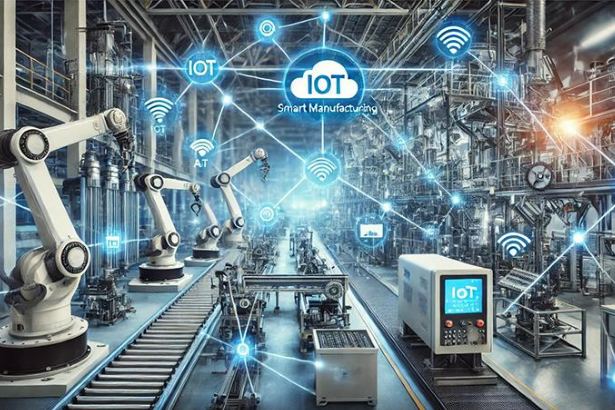
Manufacturing connectivity challenges are becoming a bigger obstacle as factories adopt artificial intelligence, industrial IoT sensors, robotics and intelligent production systems. A machine can generate valuable data, but that information has little operational value if it arrives late, cannot be accessed by the right team or never reaches the system responsible for acting on it.
For manufacturers, connectivity is no longer just an IT concern. It affects production scheduling, quality control, equipment maintenance, inventory visibility and cybersecurity. A network interruption can ripple beyond the factory floor, disrupting warehouse operations and delaying customer orders.
IndustrialSage explored this issue in its October 12, 2026, article, “5 Strategies for Navigating Connectivity Challenges in Manufacturing”. Written by Zac Amos, the article identifies five approaches: unifying IT and operational technology, deploying edge computing, upgrading wireless infrastructure, adopting zero-trust security and using low-power wide-area networks where appropriate.

IndustrialSage
The larger lesson is that smart manufacturing requires more than buying advanced machines or installing AI software. Manufacturers need a dependable architecture that connects people, equipment and business systems without compromising safety or security.
Background and Context: Why Factory Connectivity Matters More Than Ever
Modern factories run on a growing mix of technologies. Enterprise resource planning systems track orders and materials. Manufacturing execution systems coordinate production. Programmable logic controllers operate machinery, while supervisory control and data acquisition systems monitor industrial processes. Sensors, cameras, autonomous mobile robots and predictive maintenance tools add even more data sources.
These technologies often come from different vendors and were not necessarily designed to work together seamlessly.
That creates a familiar problem: a factory may have plenty of data but still lack a clear, timely picture of what is happening. A production line might record a slowdown while the warehouse system continues to show inventory as available. Maintenance staff may receive an alert too late to prevent downtime. Managers may make decisions using information that is incomplete or out of date.
The shift toward Industry 5.0 and AI-powered production raises the stakes. Automated systems depend on consistent information flows. AI models need suitable data, while robots and industrial control systems require predictable communication and carefully managed access.
Connectivity problems can therefore become business problems. They can affect production output, labor productivity, equipment utilization and delivery commitments.
Manufacturers do not necessarily need to replace every legacy system. They do, however, need to understand how their systems communicate, where delays occur and which connections are essential to safe and reliable operations.
Latest Update: Five Strategies for Overcoming Manufacturing Connectivity Challenges
IndustrialSage’s October article outlines five technology approaches that can help manufacturers build more reliable digital infrastructure. The right combination depends on the facility’s existing equipment, production requirements, cybersecurity posture and budget.
IndustrialSage
1. Unify IT and OT Network Architecture
Information technology (IT) generally covers business applications, enterprise data and corporate computing. Operational technology (OT) includes the hardware and software that monitor or control physical processes, such as production machinery and industrial controllers.
Historically, these environments have often been managed separately. That separation can make sense for safety and operational reasons, but poorly coordinated systems can create information silos.
Imagine a factory where the production line reports a completed batch, but the warehouse management system does not receive the update. Inventory records become unreliable. Shipping teams may not know which products are ready, and production planners may make decisions based on stale information.
A more coordinated IT/OT architecture can improve visibility by defining how systems exchange data, which protocols they use and who is responsible for maintaining each connection.
The goal is not to connect everything indiscriminately. Manufacturers should establish clear interfaces, standardize data where practical and preserve appropriate boundaries between enterprise networks and systems that control physical equipment.
Cybersecurity must be part of this design. IndustrialSage references an industry survey in which only 14% of respondents reported that their OT environments were prepared for new cyber threats. The article links to the SANS Institute, where readers can explore industrial cybersecurity research.
IndustrialSage
What manufacturers should do: Start by mapping critical systems and data flows. Identify where duplicate data entry, delayed updates or incompatible interfaces create operational friction. Prioritize integration projects that address measurable production or inventory problems.
2. Deploy Edge Computing for Real-Time Processing
Many industrial systems send data to remote servers or cloud platforms for storage and analysis. Cloud computing remains valuable for large-scale analytics, collaboration and centralized management. But sending every operational signal to a distant system can introduce latency or create dependence on an external connection.
Edge computing places processing resources closer to the equipment generating the data. A local gateway or industrial computer can analyze sensor readings, filter information or support applications without requiring every operation to make a round trip to the cloud.
That can be useful when a production process needs a fast response. For example, a local system could flag abnormal vibration on a motor or detect a change in a process measurement before the issue escalates.
Edge computing can also help a factory continue certain operations when an external connection is interrupted. The exact level of resilience depends on the design: not every cloud-dependent application will keep working offline, and edge systems still need maintenance, security controls and backup plans.
IndustrialSage highlights edge computing as a way to reduce latency and give manufacturers more direct control over operational data. It also cites a projected global edge-computing market value of $327.79 billion by 2033. That is a market forecast, not a measure of guaranteed savings for an individual factory.
IndustrialSage
What manufacturers should do: Identify processes where response time, local availability or bandwidth costs matter most. Pilot edge computing on a contained use case, such as equipment monitoring or local quality inspection, and measure its effect on downtime, response time and data transmission.
3. Upgrade Wireless Infrastructure With Private 5G and Wi-Fi 6/6E
Factories are challenging wireless environments. Metal equipment, walls, moving vehicles and industrial interference can weaken signals. At the same time, connected devices are multiplying, from handheld scanners and sensors to robots and machine vision systems.
Older wireless infrastructure may struggle to provide the coverage, capacity and reliability required by modern production operations.
Wi-Fi 6 and Wi-Fi 6E can help support higher device density and improved network efficiency when compatible equipment and suitable spectrum are available. Private 5G networks can offer another option for facilities that need managed wireless coverage, mobility or predictable connectivity for specific industrial applications.
Neither technology is a universal fix. Performance depends on the facility layout, radio planning, interference, device compatibility and the application’s latency and availability requirements. Wi-Fi 6E also depends on access to the 6 GHz band under the rules of the relevant country.
Wireless infrastructure can make it easier to reconfigure production areas and deploy mobile robots without routing cables to every moving asset. However, critical control systems may still require wired connections or carefully engineered redundancy.
IndustrialSage emphasizes the role of updated wireless technologies in supporting connected equipment and autonomous mobile robots.
IndustrialSage
What manufacturers should do: Conduct a site survey before purchasing new access points or private cellular infrastructure. Map dead zones, test coverage around machinery and storage racks, and prioritize applications according to their bandwidth, latency and reliability needs.
4. Implement Zero-Trust Cybersecurity
Connecting more factory systems creates more opportunities for useful data sharing. It also increases the number of devices, accounts and network paths that attackers may try to exploit.
A traditional security model may implicitly trust devices or users once they enter a network. Zero-trust architecture takes a different approach: access should be verified, limited to what is needed and reassessed according to risk.
In manufacturing, that means an employee authorized to access one machine or application should not automatically receive broad access to unrelated production systems or business records.
For example, a maintenance contractor may need remote access to diagnose a specific machine. A well-designed access policy can restrict that session to approved equipment, require strong authentication, log activity and remove access when the job is finished.
Network segmentation is another important control. It can help prevent a compromised office computer from moving freely into sensitive industrial environments. Manufacturers should also maintain asset inventories, patch systems where safe and practical, monitor unusual activity and prepare incident-response procedures that account for production safety.
Security controls must be designed around operational realities. Some industrial devices cannot be patched quickly or may rely on older protocols. Abruptly changing access rules can interrupt production, so changes should be tested and coordinated with engineering and operations teams.
IndustrialSage presents zero-trust security as a way to limit unauthorized access and reduce the potential for threats to spread across connected systems.
IndustrialSage
What manufacturers should do: Begin with the highest-risk connections, especially remote access, privileged accounts and links between corporate IT and OT. Use least-privilege permissions, multifactor authentication where feasible, and documented approval processes for vendors and contractors.
5. Use Low-Power Wide-Area Networks for the Right Devices
Not every connected device needs high-speed connectivity. Many industrial sensors transmit small amounts of information, such as temperature readings, environmental measurements, utility consumption or basic equipment status.
Using a high-bandwidth network for every low-data device can be inefficient. Low-power wide-area network technologies, often grouped under the term LPWAN, are designed to support devices that need to send relatively small amounts of data over long distances while conserving energy.
These networks can be useful across large industrial campuses, outdoor storage areas, utility infrastructure and remote monitoring points. Their long range and low power consumption can help extend monitoring to places where conventional wireless coverage is difficult or expensive.
LPWAN is not a replacement for every factory network. Its bandwidth and latency characteristics generally make it unsuitable for applications that require high-volume data transfers, real-time machine vision or precise control. Those applications may need Ethernet, industrial Wi-Fi or private cellular connectivity instead.
IndustrialSage recommends LPWAN as a supplement to higher-bandwidth networks, particularly for low-power sensors and metering devices.
IndustrialSage
What manufacturers should do: Classify connected devices according to how much data they generate, how frequently they transmit and how quickly information must be received. Match each category to the least complex network that meets its operational and security requirements.
Expert Analysis: Connectivity Is a Production Investment, Not Just an IT Expense
The five strategies point to a common principle: a factory’s connectivity architecture should be designed around production outcomes.
A manufacturer does not need the newest networking technology simply because it is available. It needs a network that supports its actual workflows, maintains appropriate security and delivers measurable value.
That changes how technology investments should be evaluated.
Start with a business problem
Rather than beginning with a purchase order for private 5G or edge servers, identify the issue that needs solving. Is a production line losing time because sensor data arrives late? Are warehouse and manufacturing records inconsistent? Do mobile robots lose connectivity in certain parts of the facility? Is remote maintenance creating an unacceptable security risk?
A specific problem makes it easier to compare solutions and measure results.
Design for legacy equipment
Many factories contain machines that have operated reliably for years. Replacing them all to achieve a fully connected environment may be impractical.
Industrial gateways, protocol converters and carefully designed integration layers can sometimes connect older equipment to newer systems. These components should be evaluated for reliability, vendor support and cybersecurity implications, not just compatibility.
Measure performance before and after deployment
Useful metrics may include:
- Unplanned downtime linked to network or data failures.
- Time required to detect and respond to production abnormalities.
- Data latency for applications that require rapid decisions.
- Wireless coverage and reliability in critical work areas.
- Time needed to reconcile inventory and production records.
- Number of unauthorized access attempts detected or blocked.
- Cost of network operation and ongoing maintenance.
Not every project will improve every metric. Establishing a baseline helps manufacturers understand whether the investment is solving the intended problem.
Treat cybersecurity and resilience as design requirements
Security added at the end of an integration project can be expensive and disruptive. Access controls, network segmentation, monitoring and recovery procedures should be considered before systems are connected.
The same applies to resilience. Manufacturers should identify which processes can tolerate a temporary loss of cloud connectivity, which must keep running locally and which require a safe shutdown if communication fails.
The best architecture is not necessarily the most complex. It is the one that supports reliable production and can be maintained by the people responsible for it.
Broader Implications: What Connected Factories Mean for U.S. Manufacturing
Connectivity has implications beyond individual production lines. It affects the ability of U.S. manufacturers to scale automation, respond to changing demand and use data more effectively across their operations.
AI adoption depends on reliable data infrastructure
AI systems can help manufacturers identify defects, predict equipment failures and optimize production schedules. But models are only useful when the data feeding them is sufficiently accurate, timely and representative.
If machine data is incomplete or production records are inconsistent, AI recommendations can become unreliable. A stronger connectivity foundation helps businesses collect and contextualize data before deploying more advanced applications.
Smaller manufacturers face a different investment challenge
Large manufacturers may have dedicated network engineering and cybersecurity teams. Smaller manufacturers often have tighter budgets and fewer specialists available to manage complex infrastructure.
For these businesses, phased implementation may be more practical than a complete network overhaul. A pilot focused on one production cell, warehouse zone or maintenance process can demonstrate value before the company expands the project.
Cybersecurity becomes an operational resilience issue
An industrial cyber incident can affect more than confidential information. Depending on the systems involved, it can disrupt production, delay shipments or create safety risks.
Manufacturers should coordinate IT, OT, engineering and security teams when planning connectivity projects. The National Institute of Standards and Technology’s cybersecurity resources offer guidance that can help organizations structure their risk-management approach.
For additional coverage, The Tech Marketer could publish an internal companion article on AI adoption in manufacturing and industrial automation. Replace this suggested link with the exact URL of a relevant published article before posting.
Related History: From Industry 4.0 to Industry 5.0
Industry 4.0 popularized the idea of connected factories in which machines, sensors and business systems exchange data to improve production. Industrial IoT, cloud analytics, digital twins and automation became central parts of that transformation.
Industry 5.0 builds on this digital foundation while placing greater emphasis on human involvement, resilience and sustainability. In practical terms, the transition does not eliminate the need for reliable networks. It makes them more important because people and intelligent systems increasingly need to coordinate their work.
Earlier factory networks were often designed around specific machines or production functions. Modern environments must support a broader mix of legacy equipment, mobile robots, cloud applications, remote service providers and AI tools.
This evolution explains why connectivity upgrades can be difficult. Manufacturers are not always building entirely new factories. Many are adding modern capabilities to facilities that have accumulated different generations of equipment and technology.
The practical path forward is often incremental: improve interoperability, modernize wireless coverage where necessary, introduce local processing for time-sensitive tasks and strengthen security as more systems become connected.
What Happens Next: A Practical Roadmap for Manufacturers
Manufacturers considering connectivity upgrades can use a staged approach instead of attempting a facility-wide transformation at once.
Phase 1: Audit the existing environment
Weeks 1 to 4, as a planning estimate
Document critical machines, network equipment, data flows, wireless dead zones, vendor connections and unsupported devices. Identify the most costly connectivity failures.
Phase 2: Select one high-value use case
Weeks 5 to 8, as a planning estimate
Choose a measurable problem, such as unreliable mobile robot connectivity, delayed machine alerts or disconnected production and inventory records.
Phase 3: Pilot the right technology
Weeks 9 to 12, as a planning estimate
Test the most appropriate combination of IT/OT integration, edge computing, wireless networking or segmented low-power connectivity. Include cybersecurity and recovery testing.
Phase 4: Measure and scale
After the pilot
Compare results against the original baseline. Expand only when reliability, operational benefits, security and ongoing maintenance costs justify the investment.
The timeline above is an illustrative planning framework, not a schedule prescribed by IndustrialSage. Large or safety-critical facilities may require substantially more time.
Conclusion
Manufacturing connectivity challenges are becoming harder to ignore as factories adopt AI, connected machinery and increasingly automated workflows. Weak connections, fragmented data and poorly managed access can undermine the value of those investments.
The five strategies discussed by IndustrialSage offer a useful starting point: unify IT and OT architecture, use edge computing where local processing matters, upgrade wireless infrastructure based on actual needs, apply zero-trust security and reserve LPWAN for devices that benefit from low-power connectivity.
No single technology solves every problem. Manufacturers need to understand their operational requirements, protect critical systems and invest in improvements that can be measured.
The goal is not simply to connect more devices. It is to build a factory where information reaches the right people and systems reliably, safely and at the moment it is needed.
Frequently Asked Questions
1. What are manufacturing connectivity challenges?
Manufacturing connectivity challenges are problems that prevent factory machines, sensors, software and business systems from exchanging information reliably. Common examples include weak wireless coverage, incompatible systems, network latency, data silos and cybersecurity risks.
2. How can manufacturers overcome manufacturing connectivity challenges?
Manufacturers can improve connectivity by integrating IT and OT systems, deploying edge computing for time-sensitive applications, upgrading wireless infrastructure, implementing zero-trust security and using low-power networks for suitable sensors.
3. What is IT/OT integration in manufacturing?
IT/OT integration coordinates business technology with the systems that monitor and control industrial operations. It can improve visibility between production, inventory and enterprise applications when designed with appropriate security boundaries.
4. Why is edge computing useful in smart factories?
Edge computing processes data close to the machines and sensors that generate it. This can reduce delays, limit unnecessary data transfers and help certain applications continue operating when cloud connectivity is interrupted.
5. Is private 5G better than Wi-Fi for manufacturing?
Not in every situation. Private 5G can suit specific mobility, coverage and managed-connectivity requirements, while Wi-Fi can be effective for many factory applications. The choice depends on coverage, latency, device compatibility, interference, security and cost.
6. What is zero-trust security in a factory?
Zero-trust security requires users and devices to verify their identity and receive only the access they need. It can help limit unauthorized access and reduce the ability of a compromised device to spread across industrial networks.
7. What does LPWAN mean in manufacturing?
LPWAN stands for low-power wide-area network. These technologies connect devices that transmit relatively small amounts of data over long distances, making them suitable for many sensors, environmental monitors and utility meters.
8. Can older factory equipment work with modern connectivity systems?
Often, yes. Gateways, protocol converters and integration layers can connect some legacy equipment to modern systems. Compatibility, safety, support and cybersecurity must be assessed before implementation.
9. How should a small manufacturer start modernizing its network?
Start with an inventory of existing equipment and network problems. Select one high-impact use case, establish baseline measurements, pilot a suitable solution and expand only after evaluating the results.
Sources & References
- IndustrialSage: 5 Strategies for Navigating Connectivity Challenges in Manufacturing, October 12, 2026.
- SANS Institute: Industrial Control Systems Security, a resource for industrial cybersecurity research and training.
- National Institute of Standards and Technology: Cybersecurity Resources.
- NIST: Guide to Operational Technology Security, SP 800-82.
- Grand View Research: Edge Computing Market. Consult the latest report for current forecasts and methodology.