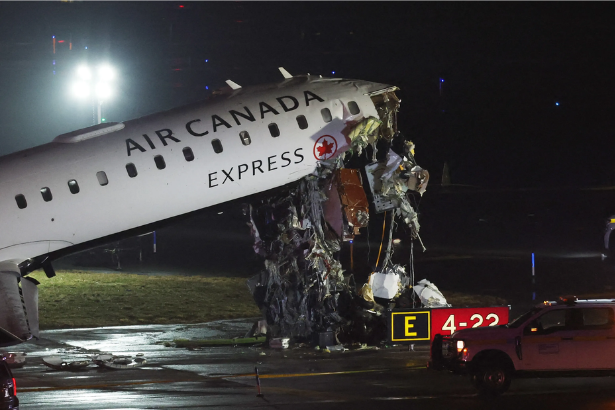
The Air Canada Express CRJ-900 was near the end of its landing roll when it hit the truck. The truck was crossing the runway in response to a different emergency on the other side of the airport. Both pilots are dead. Forty-one people were taken to hospitals. The airport is closed until at least 2 p.m. Monday. The NTSB is deploying a go-team.
A LaGuardia Airport crash in the final seconds of a routine landing killed both the pilot and co-pilot of an Air Canada Express regional jet late Sunday night, after their plane struck a Port Authority fire truck that had been authorized to cross the runway just moments before impact.
Port Authority Executive Director Kathryn Garcia confirmed the deaths at a press conference held just before 5 a.m. Monday. “Sadly, the two pilots are confirmed deceased and notifications are being made by Air Canada’s care team at this time,” Garcia said. She added that both pilots were based in Canada. The NYC medical examiner is now handling their deaths.
The collision happened at approximately 11:40 p.m. ET on Sunday, March 22, at Runway 4 at LaGuardia Airport in Queens, New York.
What Caused the LaGuardia Airport Crash
The sequence of events begins not with the Air Canada flight but with a different emergency unfolding on the other side of the airport.
United Airlines Flight 2384 had aborted its takeoff due to a cockpit warning light. The pilots reported an odor in the cabin that had sickened the flight attendants. That triggered a standard emergency response — and the Port Authority’s Aircraft Rescue and Firefighting truck, designated Truck One, was dispatched to reach the United plane.
To get there, the fire truck needed to cross Runway 4. Air traffic control granted that crossing. What happened next was captured in the ATC audio recording published by LiveATC.com.
Air Canada Flight 8646, a Bombardier CRJ-900 operated by Jazz Aviation on behalf of Air Canada, was arriving from Montreal Trudeau International Airport and was near the end of its landing roll on that same runway. The controller, realizing the collision path, urgently called over the radio: “Truck One, stop, stop, stop!” It was too late. Seconds later, the controller addressed the aircraft directly: “JAZZ 646, I see you collided with the vehicle.”
Flightradar24 data, which recorded the aircraft’s last telemetry before impact, placed the plane traveling at approximately 24 miles per hour at the moment of collision. The fire truck was knocked onto its side off Runway 4. Photos from Reuters and AFP taken at the scene showed visible damage to the nose of the CRJ-900, which had tilted upward. The NYC Fire Department said it responded to the incident at approximately 11:38 p.m., and the Port Authority confirmed the collision time as 11:47 p.m. ET.
Casualties and Hospital Response
The Air Canada flight was carrying 72 passengers and four crew members, according to a preliminary passenger list released by Air Canada. That number is subject to confirmation. No passengers were reported hurt.
Two Port Authority police officers who were inside the fire truck at the time were injured. A sergeant and an officer both suffered broken bones but are expected to recover, according to sources familiar with the matter. Port Authority Executive Director Garcia said a total of 41 people were taken to hospitals, including passengers, crew, and Aircraft Rescue and Firefighting officers.
The pilots, both Canadian nationals, were the only fatalities confirmed as of early Monday morning.
Airport Closure and Operational Impact
The FAA issued a ground stop at LaGuardia shortly after the collision was reported. The airport was officially closed at 3:16 a.m. Monday and is not expected to reopen until at least 2 p.m. ET, with the FAA flagging a high probability of further extension. Arriving flights were diverted to Newark Liberty International Airport and John F. Kennedy International Airport. LaGuardia’s own website showed additional flights returned to their points of origin.
LaGuardia served more than 30 million passengers in 2025, according to the Port Authority of New York and New Jersey. It is one of the most congested airports in the country, operating within tight runway geometry and with limited margins for simultaneous ground and air movements.
Travelers with bookings through LaGuardia are advised to check with their airlines directly. Road closures and a heavy emergency vehicle presence in Queens remain in effect as investigators work the scene.
The collision followed an evening of light rain and fog across the New York area. Water was visible on the tarmac in footage from the scene, though it has not been confirmed whether weather played any role in the incident.
NTSB, FAA, and the Investigation Ahead
The National Transportation Safety Board confirmed it is deploying a go-team to investigate, with investigators expected on site Monday. Jeff Guzzetti, a retired aircraft accident investigator and NBC News aviation analyst, told NBC News that both the truck and the aircraft would have been under the direct authority of air traffic control at the moment of the collision. “That vehicle needs to follow the orders of the controller, just like any airplane would to avoid this type of situation right here,” Guzzetti said, describing ground collisions as a “rare occurrence.”
The central questions investigators will pursue include how the crossing clearance was issued while the Air Canada flight was still on the runway, whether the controller had full situational awareness of both the truck and the aircraft simultaneously, and whether automated surface warning systems were active.
This LaGuardia Airport crash arrives during a period of heightened pressure on U.S. aviation infrastructure. The Department of Homeland Security said more than 400 TSA workers had quit since a partial government shutdown beginning February 14 left them working without pay. Air traffic control unions have flagged persistent staffing shortages for years. Whether any of those systemic factors played a role in Sunday night’s collision remains an open question that investigators will address.
For ongoing coverage of aviation safety developments and the technology systems designed to prevent incidents like this, The Tech Marketer follows the intersection of infrastructure, regulation, and emerging automation in air travel.
FAQ
Q1: What happened in the LaGuardia Airport crash on March 22, 2026? Air Canada Express Flight 8646, a Bombardier CRJ-900 operated by Jazz Aviation and arriving from Montreal, struck a Port Authority Aircraft Rescue and Firefighting truck on Runway 4 at LaGuardia Airport at approximately 11:40 p.m. ET Sunday. The fire truck had been granted clearance by air traffic control to cross the runway in response to a separate emergency involving United Airlines Flight 2384, which had aborted takeoff on the other side of the airport. Both the pilot and co-pilot of the Air Canada flight were killed. A total of 41 people were taken to hospitals.
Q2: Who were the victims and how many people were hurt overall? The pilot and co-pilot, both Canadian nationals, were killed in the collision. Their deaths were confirmed by Port Authority Executive Director Kathryn Garcia just before 5 a.m. Monday, and the NYC medical examiner is handling their cases. Two Port Authority police officers inside the fire truck, one sergeant and one officer, suffered broken bones and are expected to recover. A total of 41 people were transported to hospitals, including passengers, crew, and firefighting officers. No passengers aboard the flight were reported hurt.
Q3: Why was the fire truck on the runway when the plane was landing? The fire truck was responding to a separate declared emergency on the other side of LaGuardia Airport. United Airlines Flight 2384 had aborted its takeoff after a warning light appeared and the pilots reported a cabin odor that sickened flight attendants. Air traffic control granted the fire truck clearance to cross Runway 4 to reach the United plane. The Air Canada flight was simultaneously near the end of its landing roll on that same runway. The ATC recording captured the controller ordering the truck to stop seconds before the collision, followed by confirmation from the controller that the impact had occurred.
Q4: What is the status of LaGuardia Airport and how long will it be closed? LaGuardia was officially closed at 3:16 a.m. Monday following the collision. The FAA said the airport is not expected to reopen until at least 2 p.m. ET Monday, and noted a high probability that closure could extend further. Flights were diverted to Newark Liberty and John F. Kennedy airports. Travelers are advised to contact their airlines directly for rebooking. Road closures around the Queens airport remain in effect.
Q5: Who is investigating and what happens next? The National Transportation Safety Board confirmed it deployed a go-team that was expected to arrive at LaGuardia on Monday. The NTSB leads major aviation accident investigations in the United States and will produce a preliminary report within weeks, with a full investigation likely taking months. The FAA, Port Authority of New York and New Jersey, and Air Canada are also involved. Investigators will focus on the sequence of ATC clearances, surface movement coordination, whether automated runway incursion warning systems were active and functioning, and whether systemic staffing issues contributed.
Sources & References
- NBC New York, Jonathan Dienst and Tom Shea, Plane Collides With Vehicle at LaGuardia Airport Runway
- NBC News Live Blog, 2 Dead After Air Canada Plane and Fire Truck Collide at LaGuardia Airport
- CNN, Air Canada Plane Collides With Fire Truck on Runway at LaGuardia, 2 Killed
- Al Jazeera, New York’s LaGuardia Airport Closed After Air Canada Jet Hits Vehicle
- USA Today, LaGuardia Airport Crash: Pilot and Co-Pilot Killed
- BBC News, LaGuardia Airport Collision