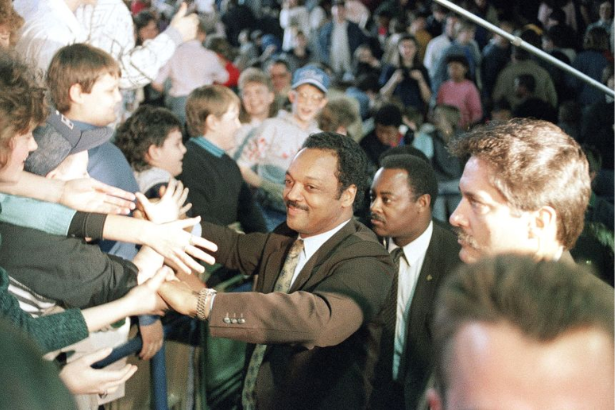
The longtime activist and Rainbow PUSH Coalition founder leaves a decades-long legacy in American politics and civil rights advocacy.
Introduction
Jesse Jackson death is dominating national search trends after the civil rights leader and two-time presidential candidate died Tuesday morning at 84, according to reports from The New York Times, Axios, and The Guardian. His family confirmed he passed away peacefully, surrounded by those closest to him. “Our father was a servant leader — not only to our family, but to the oppressed, the voiceless, and the overlooked around the world,” the family said in a statement.
He is survived by his wife, Jacqueline Jackson, whom he married in 1962, and their six children.
For more than half a century, Jackson remained one of the most recognizable voices in American public life. His passing marks the end of a direct line to the 1960s civil rights movement.
Background and Context
Jesse Louis Jackson was born October 8, 1941, in Greenville, South Carolina, during the Jim Crow era. His mother, Helen Burns, was 16 and unmarried at the time of his birth. In his teenage years she married Charles Jackson, and Jesse took his stepfather’s surname. He was an honors student, earned a football scholarship to the University of Illinois, then transferred to North Carolina A&T, where he graduated in 1964 and served as student body president.
His activism began in college. Student-led sit-ins to desegregate a local library set him on a path toward movement organizing, and by the mid-1960s he had left theological studies at Chicago Theological Seminary to join Dr. Martin Luther King Jr. in Selma. King gave him leadership of Operation Breadbasket — the SCLC’s economic activism arm — and later named him its national director.
Jackson was present at the Lorraine Motel in Memphis when King was assassinated on April 4, 1968. He did not step back from public life. He moved forward.
Latest Update or News Breakdown
The New York Times, Axios, and The Guardian all confirmed Jesse Jackson’s death on Tuesday, February 17, 2026. Coverage has highlighted:
- His decades as one of the last nationally prominent figures with a direct personal connection to Dr. King and the 1960s movement
- His presidential campaigns in 1984 and 1988 — placing third and second respectively — which remain the most successful White House runs by a Black candidate prior to Barack Obama
- His diplomatic achievements, including negotiating the release of Navy Lt. Robert Goodman from Syria in 1983 and 22 American soldiers held in Cuba in 1984
- His receipt of the Presidential Medal of Freedom in 2000
- His health challenges in later years, including a 2017 Parkinson’s disease diagnosis and a more recent diagnosis of progressive supranuclear palsy
Search queries surging include “Jesse Jackson cause of death,” “Rev Jesse Jackson,” and “Jesse Jackson presidential campaign.”
Expert Insights or Analysis
Historians have long credited Jackson with expanding the political vocabulary of the civil rights movement beyond protest into structured electoral power. His 1988 campaign secured millions of votes, won seven states and the District of Columbia, and brought healthcare, education access, and anti-apartheid policy into the Democratic Party’s platform conversation. Many analysts view those campaigns as laying essential groundwork for later minority candidates at the national level.
His Rainbow Coalition — a deliberate alliance of Black, white, Latino, Asian American, Native American, and LGBTQ voters — was a different kind of political project. It argued that civil rights and economic justice were the same fight, and that winning required building across lines that American politics had historically kept separate.
“Our flag is red, white and blue, but our nation is a rainbow,” Jackson once said. “Red, yellow, brown, Black and White — and we’re all precious in God’s sight.” The phrase captured something real about how he saw political organizing.
Unlike contemporaries who stayed rooted in movement activism alone, Jackson moved between protest and formal institutional politics throughout his career. That made him controversial in some quarters and indispensable in others.
Broader Implications
For Civil Rights Leadership
Jesse Jackson’s death marks the passing of one of the last figures with a firsthand connection to the 1960s movement. The generation that marched with King, organized the Poor People’s Campaign, and built the institutional infrastructure of modern civil rights advocacy is nearly gone. What comes next will be shaped by how that legacy is carried forward — or contested.
For American Politics
His presidential campaigns did something durable. They proved a Black candidate could compete nationally, build a cross-racial coalition, and reshape a party platform without winning the nomination. That record influenced how politicians and organizers understood electoral strategy for decades. The path Obama walked in 2008 had Jackson’s footprints on it.
For Movement Strategy
Jackson demonstrated that grassroots activism and institutional political engagement are not mutually exclusive. His career was built on moving between the two — showing up on picket lines and at negotiating tables, in foreign capitals and at Democratic National Conventions. That hybrid model became a template.
Related History
Jackson’s career touched some of the most consequential moments in modern American history. He marched in Selma in 1965. He was in Memphis when King was killed in 1968. He ran for president in an era when that was not yet considered possible for a Black candidate, and came closer than anyone had before.
His diplomatic missions drew a different kind of attention. In 1983, he flew to Syria and personally appealed to President Hafez al-Assad for the release of captured American pilot Navy Lt. Robert Goodman — and succeeded. Reagan invited him to the White House afterward. The following year he negotiated the release of 22 American soldiers held in Cuba. In 1999, he secured the release of three U.S. soldiers held in what was then Yugoslavia.
He founded PUSH in 1971, the Rainbow Coalition in 1984, and merged them into Rainbow/PUSH in 1996. He led the combined organization until 2023, when he stepped down. He received the Presidential Medal of Freedom — the nation’s highest civilian honor — in 2000.
What Happens Next
Tributes from political leaders, civil rights organizations, and public figures across party lines are expected to continue in the days ahead. Memorial services will draw national attention, and congressional commemorations are likely to follow.
Historians anticipate renewed examination of his presidential campaigns, his diplomatic record, and his model of movement-to-institution organizing. His 1988 campaign speech at the Democratic National Convention — ending with “Keep hope alive” — is already being widely circulated.
The Rainbow PUSH Coalition is expected to outline succession and leadership plans in the coming weeks. The organization Jackson built over five decades now faces the challenge of defining itself without its founder.
Conclusion
Jesse Jackson death closes a chapter in American civil rights history that opened in Greenville, South Carolina, in 1941 and ran through six decades of marches, campaigns, negotiations, and speeches that changed the country. He was not a perfect figure. His career had its controversies and its contradictions. But he stayed in the fight, through Parkinson’s and progressive supranuclear palsy, well past the point when most people would have stepped away.
From the streets of Selma to the Democratic primary stages of the 1980s, from foreign capitals to Chicago community halls, he kept showing up. That consistency was itself a form of leadership.
His influence endures in every political campaign that builds across racial and economic lines, and in every organizer who learned that the work of protest and the work of power are not separate jobs.
FAQ
Q1: How old was Jesse Jackson when he died? He was 84 years old. He was born October 8, 1941, in Greenville, South Carolina, and died Tuesday, February 17, 2026.
Q2: What was Jesse Jackson known for? He was a Baptist minister, civil rights leader, founder of the Rainbow PUSH Coalition, and a two-time Democratic presidential candidate. He also conducted significant diplomatic missions, including negotiating the release of American prisoners held in Syria, Cuba, and Yugoslavia.
Q3: Did Jesse Jackson run for president? Yes. He ran in 1984, placing third in the Democratic primary, and again in 1988, placing second — the most successful presidential runs by a Black candidate prior to Barack Obama.
Q4: What organization did Jesse Jackson found? He founded PUSH in 1971 and the Rainbow Coalition in 1984. The two merged into the Rainbow PUSH Coalition in 1996. He led the organization until 2023.
Q5: Why is Jesse Jackson death trending? His family confirmed his passing on the morning of Tuesday, February 17, 2026. Coverage from The New York Times, Axios, The Guardian, NBC News, CBS News, ABC News, and dozens of other outlets followed immediately, driving significant national search activity.
Sources and References
The New York Times: Jesse Jackson, Civil Rights Leader Who Sought the Presidency, Dies at 84
Axios: Jesse Jackson’s life in photos
The Guardian: Jesse Jackson, civil rights icon, dies aged 84