Space agencies reveal unprecedented observations as mysterious visitor prepares for closest approach
Interstellar comet 3I/ATLAS is lighting up with dramatic activity as it barrels toward Earth, according to stunning new images released this week by NASA and the European Space Agency. The cosmic visitor, captured by both the Hubble Space Telescope and ESA’s Jupiter Icy Moons Explorer spacecraft, represents only the third confirmed object from beyond our solar system ever detected.
Scientists are racing against time to extract maximum data before this ancient traveler vanishes into deep space forever, with its closest approach to Earth scheduled for December 19, 2025.
Background and Context
Think of interstellar comet 3I/ATLAS as the ultimate cosmic traveler. Astronomers discovered it in late June 2025, and by July they’d confirmed what made it special: this thing came from outside our solar system entirely.
Most comets we see were born right here, in the sun’s Oort Cloud or Kuiper Belt. But this interstellar visitor? It likely formed billions of years ago orbiting a completely different star. Scientists think it could be at least 7 billion years old, making our 4.6-billion-year-old sun look young by comparison.
We’ve only seen this twice before. ‘Oumuamua zipped through in 2017, followed by comet 2I/Borisov in 2019. But neither got this much attention from telescopes.
The size estimates are wild. The nucleus could be anywhere from 440 meters to 5.6 kilometers across. If it’s on the larger end, that makes it the biggest interstellar object we’ve ever observed. And it’s moving at a blistering 210,000 kilometers per hour.
Latest Observational Data
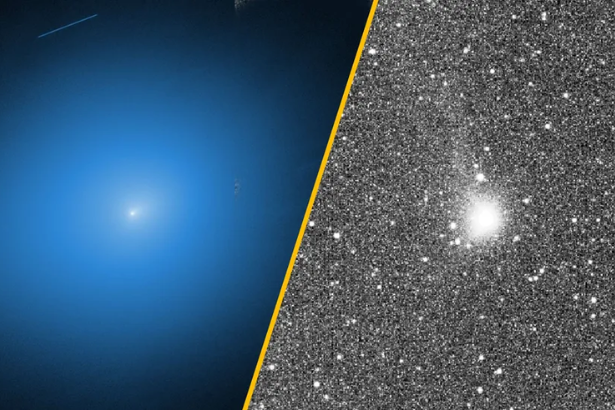
Hubble caught the interstellar comet 3I/ATLAS on November 30 when it was sitting 286 million kilometers from Earth. The telescope’s Wide Field Camera 3 captured the comet’s nucleus wrapped in a bright coma, that glowing cloud of gas and dust that appears when sunlight heats up the frozen material.
Stars streak across the Hubble image because the telescope was tracking the comet as it moved. You can even spot faint hints of a dust tail and jets shooting out from the side facing the sun.
ESA’s Juice spacecraft got an even better angle. On November 2, it observed from just 66 million kilometers away, catching the comet just days after it swooped closest to the sun in late October. Timing matters here. Comets go wild with activity right after getting that close solar blast.
Juice’s camera clearly shows two separate tails. The main one, made of electrically charged gas, shoots toward the top of the frame. A fainter dust tail, full of tiny solid bits, stretches down to the lower left. Seeing both tails confirms the comet is actively venting material.
Here’s the catch: Juice used five of its science instruments to gather detailed data during two observation sessions, but we won’t see the full results until February 2026. The spacecraft is using its main antenna as a heat shield right now while it makes its own close pass of the sun, so it can only send data back through a smaller, slower antenna.
Expert Analysis
These observations of interstellar comet 3I/ATLAS provide something rare: a real-time look at how an object from another star system behaves in our cosmic neighborhood. Scientists are impressed that it held together through its close solar encounter. Some comets shatter under that kind of heat and stress.
The intense activity suggests the nucleus is packed with volatile ices. Once we get the spectroscopic data, we’ll know exactly what elements the comet contains. That could tell us about the conditions where it formed billions of years ago in some distant star system.
What’s really impressive is how many spacecraft tracked this thing. NASA’s Mars Reconnaissance Orbiter and ESA’s Mars Express both photographed it from Mars in October. Solar observation missions watched it in September and October as it passed behind the sun from our viewpoint.
None of these spacecraft were built to study comets. But scientists quickly repurposed them for this unexpected opportunity, creating an impromptu observation network spanning the solar system.
Broader Implications
For Space Science
The interstellar comet 3I/ATLAS is essentially a sample delivery from another star system. Its composition will reveal whether planets form the same way everywhere, or if each stellar system does things differently.
The fact that it survived its solar pass intact tells us something about how these objects are built. That information feeds into models predicting how interstellar visitors respond when they encounter different stellar environments.
For Observation Networks
This coordinated campaign shows what’s possible when you can quickly mobilize space assets scattered across the solar system. Next time we detect an interstellar visitor, we’ll be even better prepared.
Some scientists are already pushing for dedicated interceptor missions. The idea is to have spacecraft pre-positioned and ready to chase down these visitors, giving us months of close observation instead of brief glimpses through telescopes.
For Detection Capabilities
We found this cosmic wanderer much more easily than ‘Oumuamua, thanks to better sky surveys. The Vera Rubin Observatory started operations in 2025, and once it’s running at full capacity, it should spot way more interstellar objects.
Here’s something wild: astronomers now estimate dozens of interstellar objects pass through the inner solar system every year. We’re just not seeing most of them yet. Better detection systems mean regular chances to study material from across the galaxy.
Historical Context
Until ‘Oumuamua showed up in 2017, interstellar visitors were purely theoretical. That weird cigar-shaped object caused arguments among scientists because it accelerated oddly and didn’t show typical comet behavior. Some people even speculated it might be artificial, though that’s extremely unlikely.
Comet 2I/Borisov in 2019 looked more like what we expected: clear outgassing, visible coma, the works. Its chemistry suggested it formed in an environment rich in carbon monoxide, different from our solar system comets.
The interstellar comet 3I/ATLAS is our third data point. Each detection helps scientists build better models of how common these visitors are and how diverse objects from other star systems can be.
What’s changed is how fast the astronomy community can respond. When this comet was confirmed, NASA, ESA, and observatories worldwide coordinated within days. We’re getting better at this.
What Happens Next
The interstellar comet 3I/ATLAS makes its closest approach to Earth on December 19 at about 270 million kilometers away. That’s nearly twice the distance from Earth to the sun, so you won’t see it with your naked eye. But if you’ve got a decent amateur telescope or access to a professional observatory, it’s still within reach.
The James Webb Space Telescope should observe the comet soon. Webb’s infrared vision could spot molecules invisible to regular optical telescopes, maybe finding complex organic compounds or unusual chemical signatures.
Ground observatories worldwide will keep tracking it through early 2026 as it heads away from the inner solar system. By mid-2026, it’ll be too faint for most instruments to detect.
When Juice’s complete dataset arrives in February 2026, scientists will spend months, maybe years, analyzing what they found. That’s when we’ll really learn what this ancient visitor is made of.
Looking ahead, astronomers expect to spot several interstellar objects every year once next-generation survey systems are fully operational. Each one gives us a chance to study material from parts of the galaxy we could never reach otherwise.
The dream scenario involves interceptor missions that can actually catch up to these visitors. Researchers are studying concepts like solar sail spacecraft that could match speeds with interstellar objects, allowing months of close study and maybe even bringing samples back to Earth.
Conclusion
The interstellar comet 3I/ATLAS proves these cosmic visitors aren’t once-in-a-lifetime events. They’re rare, sure, but they’re part of the normal traffic flowing through our solar system. The quick international response shows we’re ready to make the most of these fleeting opportunities.
As our detection tech improves and we refine our observation playbooks, interstellar objects will shift from extraordinary surprises to regular research subjects. Each visitor provides an actual sample of material from distant stellar neighborhoods, giving us insights we literally can’t get any other way.
The data streaming back from this ancient comet over the next few months will help refine our understanding of how comets form, test theories about early solar system chemistry, and maybe surprise us with discoveries about how different planetary systems can be across the galaxy.
Frequently Asked Questions
What makes interstellar comet 3I/ATLAS different from regular comets?
This comet came from outside our solar system, formed billions of years ago around a different star. Its trajectory shows it’s just passing through, unlike our homegrown comets that orbit the sun. When scientists analyze its chemistry, they’ll see signatures from whatever stellar system it came from.
How close will the comet come to Earth?
The interstellar comet 3I/ATLAS gets closest on December 19, 2025, at about 270 million kilometers away. That’s roughly 1.8 times the Earth-sun distance. There’s zero threat to our planet.
Why are so many spacecraft observing this comet?
We’ve only confirmed three interstellar objects ever. Scientists are throwing everything available at 3I/ATLAS because once it leaves, it’s gone forever. This chance won’t come back.
What will scientists learn from 3I/ATLAS?
The observations will reveal what the comet’s made of, giving clues about its birth system’s conditions. Scientists can compare this to our local comets to see if planet formation works the same way everywhere or if there’s wild variation between star systems.
Will we see more interstellar objects in the future?
Absolutely. New survey telescopes like the Vera Rubin Observatory should dramatically boost detection rates. Astronomers think dozens of interstellar objects cruise through the inner solar system every year. We’re just starting to spot them consistently.
Sources and References
- Live Science: “New NASA, ESA images show 3I/ATLAS getting active ahead of its close encounter with Earth” (December 6, 2025)
- BBC Sky at Night Magazine: “Snap! Jupiter spacecraft captures brand new image of 3I/ATLAS” (December 8, 2025)
- NASA Science: “NASA’s Hubble Space Telescope Revisits Interstellar Comet” (December 4, 2025)
- European Space Agency: Juice mission observations and data releases
- NASA Hubble Space Telescope: Wide Field Camera 3 observations