Introduction
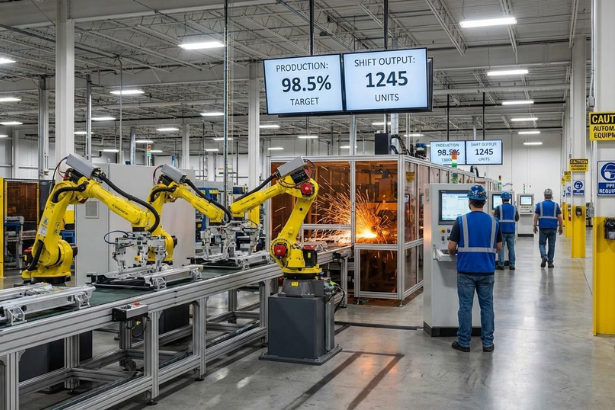
Industrial AI in manufacturing is becoming an important part of the conversation about factory productivity, quality control, and competitiveness in the United States.
For years, manufacturers have invested in automation to improve production speed, reduce repetitive work, and make operations more consistent. Artificial intelligence introduces another layer of capability. Instead of following only predefined instructions, AI-enabled systems can analyze production data, identify unusual patterns, assist with inspections, and help workers make better-informed decisions.
The opportunity is significant, but the transition is not as simple as installing new software.
Factories operate with a mixture of modern equipment, legacy machinery, specialized control systems, and processes developed over decades. An AI system must work within these conditions while meeting strict requirements for reliability, safety, quality, and uptime.
Recent developments illustrate the direction of the industry. Manufacturing.net reported in September 2026 that the U.S. Department of Commerce’s National Institute of Standards and Technology awarded more than $30 million to support 12 Manufacturing Extension Partnership centers helping small and medium-sized manufacturers adopt advanced technologies, including AI, robotics, automation, and additive manufacturing.
At the same time, the publication’s October 2026 coverage highlighted developments in physical AI, factory automation, and industrial technology.
These developments point to a central question for manufacturers: how can AI deliver practical value without introducing unnecessary complexity or operational risk?
The answer begins with understanding where the technology works, what implementation requires, and how businesses should measure success.
Background and Context: Why Industrial AI Matters Now
Manufacturing has always depended on information.
Operators monitor machine conditions. Engineers analyze production tolerances. Quality teams investigate defects. Maintenance technicians interpret equipment behavior. Plant managers balance output, labor, inventory, and delivery commitments.
Much of this work involves identifying patterns and deciding what to do next.
Traditional automation excels at repeating established processes. Industrial AI can complement that automation by helping interpret complex data and identify conditions that may require attention.
For example, a conventional inspection system might flag a component when a measurement exceeds a predefined threshold. An AI-assisted system may analyze images, historical defect patterns, and process information to identify more complicated variations.
Similarly, a maintenance team might traditionally service equipment according to a fixed schedule. An AI-based predictive maintenance system can analyze vibration, temperature, operating cycles, and other signals to help identify possible equipment problems before a failure occurs.
These capabilities do not eliminate the need for experienced workers. Instead, they can help workers focus attention where it is most useful.
From Traditional Automation to Intelligent Operations
Traditional factory automation generally follows predefined instructions and control logic.
Industrial AI adds analytical capabilities that can help systems respond to changing conditions.
The distinction matters because manufacturers do not necessarily need to replace their existing equipment to benefit from AI.
In some facilities, a practical starting point is to collect information from existing machines, improve visibility into production performance, and introduce AI for a specific task.
This approach can be more manageable than attempting a complete factory transformation.
The U.S. Manufacturing Challenge
American manufacturers face a combination of operational pressures, including labor availability, quality expectations, equipment costs, supply chain uncertainty, and competition from international producers.
Small and medium-sized manufacturers can face additional constraints. They may lack dedicated AI teams, large technology budgets, or the internal expertise needed to evaluate complex systems.
Federal support for manufacturing technology adoption reflects the importance of helping these businesses access modern capabilities.
The September 2026 NIST Manufacturing Extension Partnership funding announcement is one example of efforts to expand access to advanced manufacturing technologies.
For manufacturers, the practical question is not whether AI is attracting attention. It is whether a specific application can improve an existing operation enough to justify its cost and complexity.
Latest Developments: AI Moves Closer to the Factory Floor
Several developments illustrate how industrial AI is evolving.
1. Federal Support for Advanced Manufacturing Technology
In September 2026, Manufacturing.net reported that NIST awarded more than $30 million to support 12 Manufacturing Extension Partnership centers across the United States and Puerto Rico.
The funding was intended to help small and medium-sized manufacturers adopt technologies such as AI, robotics, automation, and additive manufacturing.
This matters because smaller manufacturers often operate with tighter investment budgets than major industrial companies.
Access to technical assistance can help them assess potential applications, prepare their operations, and make more informed technology decisions.
2. Investment in Physical AI
Physical AI describes AI capabilities that interact with the physical world through robotics, sensing, perception, and automated systems.
Manufacturing.net reported in October 2026 that Formic raised $50 million to expand its physical AI operations in U.S. manufacturing facilities.
Developments like this reflect growing interest in bringing AI closer to actual industrial tasks rather than limiting its role to office software and data analysis.
However, investment announcements should not be confused with proof that every factory can deploy these systems economically. Performance depends on the application, equipment, operating environment, and implementation requirements.
3. Industrial AI Research Focuses on Reliability
A July 2026 research roadmap from NIST examined the evolution of AI and machine learning in smart manufacturing.
The research identifies opportunities in areas such as industrial data analytics, robotics, digital twins, logistics optimization, advanced sensing, and quality assurance.
It also highlights important barriers, including inconsistent industrial data, integration with existing sensing and control systems, and the need for trustworthy and reliable AI in high-stakes environments.
These challenges help explain why industrial AI requires a different approach from deploying a general-purpose chatbot.
A factory system must operate within established production constraints. Incorrect predictions or poorly controlled actions can affect equipment, product quality, worker safety, and delivery schedules.
The goal is not simply to introduce AI. It is to make AI dependable enough to support real operations.
Seven Industrial AI Trends Shaping U.S. Manufacturing
1. Predictive Maintenance Is Becoming More Data-Driven
Unexpected equipment failure can disrupt an entire production schedule.
When a critical machine stops, the consequences may extend beyond repair costs. Production targets can be missed, downstream processes may sit idle, and delivery commitments can be affected.
Predictive maintenance uses equipment data to help identify conditions associated with possible failures.
Depending on the machinery and application, the system may analyze:
- Vibration patterns
- Temperature changes
- Motor current
- Pressure measurements
- Operating cycles
- Maintenance history
- Production conditions
An AI model can compare incoming information with historical patterns and identify anomalies that deserve investigation.
Consider a manufacturer operating several CNC machines. If one machine begins displaying an unusual vibration pattern, an AI-assisted monitoring system could alert the maintenance team before the condition develops into a more serious problem.
The alert does not automatically prove that a failure is imminent. A technician still needs to assess the machine and determine the appropriate response.
What manufacturers should do: Start with equipment that has a meaningful history of downtime or costly failures. Establish a baseline for unplanned downtime, maintenance spending, and production interruptions before introducing the system.
The business case should be measured against actual improvements rather than the number of alerts generated.
2. AI-Powered Quality Inspection Is Expanding
Quality inspection is another promising industrial AI application.
Traditional inspection methods include manual checks, measurement instruments, and rule-based machine vision systems. These remain valuable, but some inspection tasks involve variations that are difficult to describe through simple rules.
AI-based vision systems can be trained to recognize visual patterns associated with defects.
Applications may include:
- Surface defect detection
- Component identification
- Assembly verification
- Packaging inspection
- Dimensional anomaly detection
- Detection of missing or misplaced parts
For example, a manufacturer producing metal components may use an AI-assisted vision system to flag unusual surface marks for further inspection.
The system can help inspectors review large numbers of components consistently, particularly where repetitive visual tasks create fatigue.
However, performance depends on the quality of training data, lighting conditions, camera placement, product variation, and the cost of false positives or missed defects.
A system that works well on one product may require additional training before it can reliably inspect a different product.
What manufacturers should do: Begin with one clearly defined defect category. Test the system against a representative set of known-good and defective products, then measure detection performance, false alarms, inspection time, and the need for human review.
3. Industrial Robotics Is Moving Beyond Repetitive Tasks
Robots have been used in manufacturing for decades, particularly in welding, painting, material handling, and assembly.
AI can expand their capabilities by helping robots interpret visual information, recognize objects, and adapt to variations in their environment.
This is particularly relevant for factories that handle products with changing shapes, positions, or production requirements.
AI-enabled robotic applications may support:
- Component picking
- Material handling
- Machine tending
- Assembly assistance
- Visual inspection
- Sorting and packaging
Collaborative robots, commonly called cobots, can also support certain tasks alongside human workers when the application has been properly assessed and appropriate safety measures are in place.
The key distinction is that intelligent perception does not remove the need for reliable motion control or industrial safety engineering.
A robot must still operate within defined physical limits and meet the safety requirements relevant to its installation.
What manufacturers should do: Choose a task with measurable labor, quality, or throughput constraints. Evaluate the robot’s ability to handle normal product variation, interruptions, and exceptions before expanding the deployment.
4. Digital Twins Are Connecting Factory Data With Decision-Making
A digital twin is a digital representation of a physical asset, process, or system that can be updated with relevant operational information.
In manufacturing, digital twins can help engineers explore equipment performance, production flows, and process changes without immediately modifying the physical operation.
When combined with AI, a digital twin may help evaluate alternative production scenarios or identify conditions that deserve further investigation.
For example, a plant manager considering a change to a production schedule could use a digital model to assess how that change might affect machine utilization and downstream bottlenecks.
A digital twin can also support equipment commissioning, engineering analysis, and process optimization.
However, its usefulness depends on the quality and timeliness of the underlying data.
A digital model that does not reflect actual equipment behavior may produce misleading conclusions.
What manufacturers should do: Start with a specific decision that is difficult or expensive to test in the real factory. Define which information the model requires, how frequently it must be updated, and how its predictions will be validated.
5. Connected Operations Are Becoming More Important Than Isolated AI Tools
One of the biggest obstacles to industrial AI is fragmented information.
Production data may reside in machine controllers, manufacturing execution systems, enterprise resource planning software, quality databases, and maintenance applications.
If these systems cannot share information effectively, AI tools may have only a partial view of the operation.
Connected operations aim to make relevant information accessible across the systems and teams involved in manufacturing.
For example, a quality problem may appear to be associated with one machine. Connecting production records with maintenance history and supplier information may reveal additional factors that require investigation.
This does not mean every factory needs a single platform that replaces all existing systems.
In many cases, a more practical strategy is to establish reliable data connections between a limited number of important systems.
What manufacturers should do: Identify the operational decisions that currently require employees to collect information manually from several sources. Prioritize integrations that reduce this effort or improve the speed and quality of those decisions.
6. AI Is Creating New Requirements for Industrial Cybersecurity
Connecting factory systems can improve visibility, but it also creates security considerations.
Industrial environments contain operational technology, including systems that monitor and control physical equipment.
These systems may have different reliability requirements and lifecycles from conventional office IT.
A cybersecurity incident affecting a factory can disrupt production, compromise information, or interfere with operational processes.
AI deployments can introduce additional dependencies, including data pipelines, software interfaces, cloud services, model updates, and external vendors.
Manufacturers should therefore treat security as part of implementation rather than as a final step.
Important measures include:
- Separating appropriate operational and corporate networks
- Restricting access to industrial systems
- Applying authentication and authorization controls
- Maintaining reliable backups and recovery procedures
- Monitoring relevant system activity
- Assessing the security of third-party technology
- Establishing procedures for responding to incidents
The appropriate controls depend on the factory’s architecture, equipment, operational requirements, and risk profile.
What manufacturers should do: Involve operational technology engineers, IT security specialists, plant managers, and equipment vendors before connecting AI systems to production environments.
7. Workforce Skills Are Becoming a Competitive Advantage
Industrial AI does not eliminate the need for people who understand manufacturing.
In fact, successful implementation often depends on combining technical expertise with practical knowledge of machines, materials, production processes, and quality requirements.
Operators understand how equipment behaves under different conditions. Maintenance technicians recognize unusual sounds, vibrations, and operating patterns. Quality engineers understand which defects matter most to customers.
That knowledge can help teams determine whether an AI-generated alert is useful or misleading.
New systems also create training requirements. Employees may need to learn how to interpret alerts, investigate anomalies, document decisions, and escalate problems.
The goal should be to help workers use AI effectively, not simply add another dashboard to their workload.
What manufacturers should do: Include frontline employees in the design and testing process. Identify which tasks will change, what new skills are required, and how workers can provide feedback when the system produces incorrect or unhelpful results.
How Manufacturers Can Implement Industrial AI Successfully
A successful industrial AI project begins with an operational problem, not a technology demonstration.
The following framework can help manufacturers move from experimentation to implementation.
Step 1: Identify a Measurable Business Problem
Choose a problem that matters to the operation.
Examples include excessive unplanned downtime, recurring quality defects, slow inspections, or production scheduling difficulties.
Define the current performance level before selecting a technology.
Step 2: Audit Data Availability
Determine which data is already available, how reliable it is, and whether it can be accessed safely.
Manufacturers should not assume that every machine produces usable data or that historical records are complete enough to support an AI model.
Data preparation may be a significant part of the project.
Step 3: Choose a Limited Pilot
Start with a specific machine, production line, or inspection task.
A smaller pilot makes it easier to establish accountability, evaluate performance, and identify problems before expanding the system.
Step 4: Establish Safety and Security Requirements
Identify the systems the AI solution will access and determine whether it will only provide recommendations or influence physical operations.
Applications that affect machine control require particularly careful engineering, testing, and safety review.
Step 5: Measure Results Against a Baseline
Evaluate the pilot using operational metrics.
Depending on the application, these might include:
- Unplanned downtime
- Scrap and rework
- First-pass yield
- Inspection time
- Production throughput
- Maintenance costs
- Energy consumption
- False alarms
- Operator workload
Avoid relying on vendor projections alone. Measure actual performance under representative operating conditions.
Step 6: Train Workers and Define Responsibilities
Specify who reviews alerts, who can approve changes, and who is responsible when the system produces an unexpected result.
Provide training that reflects the actual production workflow.
Step 7: Expand Only After Validation
A successful pilot does not automatically justify a plant-wide deployment.
Before expanding, confirm that the solution remains reliable under different operating conditions and that its costs are justified by the results.
Document what worked, what failed, and which assumptions need to change.
The Business Case: How to Measure Industrial AI ROI
Manufacturers should evaluate AI projects using the same commercial discipline applied to other capital investments.
A project may deliver technical improvements without generating enough financial value to justify its ongoing costs.
The following table illustrates a practical evaluation framework.
| Metric | What to Measure | Why It Matters |
|---|---|---|
| Unplanned downtime | Hours lost before and after implementation | Helps quantify equipment availability improvements |
| Scrap and rework | Defective output and associated costs | Measures quality-related savings |
| Inspection productivity | Time required per inspection | Shows whether quality teams can process work more efficiently |
| Production throughput | Units produced during comparable periods | Measures output under similar operating conditions |
| Maintenance costs | Labor, parts, and emergency repair expenses | Helps evaluate maintenance-related benefits |
| Implementation costs | Software, equipment, integration, training, and support | Captures the full investment |
| False positives | Alerts that do not correspond to actionable problems | Reveals operational disruption and unnecessary investigation |
| Payback period | Time required for realized benefits to recover the investment | Helps compare the project with alternative uses of capital |
An Illustrative ROI Example
Consider a hypothetical manufacturer evaluating an AI-assisted inspection system.
Suppose the company estimates that the system could produce the following annual benefits:
- $60,000 in reduced scrap and rework
- $30,000 in inspection labor savings
- $10,000 in other measurable operational savings
The estimated annual benefit would be $100,000.
If implementation costs $70,000 and ongoing annual operating costs total $20,000, the estimated net annual benefit would be $80,000.
Under these assumptions, the simple payback period would be approximately 10.5 months:
$70,000 initial investment divided by $80,000 annual net benefit, multiplied by 12 months.
This is an illustrative calculation, not an industry benchmark or a forecast of typical AI returns. Actual results depend on implementation costs, operational conditions, and whether the expected benefits are realized.
Manufacturers should also consider the time required for integration, employee training, model maintenance, and future software updates.
What Happens Next: The Future of Industrial AI
Industrial AI is likely to evolve through a combination of better data integration, more capable robotics, improved sensing, and stronger connections between engineering and production systems.
Three developments deserve particular attention.
More Focus on Practical Deployment
Manufacturers are likely to place greater emphasis on solutions that solve specific operational problems.
A technology that reduces inspection delays or helps prevent a costly equipment failure may be easier to justify than a broad AI initiative without clear ownership or measurable outcomes.
Greater Integration Between AI and Physical Systems
Advances in physical AI and robotics may allow machines to handle more varied tasks.
However, deployment will continue to depend on safety, repeatability, equipment integration, and the ability to manage unexpected conditions.
Stronger Emphasis on Trust and Reliability
Industrial systems operate in environments where errors can have direct physical and financial consequences.
Manufacturers will need to evaluate how AI systems handle uncertainty, how decisions can be reviewed, and how the operation can recover when a system fails.
Reliability will be as important as model capability.
Conclusion
Industrial AI in manufacturing offers U.S. factories new ways to improve quality, maintenance, production visibility, and automation.
The strongest opportunities are not necessarily the most futuristic ones. They are the applications that solve identifiable operational problems, work with existing production systems, and produce measurable benefits.
Predictive maintenance can help identify equipment conditions that deserve attention. AI-powered inspection can support quality teams. Intelligent robotics can extend automation to more variable tasks. Connected operations can help workers make decisions using better information.
But successful implementation requires more than purchasing software.
Manufacturers need reliable data, clearly defined responsibilities, cybersecurity controls, workforce training, and realistic performance measurements.
For small and medium-sized manufacturers in particular, a carefully selected pilot may provide a more practical starting point than an expensive, company-wide transformation.
The central lesson is straightforward: industrial AI creates value when it improves the way a factory operates.
The next stage of manufacturing innovation will depend not only on what AI can do, but also on how reliably manufacturers can put it to work.
Frequently Asked Questions
1. What is industrial AI in manufacturing?
Industrial AI in manufacturing refers to the use of artificial intelligence and machine learning to analyze production data, improve quality inspection, support maintenance, optimize operations, and assist industrial automation.
2. How are U.S. manufacturers using AI?
Applications include predictive maintenance, visual quality inspection, production analytics, robotics, process optimization, and digital twins. Adoption varies by company, industry, and application.
3. Can small manufacturers afford industrial AI?
Some applications can be introduced incrementally, particularly when they address a specific problem using existing equipment and data. Costs depend on integration requirements, hardware, software, training, and ongoing support. Manufacturers should evaluate the full cost before committing.
4. What is the difference between industrial AI and traditional automation?
Traditional automation generally follows predefined instructions and control logic. Industrial AI adds capabilities for analyzing complex information, identifying patterns, and supporting decisions. The technologies can complement each other.
5. How does predictive maintenance work?
Predictive maintenance uses equipment information, such as vibration, temperature, operating cycles, and maintenance history, to identify patterns that may indicate developing problems. Technicians investigate those signals and determine the appropriate response.
6. What role does AI play in factory quality control?
AI can analyze images and production data to identify potential defects, verify assembly steps, and flag unusual patterns. Its effectiveness depends on data quality, application design, and validation under real production conditions.
7. What are the biggest challenges of industrial AI?
Common challenges include poor data quality, integration with legacy equipment, cybersecurity, safety, implementation costs, workforce training, and demonstrating a measurable return on investment.
8. Does industrial AI replace manufacturing workers?
AI can automate certain tasks and change how employees perform their jobs, but factories still require people to maintain equipment, manage production, assess quality, handle exceptions, and make operational decisions. The impact varies by role and application.
9. How should a manufacturer start an AI project?
Start with a specific operational problem, establish a baseline, assess data availability, choose a limited pilot, define safety and security requirements, and measure the results before expanding.
10. What is the future of AI in manufacturing?
Likely areas of continued development include intelligent robotics, predictive maintenance, AI-assisted inspection, digital twins, connected production systems, and more reliable integration between AI software and physical industrial equipment.
Sources and References
- Manufacturing.net: Feds Direct $30M to Help Small Manufacturers Deploy AI, Automation. September 18, 2026. Reporting on federal support for advanced manufacturing technology adoption.
- Manufacturing.net: Formic Raises $50 Million to Scale Physical AI Across U.S. Manufacturing. October 23, 2026. Reporting on investment in physical AI and U.S. manufacturing operations.
- National Institute of Standards and Technology: 2026 Roadmap on Artificial Intelligence and Machine Learning for Smart Manufacturing. July 3, 2026. Research on industrial AI opportunities, integration, and reliability.
- Manufacturing.net: 3 Biggest Hurdles in Bringing AI to Factory Floor and How to Overcome Them. April 2, 2026. Coverage of industrial AI deployment challenges.
- Manufacturing.net: Why the Next Manufacturing AI Breakthrough Is Connected Operations. October 9, 2026. Industry analysis of connected manufacturing systems.