Introduction
The Huawei MatePad Air 2026 has officially launched in Malaysia, bringing a 12-inch OLED display, a new Kirin T93C processor and a suite of AI-powered productivity features to a tablet that weighs just 509 grams.
Huawei’s Malaysian launch price is RM3,999 for an 8GB RAM and 256GB storage configuration. The company is also offering launch incentives worth up to RM4,503, including an early-bird rebate and accessories.
The timing is interesting because the tablet market is increasingly trying to blur the line between a traditional tablet and a lightweight laptop. Huawei’s pitch is straightforward: give users a large OLED display, keyboard and stylus support, desktop-style productivity software and AI tools, then keep the whole package light enough to carry around all day.
The supplied Google Trends screenshot shows a sharp jump in searches for “phonearena”, coinciding with the publication of PhoneArena’s hands-on review of the new tablet.
Background and Context
Huawei unveiled the MatePad Air during its July 14, 2026 flagship product launch in Kuala Lumpur, alongside other products including the Pura 90 series and FreeClip 2 S.
The Malaysian launch now gives the tablet a concrete price and retail proposition.
The MatePad Air is built around a 12-inch OLED panel with a 2800 x 1840 resolution. The display supports up to a 144Hz refresh rate, while Huawei’s PaperMatte treatment is designed to reduce reflections and make the surface more comfortable for reading and handwriting. PhoneArena’s testing measured peak brightness at 797 nits at full-screen output, while The Star reports a peak figure of up to 1,200 nits under Huawei’s specified conditions.
That combination puts the screen at the center of the product.
Huawei is not positioning the MatePad Air simply as a video-consumption tablet. It wants the display to function as a workspace for writing, drawing, reading, presentations and AI-assisted productivity.
Latest Update: Huawei MatePad Air 2026 Arrives in Malaysia
The Malaysian launch gives the Huawei MatePad Air 2026 a single configuration: 8GB of RAM and 256GB of internal storage for RM3,999.
The tablet comes in Sakura Pink, Airy Blue and White. Huawei’s launch promotion includes a RM500 early-bird rebate voucher, an M-Pencil Pro, Smart Magnetic Keyboard and wireless mouse, among other benefits. The Star reports that the combined value of the launch freebies can reach RM4,503, although Huawei has not specified when the promotion will end.
That bundle matters.
At RM3,999, the MatePad Air is not competing purely on tablet price. Huawei is effectively selling a lightweight productivity setup that can include the keyboard, stylus and mouse.
The more interesting question is whether that setup can genuinely replace a laptop for enough users.
The 509-Gram Hardware Pitch
The physical design is arguably the strongest part of the MatePad Air story.
PhoneArena measured the tablet at 5.3mm thick and 509 grams, giving it a remarkably low weight for a 12-inch device. Its review praised the thin, lightweight construction and the pearlescent finish on the rear, which it found more comfortable to hold than bare metal.
SoyaCincau, in a Huawei-sponsored article, similarly emphasizes portability. It reports that the tablet weighs 509 grams and that the tablet-plus-keyboard combination reaches 817 grams.
That puts the MatePad Air in an interesting middle ground.
A conventional laptop can offer more computing flexibility, but it also tends to demand more space and weight. A smaller tablet is easier to carry but can compromise screen size and typing comfort.
Huawei is trying to sit directly between those two categories.
The OLED Display Is More Than a Spec Sheet Number
The 12-inch OLED panel is one of the biggest upgrades highlighted by PhoneArena.
The reviewer notes that Huawei has moved from the previous generation’s IPS LCD to OLED, while retaining the PaperMatte option. The matte treatment is particularly suited to handwriting and drawing because the surface provides a more paper-like feel and reduces distracting reflections.
The display specifications include:
- 12-inch OLED panel
- 2800 x 1840 resolution
- Up to 144Hz refresh rate
- PaperMatte anti-glare treatment
- Up to 1,200 nits peak brightness according to Huawei’s launch specifications
- 4.69mm bezels
- 92% screen-to-body ratio according to Huawei-sponsored product material
This makes the device particularly interesting for people who spend more time reading and writing than watching video.
A glossy OLED display can look spectacular.
A good matte display can be more useful.
That distinction matters on a productivity tablet.
Performance: Kirin T93C Moves the Air Forward
Under the hood is Huawei’s Kirin T93C, a 7nm chip that PhoneArena describes as a meaningful improvement over the previous T92 generation. Its testing recorded Geekbench 7 scores of 1,102 for single-core performance and 4,347 for multi-core performance.
PhoneArena also measured 3DMark Wild Life Extreme scores of 2,159 in the high test and 1,923 in the low test. The reviewer’s conclusion was that the chip is not competitive with the fastest Apple M-series or Qualcomm Snapdragon processors, but is more than capable for everyday tablet workloads.
That is an important distinction.
Huawei is not trying to claim workstation-class processing power here.
Instead, the MatePad Air appears designed around a different calculation: if the tablet is fast enough for documents, multitasking, note-taking, drawing, browsing and media, then reducing weight may matter more to the target customer than chasing benchmark records.
AI Is Becoming the Tablet’s Productivity Layer
The Huawei MatePad Air 2026 also arrives at a time when manufacturers are turning AI from a headline feature into a layer across everyday software.
Huawei’s Notes application can perform speech-to-text transcription and clean up handwritten notes. The company also promotes AI features for organizing and improving written material.
SoyaCincau’s Huawei-sponsored coverage goes further, highlighting WPS AI Office features such as AI Summarizer, AI-generated slides and an AI Sheet Assistant for charts and data analysis. It also describes AI Tutor functionality within Huawei Notes.
Because that article is sponsored by Huawei, those claims should be read as product-positioning information rather than independent testing.
Still, the direction is clear.
The tablet is increasingly being designed around what software can do for the user, rather than simply how much silicon sits underneath the screen.
Expert Insights: Why the Lightweight Design Matters
PhoneArena’s two-week review provides the most useful independent perspective among the supplied sources.
The reviewer gave the MatePad Air an overall score of 7 out of 10, with its strongest category being design at 8.4. Audio also scored highly at 9, while software received 4, reflecting the reviewer’s concerns around Google’s services and Huawei’s software-update record.
That tells us something important about the product.
The MatePad Air’s appeal is not primarily raw performance.
It is the combination of:
- Low weight
- Thin construction
- Large OLED display
- Strong stylus experience
- Keyboard support
- Useful speakers
- Fast charging
- AI-assisted productivity
The weaknesses are equally important.
Huawei does not provide official Google services on the tablet, and PhoneArena notes that getting Google accounts working through solutions such as GBox or microG requires additional configuration. The reviewer also criticizes Huawei’s history of relatively infrequent software updates.
For some buyers, those limitations will matter more than the weight savings.
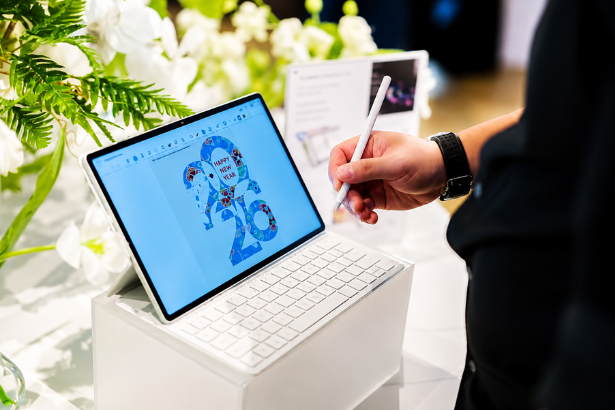
Keyboard and Stylus Turn It Into a Different Kind of Computer
The keyboard accessory is deliberately simple.
PhoneArena notes that the magnetic keyboard folio does not include a trackpad. That keeps the overall setup lighter, while still providing a usable typing surface. The reviewer found the keyboard spacious, relatively quiet and easy to position using its magnetic attachment.
The M-Pencil 3 is another major part of the experience.
PhoneArena found handwriting to be particularly pleasant on the PaperMatte display and reported no noticeable latency during its testing.
That makes the MatePad Air more than a conventional tablet for media consumption.
It becomes a digital notebook, sketchpad and lightweight workstation.
For students, designers, writers and people who spend much of their day in meetings, that combination could be more valuable than having the fastest processor available.
Battery Life and Charging
The MatePad Air packs a 10,100mAh battery and supports 66W wired charging.
PhoneArena’s battery testing produced an estimated overall battery score of 5 hours and 9 minutes, with 10 hours and 23 minutes of browsing, 7 hours and 31 minutes of video playback and 9 hours and 19 minutes of gaming. A full charge took about 1 hour and 29 minutes in its measurements.
Those results are not class-leading across every category.
But they are respectable for a 5.3mm-thick tablet.
The trade-off becomes easier to understand when the battery is considered alongside the weight. Huawei has packed a 10,100mAh battery into a device that weighs just 509 grams.
Broader Implications
The Tablet Is Becoming a Laptop Alternative, Not Just a Laptop Companion
The Huawei MatePad Air 2026 reflects a broader change in the tablet market.
For years, tablets were largely positioned as secondary screens. Today, manufacturers are increasingly trying to make them primary computing devices for lighter workloads.
That means keyboards, desktop-style office applications, multitasking, stylus input and AI assistants are no longer optional extras in the marketing story.
They are the story.
Huawei’s use of WPS Office, Huawei Notes, GoPaint and AI features shows how manufacturers are building software ecosystems around this new role.
The challenge is that tablets still live in an awkward space between mobile and desktop operating systems.
Huawei’s HarmonyOS provides the foundation, but the lack of official Google services remains a major consideration for international users.
Weight Could Become the New Performance Metric
There is also a subtle hardware trend here.
The MatePad Air is not the fastest tablet on the market. PhoneArena explicitly notes that its 7nm Kirin T93C cannot compete with the fastest Apple M-series and Qualcomm Snapdragon processors.
Yet the product can still make a strong case because it is so light.
For many real-world tasks, carrying 509 grams instead of a heavier laptop may have a bigger daily impact than shaving seconds from a rendering task.
That is an increasingly interesting trade-off as tablets become capable enough for mainstream productivity.
For related coverage of emerging devices, AI hardware and consumer technology, an internal link suggestion is The Tech Marketer’s technology section at thetechmarketer.com.
Related History or Comparable Technologies
The MatePad Air sits in a crowded premium-tablet category alongside Apple’s iPad Air and iPad Pro lines and Samsung’s Galaxy Tab family.
Its strategy is somewhat different.
Rather than winning primarily through processor performance, Huawei emphasizes portability, OLED display quality, handwriting and a PC-like accessory ecosystem.
The 509-gram weight is particularly notable when paired with a 12-inch display. PhoneArena’s specifications list the device at 270 x 183 x 5.3mm and 509 grams.
Huawei is also pushing the idea that a tablet can handle increasingly sophisticated office tasks.
That includes document editing, presentations, spreadsheets, note-taking and creative work.
The result is less “tablet replacing your laptop” and more “tablet taking over the parts of laptop computing that you perform most often.”
That is a much more realistic proposition.
What Happens Next
The immediate test for the MatePad Air will be whether Malaysian buyers see enough value in the RM3,999 price.
The launch bundle could make the proposition more attractive because Huawei is including or offering accessories and services with a combined stated value of up to RM4,503.
But the long-term question is software.
Hardware is no longer the obvious weakness.
The MatePad Air has a good display, capable everyday performance, strong audio, fast charging and an unusually portable design.
The harder problem is whether HarmonyOS and Huawei’s app ecosystem can deliver everything a productivity-focused customer expects.
That becomes especially important for buyers accustomed to Google’s ecosystem.
If Huawei can continue improving its software ecosystem while maintaining this level of hardware portability, the MatePad Air becomes a more credible laptop alternative.
Conclusion
The Huawei MatePad Air 2026 is an interesting tablet because its biggest advantage is not a benchmark number.
It is the fact that Huawei has put a 12-inch OLED display, a 10,100mAh battery, keyboard support, stylus input and a relatively capable Kirin T93C processor into a device measuring just 5.3mm thick and weighing 509 grams.
In Malaysia, the tablet launches at RM3,999 with 8GB of RAM and 256GB of storage, while launch offers can add substantial accessory value.
The independent review picture is encouraging on hardware, especially design, audio, writing and everyday responsiveness.
But Huawei’s lack of official Google services and relatively limited software-update history remain significant caveats.
That leaves the MatePad Air with a clear identity.
It is not trying to be the world’s most powerful tablet.
It is trying to be the tablet you actually want to carry.
And at 509 grams, that argument is surprisingly convincing.
FAQ
What is the Huawei MatePad Air 2026 price in Malaysia?
The Huawei MatePad Air 2026 is priced at RM3,999 in Malaysia for the 8GB RAM and 256GB storage configuration.
How much does the Huawei MatePad Air 2026 weigh?
The tablet weighs 509 grams and measures 5.3mm thick, according to PhoneArena’s specifications and testing.
What display does the MatePad Air 2026 have?
It has a 12-inch OLED display with a 2800 x 1840 resolution and support for refresh rates up to 144Hz. Huawei also offers its PaperMatte anti-glare treatment.
Does the MatePad Air 2026 support AI?
Yes. Huawei promotes AI features through apps including Huawei Notes and WPS AI Office. Features include speech-to-text, handwriting enhancement, document summarization and AI-assisted productivity tools.
What processor does the MatePad Air 2026 use?
The tablet uses Huawei’s Kirin T93C processor. PhoneArena’s testing recorded Geekbench 7 scores of 1,102 single-core and 4,347 multi-core.
Does the MatePad Air 2026 have Google services?
No. PhoneArena notes that the tablet does not include official Google services. The reviewer says third-party solutions such as GBox and microG can require additional setup.
How good is the MatePad Air 2026 battery?
The tablet has a 10,100mAh battery and 66W charging. PhoneArena measured 10 hours and 23 minutes of browsing, 7 hours and 31 minutes of video playback and 9 hours and 19 minutes of gaming.
Is the MatePad Air 2026 good for productivity?
The supplied sources suggest it is well suited to lightweight productivity, particularly note-taking, writing, presentations and drawing. The keyboard, M-Pencil support and AI features reinforce that positioning. However, software compatibility should be considered carefully by users who rely heavily on Google’s ecosystem.
Sources & References
- PhoneArena, “Huawei MatePad Air 2026 Review: A super-likable lightweight tablet”
PhoneArena review - The Star, “Huawei launches MatePad Air at RM3,999 with a 12in OLED screen”
The Star report - SoyaCincau, “Is This 509g Device the Lightest AI Productivity Tablet for Work and Study?”
SoyaCincau article - Huawei, “HUAWEI Flagship Product Launch 2026”
Huawei launch page