Introduction
The debate over high speed rail in the United States has suddenly become much louder. A recent CNN report examining America’s rail problem has put Brightline back at the center of the conversation, after the private rail company filed for bankruptcy while continuing to operate its Florida service and pursue its planned Las Vegas-to-Southern California project. KTVZ
The timing is striking.
The United States is spending billions to modernize passenger rail, Amtrak is introducing faster trains, and Brightline West is being developed as a potential breakthrough for genuinely high-speed passenger service. Yet the country still lacks a nationwide high-speed rail network comparable with those in Japan, France or China.
The problem is not simply that Americans prefer cars.
It is a combination of geography, infrastructure, financing, political priorities, legacy railroad networks and a difficult economic equation. And Brightline’s experience illustrates just how hard it is to make the private-sector model work on its own.
Background and Context
For much of the 20th century, American railroads were central to the country’s economic expansion. Passenger rail, however, gradually lost ground as highways and commercial aviation became the dominant ways to move people across long distances.
That historical shift created a structural problem that still exists today.
High-speed rail requires more than fast trains. It requires dedicated tracks, grade separations, electrification, signaling systems, stations, maintenance facilities and enough passengers to make the enormous upfront investment worthwhile.
In countries such as Japan and France, governments made sustained investments in those systems.
The United States largely built a different transportation architecture.
Interstate highways connected metropolitan areas, while aviation became the preferred option for longer trips. The result was a rail network that often has to share tracks with freight trains, limiting passenger speeds and reliability.
As rail analyst Lou Thompson told CNN, foreign governments wanted high-speed rail and were willing to finance it, while the United States did not consistently make the same commitment. KTVZ
IndexBox’s recent analysis reaches a similar conclusion, pointing to inadequate government funding as one of the central obstacles, alongside America’s car-oriented transportation culture and enormous geography. IndexBox
Latest Update: Brightline Puts America’s Rail Problem Back in the Spotlight
Brightline was supposed to demonstrate that private investment could create a modern passenger rail business in the United States.
Its Florida operation connects Miami and Orlando, with intermediate stations including Fort Lauderdale, Boca Raton and West Palm Beach. The service was designed around a relatively simple proposition: target heavily traveled corridors where driving is unpleasant and flying is inefficient.
That concept remains attractive.
But according to the CNN report published October 4, Brightline filed for bankruptcy protection after generating insufficient revenue to meet its debt obligations. The Florida operation continues, and the company is still pursuing its proposed high-speed connection between Las Vegas and Southern California. KTVZ
That distinction matters.
Brightline’s bankruptcy does not mean passenger rail has stopped working in Florida. It also does not automatically mean Brightline West is cancelled.
Instead, it raises a harder question: how much capital can a private rail operator reasonably carry before government support becomes essential?
Brightline’s Florida service has shown there is demand for faster intercity rail. CNN reported that the company carried approximately 1.8 million passengers in the second quarter, up 16% from a year earlier. KTVZ
Yet passenger numbers alone do not solve the enormous capital costs involved in building new rail infrastructure.
That is the central tension in America’s rail experiment.
Read the CNN report on why high-speed rail struggles in the United States
What Counts as High-Speed Rail?
Part of the American rail debate is complicated by terminology.
The United States already has trains capable of relatively high speeds.
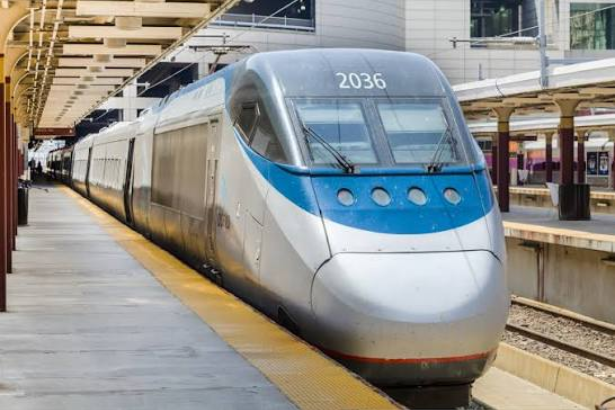
Amtrak’s new NextGen Acela trains can reach up to approximately 160 mph, or 257 km/h, under the right conditions. But the trains cannot sustain that speed across the Northeast Corridor because the infrastructure itself imposes limitations. CNN notes that the maximum speed is achieved only on limited sections of the route. KTVZ
Brightline’s Florida trains can reach approximately 125 mph, or 200 km/h, but again, only on a portion of the route. KTVZ
That is very different from a dedicated high-speed railway.
Japan’s Shinkansen, France’s TGV and China’s high-speed network were designed around dedicated infrastructure capable of supporting high-speed operations over substantial distances.
The difference is important because simply purchasing faster trains does not transform an existing railroad into a high-speed system.
The tracks have to be designed for it.
The signaling has to be designed for it.
Curves, crossings, bridges, power systems and station approaches all have to accommodate it.
That is why building high-speed rail is fundamentally an infrastructure project rather than merely a train procurement project.
Why High Speed Rail in the United States Is So Difficult
1. America’s geography works against the economics
The United States is enormous.
That sounds obvious, but it has major implications for rail.
High-speed trains are particularly competitive when they connect large population centers within a few hundred miles of each other. Once distances become substantially longer, aviation becomes increasingly difficult to beat on total travel time.
Lou Thompson told CNN that around 400 miles is a critical range where high-speed rail begins facing stronger competition from air travel. KTVZ
Europe and Japan have dense clusters of major cities that fit neatly into high-speed rail corridors.
The United States has some promising corridors, but the population is spread across a much larger landmass.
That makes route selection crucial.
Los Angeles to San Francisco makes sense.
Boston to New York to Washington makes sense.
Las Vegas to Southern California makes sense.
But a nationwide network connecting every major American city would be much harder to justify economically.
2. America already built another transportation system
The United States spent generations investing in highways and aviation.
Those investments created an enormous installed base.
Cars are everywhere.
Roads reach almost every community.
Airports connect distant cities.
Parking infrastructure is ubiquitous.
Consumers have built their lives around that system.
High-speed rail therefore isn’t competing against an empty space. It is competing against transportation networks that have been developed for decades.
IndexBox’s analysis argues that America’s automobile culture is part of the explanation, but it also emphasizes the historical role of government investment and competing commercial interests. IndexBox
The implication is significant.
Americans do not necessarily have to dislike trains for high-speed rail to struggle.
The train has to be dramatically useful.
3. Existing tracks are not enough
One of America’s biggest rail disadvantages is that much of the passenger network operates on infrastructure that was not designed for modern high-speed service.
Freight railroads remain a crucial part of the U.S. transportation system.
That creates conflicts over capacity, scheduling and infrastructure.
A high-speed passenger train cannot simply run at 200 mph through a network optimized around slower freight movements.
Dedicated infrastructure is expensive, but without it, the promise of high-speed rail becomes difficult to deliver.
4. The upfront investment is enormous
This is perhaps the biggest obstacle.
A high-speed railway requires billions of dollars before it carries its first passenger.
Brightline West illustrates the scale.
The planned route between Las Vegas and Rancho Cucamonga will stretch approximately 218 miles. The company says trains will be capable of speeds up to 200 mph, with an expected journey time of roughly two hours. Brightline West
The U.S. Department of Transportation previously approved $2.5 billion in private activity bond authority for the project. The agency described the project as a $12 billion development connecting Southern California and Las Vegas. Department of Transportation
The federal government’s Build America Bureau pipeline has also listed a potential $6 billion RRIF direct loan for Brightline West, against a reported project cost of approximately $21.05 billion in the 2025 pipeline document. Department of Transportation
The numbers show why private financing alone can be difficult.
A rail operator has to spend enormous amounts of money on infrastructure long before passenger revenue reaches maturity.
Brightline West Is the Test Case to Watch
Despite the financial troubles surrounding Brightline’s Florida operation, Brightline West remains one of the most closely watched transportation projects in America.
The proposed route would run from Las Vegas to Rancho Cucamonga, with stations planned for Las Vegas, Apple Valley, Hesperia and Rancho Cucamonga. Most of the alignment is planned within the Interstate 15 corridor. Brightline West
Brightline says the service could carry approximately 9 million one-way passengers annually and eliminate hundreds of millions of vehicle miles traveled each year. Those are company projections, not independent forecasts. Brightline West
The route also has a natural transportation advantage.
The Los Angeles-Las Vegas corridor generates tens of millions of trips annually, and most are made by car. Brightline believes a two-hour rail journey could capture a meaningful share of that market. Brightline West
If that happens, the project could become more than a transportation link.
It could become proof that Americans will choose high-speed rail when the service is fast enough, frequent enough and convenient enough.
That would be a powerful demonstration effect.
Amtrak Is Quietly Building a Different Future
The private Brightline story tends to dominate headlines, but Amtrak is pursuing a broader modernization strategy.
In July 2026, Amtrak said 13 NextGen Acela trainsets were already in service, supporting 32 weekday NextGen Acela trips. The company said additional trainsets would allow it to expand capacity and schedule flexibility. Amtrak Media
Amtrak was also awarded nearly $3 billion in federal grants in August 2026 for projects involving new trains and improvements to state-supported and long-distance services. Amtrak Media
And in September, Amtrak announced the creation of a System Expansion Committee focused on new routes, additional frequencies and strategic investments across the national passenger rail network. Amtrak Media
That suggests America’s rail future may not arrive as one giant national high-speed network.
It could emerge corridor by corridor.
The Northeast could become faster.
California could eventually develop portions of its planned high-speed system.
Brightline West could establish a new model in the Southwest.
Other regional corridors could follow if the economics work.
Expert Insights and Analysis
The most important lesson from the current debate is that high-speed rail is a system, not a vehicle.
Buying a train capable of 200 mph does not create a 200-mph railway.
The track must support those speeds. Signals must support them. Stations need to handle passenger volumes. Maintenance systems need to keep the railway operating safely. And the route needs enough demand to justify the investment.
That is why Thompson’s argument about public funding is so important.
High-speed rail generates benefits that do not necessarily appear on a train operator’s balance sheet.
Fewer cars can mean less congestion.
Electrified trains can reduce emissions compared with some alternatives.
Rail stations can concentrate development.
A reliable rail connection can change how people live and work.
Those benefits can accrue to society even when ticket revenue alone cannot cover the entire infrastructure investment.
As Thompson told CNN, some of high-speed rail’s value comes from public benefits such as lower pollution, reduced noise, safety and land-use advantages. KTVZ
That creates a policy problem that private companies alone cannot easily solve.
Broader Implications
The U.S. does not necessarily need a nationwide bullet-train network
One misconception is that America must immediately replicate China’s enormous high-speed rail system.
It doesn’t.
A more realistic strategy may be to identify corridors where rail has the strongest competitive advantage.
Consider the basic equation:
Short enough to make rail competitive with flying.
Long enough that driving is inconvenient.
Dense enough to generate large passenger volumes.
Expensive enough in road and airport congestion that travelers have a reason to switch.
That is exactly the type of market Brightline has targeted.
Infrastructure can create its own demand
There is another important lesson.
Passenger rail is often judged by current ridership before the infrastructure has had time to mature.
But transportation systems can create new economic activity.
A station can become a development hub.
A reliable rail connection can change where businesses locate.
A two-hour journey can make a weekend trip possible without a car.
A three-hour city-to-city journey can make rail competitive with the total airport experience.
That means evaluating rail solely on current ticket revenue can miss some of the wider economic effects.
Internal link suggestion: Add an internal link here to The Tech Marketer’s future coverage of transportation technology, smart infrastructure and mobility innovation at The Tech Marketer.
America may be entering a corridor-by-corridor rail era
The most realistic future may not resemble Europe or Japan exactly.
Instead, the U.S. could develop a collection of high-performance corridors.
The Northeast could continue upgrading.
California could eventually deliver parts of its long-planned system.
Brightline West could connect Las Vegas with Southern California.
Other metropolitan regions could develop medium-speed and higher-speed services where demand supports them.
The result would be less like a single national railroad and more like a network of strategically selected transportation corridors.
Related History and Comparable Technologies
America’s current struggle looks unusual only when compared with countries that made different infrastructure choices.
Japan’s Shinkansen demonstrated decades ago that high-speed rail could become an integral part of a modern economy.
France built the TGV around dedicated high-speed infrastructure.
China went much further, constructing the world’s largest high-speed rail network through sustained state investment.
Morocco has also demonstrated that high-speed rail is not limited to the world’s richest countries.
IndexBox highlights this international contrast, noting that high-speed passenger rail is widespread across countries including Japan, France, China and Morocco, while the United States remains an outlier. IndexBox
The U.S. case is therefore less about technological inability.
America can build fast trains.
The challenge is building the infrastructure and financing model around them.
What Happens Next?
The next few years will be unusually important.
Brightline West
Brightline West remains the most visible private high-speed rail experiment in the country.
The company says construction will produce more than 10,000 union jobs and eventually support approximately 800 permanent operations and maintenance positions. Brightline West
If the route opens successfully and attracts large numbers of travelers, it could provide evidence that high-speed rail can work commercially on the right U.S. corridor.
NextGen Acela
Amtrak’s new trains will continue expanding across the Northeast Corridor.
The immediate goal is not to create a Japanese-style Shinkansen system. It is to extract more speed, capacity and reliability from one of America’s most important passenger rail corridors. Amtrak Media
Federal investment
Federal funding will remain critical because new rail infrastructure requires capital on a scale that ticket revenue cannot easily provide at the beginning.
The Department of Transportation announced a $5.3 billion rail investment package in August 2026 covering safety upgrades, infrastructure and new Amtrak trainsets. Department of Transportation
California
California’s high-speed rail project remains another crucial test.
Its problems demonstrate the opposite side of the American rail equation: even when government funding is available, megaprojects can face cost increases, delays, permitting challenges and political controversy.
That makes project execution just as important as funding.
Conclusion
The question is no longer whether the United States can technically build a high-speed train.
It can.
The harder question is whether America can build the infrastructure, financing structure and passenger demand needed to make high-speed rail sustainable.
Brightline’s financial troubles have exposed the difficulty of relying on private capital to carry that burden alone. At the same time, the continued development of Brightline West, the expansion of NextGen Acela and new federal rail investment show that the American passenger rail story is far from over. KTVZ
The United States probably does not need thousands of miles of high-speed track everywhere.
It needs the right tracks in the right places.
If Brightline West can turn the Las Vegas-to-Southern California corridor into a commercially successful high-speed railway, the significance could extend far beyond Nevada and California. It could demonstrate that American travelers will choose rail when the service is genuinely competitive with driving and flying.
That may be the real test for high speed rail in the United States.
Not whether America can build a fast train, but whether it can finally build a transportation system around one.
FAQ
Why has high speed rail in the United States struggled?
The biggest obstacles include high infrastructure costs, limited government funding, America’s car-oriented transportation system, geographic distances, fragmented rail infrastructure and competition from aviation. CNN’s reporting also points to the lack of sustained government support as a major historical factor. KTVZ
Does the United States have high-speed trains?
Yes, but the country does not currently have a nationwide passenger rail system comparable with major international high-speed networks. NextGen Acela trains can reach approximately 160 mph, while Brightline’s Florida trains reach about 125 mph on portions of their route. KTVZ
What is Brightline West?
Brightline West is a planned 218-mile electric high-speed passenger railway connecting Las Vegas with Rancho Cucamonga, California. The company says trains will reach up to 200 mph and make the trip in about two hours. Brightline West
Did Brightline go bankrupt?
According to CNN’s October 4 report, Brightline filed for bankruptcy protection after insufficient revenue left it unable to meet its debt obligations. Its Florida passenger operation continues, and the company says its western high-speed project remains in development. KTVZ
Can high-speed rail compete with airplanes in America?
It can on certain corridors. Rail has its strongest potential when cities are close enough for train travel to be competitive with flying but far enough apart that driving is inconvenient. The exact economics depend on travel time, frequency, fares, station locations and passenger demand.
Why doesn’t America simply copy Japan or France?
The countries have different geography, population density, infrastructure histories and transportation systems. The United States is much larger and has historically invested heavily in highways and aviation rather than building a dedicated nationwide high-speed rail network.
Is Brightline West still moving forward?
Brightline continues to describe Brightline West as an active project connecting Las Vegas and Southern California. Its official project materials say the line will use new dedicated tracks and operate at speeds of up to 200 mph. Brightline West
Could high-speed rail reduce traffic and emissions?
Potentially. Brightline West says its fully electric system is designed to reduce vehicle miles traveled and carbon emissions, although those figures are company projections rather than independent measurements. Brightline West
Sources & References
- CNN Newsource, “Why doesn’t high-speed rail work in the United States?”, October 4, 2026. Read the CNN report
- IndexBox, “Why High-Speed Rail Has Struggled in the United States,” October 4, 2026. Read the IndexBox analysis
- U.S. Department of Transportation, “U.S. Department of Transportation Approves $2.5 Billion Private Activity Bonds Allocation for Brightline West Project.” Read the USDOT announcement
- Amtrak, “NextGen Acela Fleet Continues to Grow,” July 6, 2026. Read the Amtrak update
- Brightline West, “Project Overview.” View the Brightline West project details
- Amtrak, “Amtrak Awarded Nearly $3B in USDOT Grants to Buy New Trains and Improve Service Nationwide,” August 14, 2026. Read the Amtrak announcement