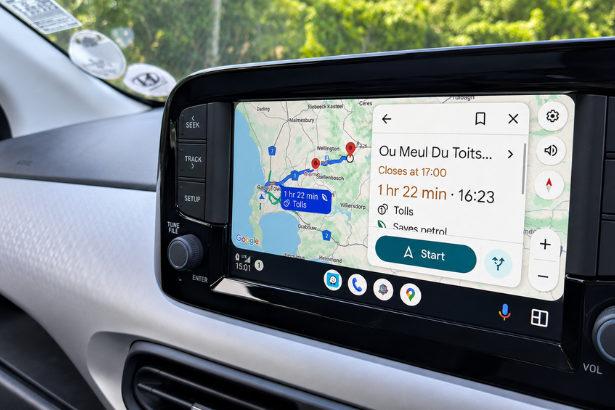
Google Maps Immersive Navigation Android Auto 2026 is finally beginning to reach drivers after months of being restricted to native phone interfaces. Google announced Immersive Navigation in March 2026 and has been rolling it out on iOS and Android phones since then, but Android Auto users, who interact with Google Maps through their car’s display rather than their phone screen, were left waiting. That wait appears to be ending. Users on Reddit’s r/AndroidAuto community began reporting the new 3D navigation interface appearing in Android Auto following the release of Android Auto v17.3, with screenshots confirming the full Immersive Navigation experience including 3D buildings, individual trees, easy-to-spot flyovers, and off-ramps rendering accurately on car displays. Google has not made an official announcement about the Android Auto rollout, and the update appears to be a server-side deployment rather than a version-locked feature, meaning not every user who updates to v17.3 will see it immediately.
What Immersive Navigation Actually Is
Before examining its arrival in Android Auto specifically, the feature itself requires clear explanation for drivers who have not encountered it on their phones.
At its core, Immersive Navigation is an upgrade for Google Maps that renders urban terrain in more elaborate 3D. Using Gemini models, it merges conventional navigation data with information gleaned from Street View and aerial photos, producing a navigation view that reflects what the driver is actually seeing in front of them rather than a schematic representation of streets and turns.
The practical difference is significant. The most commonly cited navigation frustration, not being sure whether to take an exit or drive underneath it on a highway interchange, is addressed directly by the feature. Three-dimensional rendering of overpasses and flyovers makes the choice visually clear in a way that a flat bird’s-eye map cannot replicate. Individual trees, crosswalks, building entrances, and other landmarks are rendered in enough detail that the navigation view resembles what the driver actually sees through the windshield, rather than an abstraction of it.
Landmark-Based Voice Instructions: The Bigger Change
The visual upgrade is meaningful, but the change to voice instructions may have more practical impact on the daily driving experience.
Alongside the 3D rendering, Google is pairing Immersive Navigation with better voice instructions that use landmarks rather than distances. Instead of “In 1 mile, exit right,” drivers will now hear something like “Go past this exit and take the next one for Duval Road.” Pocket-lint’s Roger Fingas described the specific problem this solves: “I don’t know about you, but I find it far more intuitive to navigate based on landmarks, since I can’t really picture a mile (or a kilometer) in my head.”
The landmark-based instruction approach is a direct challenge to Apple Maps, which has long offered similar contextual navigation cues in its own 3D mode. Google Immersive Navigation is clearly designed to compete with what Apple Maps offers on CarPlay, and the upgrade to voice instruction specificity brings Google Maps closer to parity on a dimension where Apple had established a meaningful experiential edge in recent years.
How the Android Auto Rollout Actually Works
The mechanics of how Immersive Navigation is reaching Android Auto users matters because it affects when any specific user will see the feature.
The new Immersive Navigation UI was spotted running on Android Auto in screenshots shared to Reddit by user radgatt. The screenshots showed the full 3D UI with easy-to-spot flyovers, 3D buildings, and even individual trees rendering correctly on a car display. The user began seeing the new UI after updating to Android Auto v17.3, which was released on July 12 and is itself rolling out incrementally.
However, Android Authority’s Akshay Gangwar noted a critical caveat: another Reddit user running the latest beta versions of both Android Auto and Google Maps confirmed that the new UI was not showing up for them despite being on a newer build. This strongly suggests the feature is tied to a Google server-side update rather than to any specific app version. That means updating to Android Auto v17.3 makes you eligible for Immersive Navigation in your car, but Google’s servers must then flip the switch to actually deliver the feature to your account.
This server-side deployment pattern is how Google has historically rolled out major Maps features, and it means the update could take days, weeks, or even longer to reach all eligible users.
Who Can Get It: Requirements and Limitations
The feature has a specific set of requirements, and geographic and hardware limitations affect who qualifies and when they will see it.
To enable Immersive Navigation on Android Auto, a user needs to be running Android Auto v17.3 and the latest version of Google Maps, and Google’s servers must have enabled the feature for their account. Beyond software requirements, Pocket-lint noted performance limitations: the feature will not run smoothly on older phones that struggle with 3D rendering, and devices without 5G connectivity may face slowdowns given the Street View and aerial imagery data the feature pulls in real time.
Geographic availability is the other major constraint. Immersive Navigation is built for urban environments, specifically major cities, and Google’s priority in the current phase is the largest American population centers. Even within the US, the feature has uneven coverage. Rural areas are not expected to receive Immersive Navigation coverage in the near term. Countries like Canada and the United Kingdom will likely be next in line, but even users in those markets may wait months for the feature to reach their specific city.
The current rollout is confirmed for the United States. Google has made no announcement about an international expansion timeline.
What About CarPlay: iPhone Users Still Waiting
The arrival of Immersive Navigation in Android Auto raises the question of when CarPlay users will see the same update, and the answer is currently uncertain.
Pocket-lint confirmed that CarPlay is not yet supported for Immersive Navigation in Google Maps. This is notable because the feature has been available on the native Google Maps iOS app for iPhone users since March 2026, but the CarPlay in-car interface remains on the older navigation rendering. Pocket-lint’s Roger Fingas suggested that Google is likely to prioritize a CarPlay update ahead of the iOS 27 and iPhone 18 launches this fall, not wanting to cede further ground to Apple Maps in the iPhone ecosystem.
The competitive dynamic here is straightforward: iPhone users who want 3D landmark-based navigation in their car currently get it from Apple Maps via CarPlay, not from Google Maps. Every month Google delays Immersive Navigation on CarPlay is another month that Apple Maps has a tangible experiential advantage for in-car navigation on iPhone.
The Google-Apple Maps Navigation Battle
The context for why Immersive Navigation matters at all is the decade-long competition between Google Maps and Apple Maps for driver preference.
Google Maps has held a significant overall advantage in map data accuracy, points of interest coverage, and real-time traffic for most of its history against Apple Maps. Apple Maps spent years being mocked for map errors and routing mistakes after its troubled 2012 launch. In recent years, however, Apple Maps has improved substantially and introduced 3D Lookaround views, detailed city mapping, and landmark-based navigation that have made it a genuinely competitive navigation option, particularly for iPhone users.
The introduction of Immersive Navigation in Google Maps represents Google’s response to that improvement. Using Gemini AI alongside Street View and aerial imagery to produce navigation visuals that match what a driver actually sees in front of them is the most technically ambitious navigation upgrade Google has shipped in the Maps product since real-time traffic became a standard feature.
Latest Update: v17.3 Released, Rollout Has Begun
The Google Maps Immersive Navigation Android Auto 2026 rollout began on July 13 following the July 12 release of Android Auto v17.3. The update is server-side, meaning not all users on v17.3 will see Immersive Navigation immediately.
Users in major U.S. cities on updated Android Auto and Google Maps versions should begin seeing the feature appear without any additional action required once Google’s servers enable it for their account. The feature works in the US on iOS, CarPlay, Android, Android Auto, and cars with Google built-in, with iOS and Android phones having had access since March 2026 and Android Auto now joining that list.
For full coverage, follow ZDNet, Android Authority, and Pocket-lint.
Broader Implications: In-Car Navigation Is Having a Moment
The Google Maps Immersive Navigation Android Auto 2026 rollout is the most visible evidence yet that in-car navigation software is entering a new competitive era driven by AI and computer vision.
The combination of Gemini AI, Street View imagery, aerial photography, and real-time rendering that powers Immersive Navigation would not have been technically feasible at acceptable latency on a phone-to-car connection a few years ago. The rollout requirement that devices need 5G connectivity for smooth performance reflects how recently this capability became mainstream. The feature is essentially bringing the visual fidelity of a gaming engine to the navigation interface inside a car, using real-world imagery rather than synthetic 3D models.
Both Google and Apple are investing heavily in this direction, and the gap between current car navigation and what was available even five years ago is dramatic. The next frontier will be extending this kind of rendering to rural and suburban environments, addressing the remaining coverage limitations that currently restrict Immersive Navigation to major urban centers.
For more technology and consumer apps coverage, visit The Tech Marketer.
What Happens Next
Google will continue expanding the server-side rollout of Immersive Navigation to more Android Auto users in US cities. Canada and the UK are the likely next geographic markets. CarPlay support for Immersive Navigation is expected ahead of the iOS 27 and iPhone 18 fall launches. Rural coverage expansion has no announced timeline. Users who want to check eligibility should ensure they are running Android Auto v17.3 and the latest Google Maps version.
FAQ
What is Google Maps Immersive Navigation for Android Auto?
Google Maps Immersive Navigation is a 3D navigation upgrade that uses Gemini AI combined with Street View and aerial imagery to render urban environments in detailed 3D on your navigation display. It shows 3D buildings, individual trees, crosswalks, overpasses, and building entrances that match what drivers actually see in front of them. It also replaces distance-based voice instructions with landmark-based guidance, such as “go past this exit and take the next one for Duval Road” instead of “in 1 mile, exit right.”
How do I get Google Maps Immersive Navigation on Android Auto?
Update your phone to Android Auto v17.3 and the latest version of Google Maps, then connect your phone to your car. However, the feature is a server-side rollout, meaning Google must enable it for your account before it appears. Not everyone on v17.3 will see it immediately. The feature is currently available only in the United States, in major cities, and may not work smoothly on older phones without 5G connectivity.
Is Google Maps Immersive Navigation available on CarPlay for iPhone users?
Not yet on CarPlay in the car interface. Immersive Navigation has been available on the native Google Maps iOS app for iPhone users since March 2026, but the CarPlay in-car interface has not yet received the update. Pocket-lint expects Google to prioritize CarPlay support ahead of Apple’s iOS 27 and iPhone 18 launches this fall to avoid ceding further ground to Apple Maps.
Why is the Immersive Navigation rollout for Android Auto slow?
Google is deploying Immersive Navigation as a server-side update rather than tying it to a specific app version. This means that even users running Android Auto v17.3 and the latest Google Maps may not see the feature until Google’s servers enable it for their account. This server-side approach allows Google to control the rollout speed and monitor performance without pushing the feature to all eligible devices simultaneously.
What cities will get Google Maps Immersive Navigation first?
Immersive Navigation is built for major urban environments and is currently rolling out across the United States, with Google prioritizing the largest American population centers. Rural areas are not expected to receive coverage in the near term. Canada and the United Kingdom are likely the next international markets. Google has made no announcement about a specific city list or international expansion timeline.
Sources and References
- ZDNet (original submission, blocked): https://www.zdnet.com/article/i-tried-google-maps-new-3d-immersive-view-for-android-auto/
- Android Authority (fully accessed): https://www.androidauthority.com/google-maps-immersive-navigation-android-auto-rollout-3686750/
- Pocket-lint (fully accessed): https://www.pocket-lint.com/android-auto-immersive-navigation/