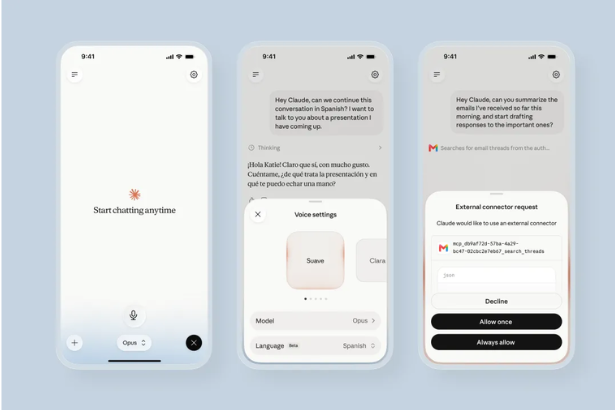
Claude voice mode just received its most significant upgrade since Anthropic launched the feature in beta. As of July 23, 2026, Anthropic has expanded voice mode beyond the Claude Haiku 4.5 model it previously ran exclusively, allowing users to route spoken conversations through Claude Opus and Claude Sonnet for the first time. The update also introduces connector support, enabling voice mode to interact with the external tools and services users have linked to their Claude accounts, and adds support for 11 languages, including the ability to switch between languages mid-conversation. For users who pay for more capable Claude models, this upgrade brings voice mode capabilities into alignment with the text-based intelligence they have always had access to in chat.
What Changed: From Haiku-Only to a Full Model Selector
Until today, Claude voice mode operated exclusively on Claude Haiku 4.5, a model that prioritizes speed and low latency over deeper reasoning. That made sense as a starting point when the feature first rolled out in beta, but it created a meaningful gap between what users could accomplish in a spoken conversation with Claude and what they could accomplish in a typed one. A user with a Claude Max or Pro subscription had access to Opus-level reasoning in text but was silently downgraded to Haiku the moment they switched to voice.
Before today, Claude voice mode only ran on Anthropic’s Haiku model, which favors instant results over deeper thought. Expanding voice mode to Claude Opus and Claude Sonnet models brings voice mode capabilities in line with Claude’s text-based intelligence. Users can now also switch between models during an active voice session, rather than having to exit and restart with a different model selected. Anthropic
The model picker exposes Opus, Sonnet, and Haiku as selectable options, with a thinking level control alongside it. That control allows users to dial up or down the depth of reasoning the model applies to a given voice request, an addition that has no equivalent in most competing voice AI products.
How Opus and Sonnet Change the Voice Experience
The practical difference between running voice mode on Haiku versus Opus or Sonnet is not subtle. Haiku is Anthropic’s fastest and lightest model, designed to produce quick responses with minimal latency. It handles simple conversational exchanges well but struggles with the kind of multi-step reasoning, tool-heavy requests, and longer analytical tasks that Opus and Sonnet handle comfortably in text.
Routing Opus or Sonnet into voice opens tasks that were awkward before, from longer reasoning to tool-heavy requests handled by speech. In testing, interruption handling held up: the model pauses the moment it hears you and resumes sensibly, and it tolerated long silences without cutting in early, so the mode stays usable despite the added intelligence. Wikipedia
That last point matters more than it might initially appear. Adding a more powerful model to a voice interface often introduces latency and awkward interruption behavior, problems that make the experience feel less natural even when the underlying intelligence improves. The fact that interruption handling held up in early testing suggests Anthropic has done meaningful engineering work to maintain conversational fluency at higher model tiers, not just swapped the model underneath an existing interface.
Connector Support: Voice Mode Meets Your Tools
The second major addition to this update is connector support. Voice mode can also work with connectors, bridging Claude chat with tools you use. Connectors are the integrations that Claude users set up to link external services, including Gmail, Google Drive, Google Calendar, and other productivity tools, to their Claude accounts. Until now, those connectors were only accessible in text-based chat sessions. Wikipedia
Bringing connector support into voice mode transforms what a spoken Claude session can accomplish. A user could now ask Claude verbally to check their calendar for open meeting slots, search their Gmail for a thread they need to reference, or pull a document from Google Drive, all without switching from voice to text. That combination of voice interaction and tool access moves Claude voice mode closer to the kind of ambient AI assistant experience that represents the long-term vision for voice AI, where the interface disappears and the assistant simply handles tasks across connected systems on request.
11 Languages and Mid-Conversation Switching
Anthropic says the upgraded Claude voice mode supports 11 languages. Users can even switch between languages when working with Claude voice mode. The full list of supported languages has not been published in all sources at time of writing, but the mid-conversation language switching capability is a technically meaningful addition. Most voice AI products require users to select a language before a session begins and restart if they want to switch. Enabling real-time language switching within a single conversation reflects both the multilingual capability of Opus and Sonnet compared to Haiku and a deliberate design choice to accommodate bilingual users and international conversations. Wikipedia
Anthropic’s Strategy: Reasoning-First, Not Speech-Native
The voice mode upgrade reflects a specific and deliberate strategic position that distinguishes Anthropic from its primary competitor in the space. Where OpenAI is pouring resources into a bidirectional, speech-native model, Anthropic is taking the opposite path, placing its strongest reasoning models on a conventional voice stack rather than chasing voice-specific tricks. Wikipedia
OpenAI’s approach with its Advanced Voice Mode centers on a speech-to-speech architecture where audio goes in and audio comes out without text as an intermediary, producing more natural prosody and emotional responsiveness but sacrificing some of the structured reasoning capability that text-based models deliver. Anthropic is making the opposite bet: that users ultimately want intelligence and accuracy from a voice assistant more than they want it to sound slightly more natural, and that placing Opus-level reasoning on a voice interface delivers more practical value than building a speech-native model from scratch.
Whether that bet proves correct will depend on how users actually engage with the upgraded voice mode over the coming months. The connector integration suggests Anthropic is building toward a task-completion use case rather than a companionship or ambient conversation one, which is a meaningful distinction in how the product will be evaluated.
How This Fits Anthropic’s Broader 2026 Product Push
The voice mode upgrade lands in the middle of one of the most active product release periods in Anthropic’s history. The company shipped Claude Sonnet 5 on June 30, 2026, followed closely by Claude Fable 5 and Claude Mythos 5, which brought Mythos-class capability to general availability for the first time. Claude Code has received continuous updates across the year, and the Cowork platform expanded to Windows and to Team and Enterprise plans in the first quarter. Voice mode was the feature most visibly lagging behind the rest of the Claude product suite, running on a model that had not been refreshed while the rest of the lineup pushed forward through multiple generations.
Today’s upgrade closes that gap. It also positions voice mode as a genuine productivity tool rather than a novelty, particularly for users who have already built connector integrations into their Claude workflow and can now access those connections by voice.
Latest Updates
Anthropic officially announced the Claude voice mode upgrade on July 23, 2026. The Verge confirmed the full scope of the update, including the addition of Opus and Sonnet model support, connector integration, and the 11-language rollout with mid-conversation language switching. 9to5Mac confirmed that users can now switch models during an active voice session and reported that connector support bridges Claude voice with external tools for the first time. Testing Catalog reported the technical detail that the model selector had been present in the voice interface for roughly three weeks but previously routed all sessions to Haiku regardless of selection, with today’s update being the first time selecting Opus or Sonnet actually routes conversations through those models.
Sources: The Verge | 9to5Mac | Testing Catalog
Broader Implications
The decision to put Opus and Sonnet behind a voice interface is a statement about where Anthropic believes AI value is created. The company is not competing with smart speakers or entertainment-focused voice products. It is building a professional AI assistant that happens to accept voice input, and the connector integration makes that positioning explicit. The gap between a voice assistant that can answer questions and one that can actually take actions inside the tools a user depends on for work is enormous in practical terms, and Anthropic has now crossed that threshold for paid subscribers.
For the broader AI voice market, Anthropic’s approach provides a meaningful alternative architecture to OpenAI’s speech-native model. Whether users prefer the intelligence and tool integration of Anthropic’s stack or the naturalness and emotional responsiveness of a speech-native system will become clearer as both products mature through the second half of 2026. For more AI and tech coverage, visit thetechmarketer.com.
3. FREQUENTLY ASKED QUESTIONS
- What is the Claude voice mode upgrade announced in July 2026?
Anthropic upgraded Claude voice mode on July 23, 2026 to support Claude Opus and Claude Sonnet models for the first time, replacing the previous Haiku-only limitation. The update also adds connector support so voice mode can interact with external tools like Gmail and Google Drive, introduces support for 11 languages, and allows users to switch models and languages during an active voice session.
- Why was Claude voice mode previously limited to Haiku?
Claude Haiku is Anthropic’s fastest and lightest model, making it the natural choice for a voice interface where low latency is critical for a natural conversational feel. However, the Haiku limitation meant users with access to more capable models like Opus and Sonnet were silently downgraded when switching to voice, creating a meaningful gap between voice and text capabilities.
- What can Claude voice mode do with connectors?
With connector support now active in voice mode, users can verbally ask Claude to access external tools and services they have linked to their Claude account, including Gmail, Google Drive, and Google Calendar. This allows voice sessions to retrieve emails, check calendars, pull documents, and perform other connected-service tasks without switching to text-based chat.
- How does Anthropic’s voice mode strategy differ from OpenAI’s?
Anthropic is placing its strongest reasoning models on a conventional voice stack, prioritizing intelligence and tool integration over speech-native naturalness. OpenAI’s Advanced Voice Mode uses a bidirectional, speech-to-speech architecture that produces more natural prosody but sacrifices some structured reasoning capability. The two represent competing bets about what users ultimately value most in a voice AI assistant.
- Which languages does the upgraded Claude voice mode support?
Anthropic confirmed the upgraded Claude voice mode supports 11 languages and allows users to switch between languages during an active voice conversation, without needing to exit and restart the session. The full list of supported languages had not been published across all sources at time of writing.
4. SOURCES AND REFERENCES
- The Verge: Anthropic Voice Mode Claude Opus Sonnet Haiku AI
- 9to5Mac: Anthropic Upgrades Claude Voice Mode With More Powerful Models
- Testing Catalog: Claude Voice Mode to Get Opus and Sonnet Model Options