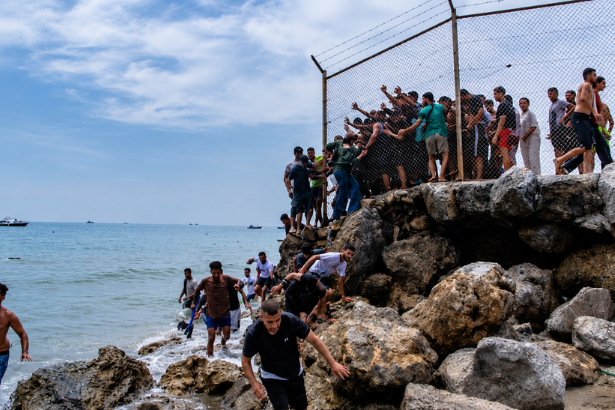
Humanitarian emergency unfolds as one of Europe’s busiest border crossings faces its largest migration surge in years.
The Ceuta migrant crisis has become one of Europe’s biggest breaking news stories after tens of thousands of migrants attempted to enter the Spanish enclave of Ceuta from Morocco. Authorities confirmed multiple fatalities during the unprecedented surge, while Spain and Morocco rapidly reinforced security along the European Union’s southern land border.
Background and Context
Ceuta is a Spanish autonomous city located on the northern coast of Africa. Together with Melilla, it forms the European Union’s only land border with Africa.
The enclave has long served as a gateway for migrants seeking entry into Europe, but the scale of this week’s crossings has exceeded previous incidents. Local authorities described reception facilities as overwhelmed, with emergency services struggling to process arrivals.
Latest News
According to Reuters, approximately 49,000 migrants attempted to cross into Ceuta within a single day, prompting Spain and Morocco to tighten border controls.
Officials reported at least 19 deaths, with many victims believed to have drowned or been caught in crowd crushes near the Tarajal beach crossing. Moroccan security forces deployed water cannons while Spanish authorities announced plans to accelerate deportation procedures where legally possible.
Political leaders, including Spanish Prime Minister Pedro Sánchez, traveled to Ceuta as emergency operations expanded across the enclave. Authorities have not declared a national emergency but acknowledged that local resources are under extraordinary pressure.
Why This Story Matters
Beyond the humanitarian tragedy, the crisis highlights how technology increasingly shapes border management.
Authorities rely on:
- AI-assisted surveillance systems
- Drone monitoring
- Thermal imaging cameras
- Maritime radar networks
- Digital identity verification
- Cross-border intelligence sharing
The incident is also expected to influence future European discussions on migration policy, asylum procedures, and border technology investments.
Expert Analysis
Migration experts say the scale of the crossings demonstrates how quickly migration routes can shift when legal or political conditions change.
Recent legal developments regarding migrant returns have been cited as one possible factor behind the increased movement, although officials have not confirmed a single cause for the surge. Analysts also point to economic pressures, regional instability, and long-term migration trends as contributing factors.
Broader Implications
The Ceuta crisis raises several important questions:
- Can existing EU border infrastructure handle sudden migration surges?
- Will Spain expand investment in smart border technologies?
- Could the crisis reshape European asylum policy?
- How will Spain and Morocco strengthen bilateral cooperation?
The answers could influence migration management across Europe for years.
Related History
Ceuta has experienced several major migration events over the past decade, most notably the 2021 mass crossings.
However, officials describe the current surge as one of the largest ever recorded, both in the number of attempted crossings and the humanitarian impact.
What Happens Next
Authorities are expected to:
- Continue emergency humanitarian operations.
- Increase security along the Morocco-Spain border.
- Investigate the circumstances surrounding the fatalities.
- Coordinate additional support from the European Union.
- Review migration and asylum policies in light of the crisis.
Conclusion
The Ceuta migrant crisis represents far more than a border incident. It combines humanitarian tragedy, geopolitical tensions, migration policy, and modern border technology into one of Europe’s most significant news stories this year.
As Spain and Morocco work to stabilize the situation, policymakers across Europe will likely examine whether current border systems are equipped for future migration pressures.
FAQ
What is the Ceuta migrant crisis?
It refers to the mass movement of migrants from Morocco into Spain’s North African enclave of Ceuta, resulting in a humanitarian emergency and multiple fatalities.
How many people died?
Reuters reported at least 19 deaths, while other outlets reported similar casualty figures as authorities continued recovery operations.
Where is Ceuta?
Ceuta is a Spanish autonomous city located on the northern coast of Africa and forms part of the European Union.
Why is Ceuta important?
It is one of only two European Union land borders with Africa, making it a major migration route.
What technologies are used at the border?
Spanish authorities employ surveillance cameras, drones, radar systems, thermal sensors, and digital monitoring tools to manage border security.
Sources & References
- Reuters – Spain and Morocco halt deadly rush on Spanish enclave after 49,000 cross in a day.
- Associated Press – At least 18 die after breach of border between Morocco and Spanish territory of Ceuta.
- The source links you shared:
- Express-News
- Chicago Tribune
- CNN en Español