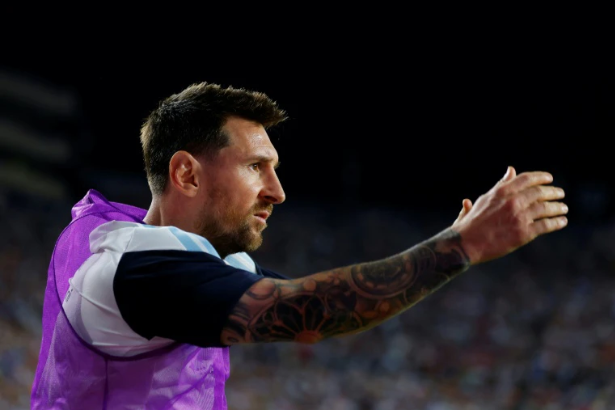
Argentina vs Iceland on June 9, 2026 ended exactly the way the world champions needed: a comfortable 3-0 victory, clean sheet, and Lionel Messi coming off the bench to convert a penalty for his 117th international goal — all in front of 88,000 fans at Jordan-Hare Stadium in Auburn, Alabama, the most attended soccer match in Alabama state history. With the World Cup beginning Thursday, Argentina head to the tournament unbeaten in their final preparations, with Messi’s fitness confirmed and the defending champion’s momentum firmly intact.
Argentina vs Iceland Final Score and Full Match Stats
Final Score: Argentina 3, Iceland 0 Date: June 9, 2026 | Venue: Jordan-Hare Stadium, Auburn, Alabama Attendance: 88,000
Goals:
- Valentin Barco (ARG) — first half
- Lionel Messi (ARG, pen) — 70th minute onwards
- Thiago Almada (ARG) — second half
Key Performers — Argentina:
- Lionel Messi: 1 goal (penalty), 1 assist (for third goal), came on 70th minute
- Valentin Barco: 1 goal (first half)
- Thiago Almada: 1 goal (tap-in, second half)
- Lautaro Martinez: drew the penalty, twice hit the post
- Rodrigo De Paul: assist for Almada’s goal
Key Iceland Moments:
- Mikael Egill Ellertsson missed an open goal in the opening minutes
- Goalkeeper Elias Olafsson brought down Lautaro Martinez for the penalty
- Elias Olafsson also made a key save against Nico Paz’s powerful hit in the first half
Argentina World Cup record in warm-ups: W2, D0, L0 — 7 goals scored, 0 conceded across the Honduras friendly and Iceland friendly
Valentin Barco Goal: Argentina Take the Lead
Iceland’s Mikael Egill Ellertsson handed the three-time world champions a psychological gift in the opening minutes, blasting over with the goal gaping. Instead of going behind, Argentina used that escape as a catalyst.
Iceland could only partially clear a goalmouth scramble inside their box, and the ball broke to Strasbourg defender Valentin Barco to fire into the bottom corner.
Barco’s goal was exactly the kind of composed, low, hard finish that sets the tone for a dominant display. The Strasbourg left-back, playing in an unusual attacking position in Scaloni’s rotated lineup, converted when it mattered most. The miss from Ellertsson and the immediate Argentina response established the pattern of the match: Iceland with moments, Argentina with the result.
Messi’s 117th International Goal: The Penalty That Settled It
The 88,000 people who packed Jordan-Hare Stadium waited for the moment they had traveled to Alabama to see, and it arrived in the 70th minute when Lionel Messi jogged onto the pitch to replace Nico Paz.
Messi came on in the 70th minute and set up a penalty kick with his first touch of the match, before converting the spot kick to double Argentina’s lead.
Messi set up the penalty with a throughball to Lautaro Martinez, who was taken out by Iceland goalkeeper Elias Olafsson. Messi buried the spot kick into the roof of the net, scoring the 117th international goal of his career.
The penalty technique was classic Messi: measured run-up, precise placement, no hesitation. For a player recovering from a left hamstring strain that kept him out of the Honduras friendly, converting a high-pressure spot kick in front of 88,000 fans eight days before a World Cup is the most effective possible confirmation that the recovery is complete.
Thiago Almada Taps In the Third: The Final Nail
Argentina added a third goal before the final whistle, completing what became a comprehensive statement win heading into the World Cup.
Messi’s involvement in the third goal was also telling. Messi’s pass fed Rodrigo De Paul, who squared for Almada to tap in.
Almada’s tap-in from De Paul’s square pass, set up by Messi’s through-ball, illustrated the fluidity of the second-half lineup that included Enzo Fernandez, Alexis Mac Allister, and Lautaro Martinez alongside Messi. The players who started on the bench, Argentina’s most recognizable names, combined to produce the clearest football of the evening.
Lautaro Martinez had earlier hit the post twice from the right side of the box before finally getting involved in the goal sequence. His persistence in the first half after coming on at half-time, twice denied by the woodwork, contributed to the Icelandic defense’s increasing anxiety that eventually produced the foul for Messi’s penalty.
Jordan-Hare Stadium: The Most Attended Soccer Game in Alabama History
The scale of the occasion at Jordan-Hare was historic on its own terms, entirely separate from the World Cup context.
Anticipation was brewing in Auburn as two international soccer teams prepared to converge on Jordan-Hare Stadium Tuesday for what will likely be the most attended soccer game ever played in the state of Alabama. The match was the first international soccer game ever played at Jordan-Hare Stadium.
The previous high for a stand-alone soccer match in Alabama was 35,753 at Legion Field for the U.S. Women’s National Team victory tour in 2015. The Birmingham stadium also hosted 11 Olympic soccer matches in 1996, with total attendance of 431,200 across those games. Jordan-Hare’s 88,000 for a single match surpasses every previous single-game benchmark in the state.
Alabama has hosted 12 international soccer matches since 1996, which included an Olympic tournament and Women’s National Team Victory Tour. Jordan-Hare Stadium joined Legion Field in Birmingham as only the second Alabama venue to host international soccer of this caliber, with a crowd that reflected not just the global reach of the sport but the specific, unprecedented draw of watching Lionel Messi in person.
Messi’s Hamstring and Why He Started on the Bench
The decision to start Messi on the bench was precautionary and planned, not a sign of concern.
Messi, 38, missed Argentina’s first friendly against Honduras on Saturday as he continued his recovery from left hamstring soreness, which forced him to prematurely exit Inter Miami’s final match before the World Cup break on May 24.
Lionel Scaloni named an experimental lineup in front of the 88,000 capacity crowd, with Messi joined on the sidelines at the start by Julian Alvarez, Enzo Fernandez, and Alexis Mac Allister. The plan was to introduce the starting XI gradually in the second half, give the first team 45 minutes of match sharpness, and confirm Messi’s fitness with a controlled cameo appearance that did not risk the hamstring.
The plan executed perfectly. Messi came on at 70 minutes, immediately assisted the penalty opportunity, converted the spot kick, and assisted the third goal. His involvement in three of the game’s defining moments in 20 minutes of play was the most efficient possible return from his bench start.
Argentina’s Experimental Lineup: Scaloni’s Rotation Plan
With his World Cup status seemingly certain, Messi is set to set a record this month alongside Cristiano Ronaldo when he appears in his sixth career World Cup.
Scaloni’s lineup choices against Iceland confirmed the tactical priorities heading into the tournament. The experimental first half, built around players competing for fringe roster spots and minutes, allowed Scaloni to assess depth options he has not been able to evaluate in meaningful match conditions. Nico Paz’s failure to convert the big first-half chance that Olafsson saved was the kind of information Scaloni needed: useful data before the World Cup roster is locked.
The second half, with Fernandez, Mac Allister, Alvarez, Martinez, and Messi all introduced, was closer to the Argentina that will take the field against Ecuador on June 13. The combination play between those players, the penalty, the two post-hits from Martinez, and Almada’s tap-in from De Paul’s assist, sketched the outlines of a team functioning well at full strength.
What’s Next: Argentina Open World Cup vs Ecuador on June 13
The World Cup begins Thursday, June 11. Argentina open their Group C campaign on June 13 against Ecuador, followed by Mexico on June 17 and Bolivia on June 21.
Argentina will arrive as reigning champions, having won their third title in Qatar in 2022 and their record-extending 16th Copa America in 2024. They are one of the tournament favorites, and Messi’s confirmed fitness following the hamstring scare changes the betting markets’ outlook materially.
Messi set to appear in his sixth career World Cup, matching a record, will be one of the most closely watched storylines of the tournament. At 38, he has made clear that this will be his final World Cup. Every match, every goal, every assist carries the weight of a farewell.
Latest Updates
The match was played on the evening of June 9, 2026 at Jordan-Hare Stadium in Auburn, Alabama. Al Jazeera confirmed the 3-0 final score, Messi’s penalty in the 70th minute for his 117th international goal, Barco’s first-half opener, and Almada’s third goal assisted by De Paul off a Messi pass. WSFA confirmed that the match at Jordan-Hare Stadium was the most attended soccer match in Alabama state history at 88,000 fans, that it was the first international soccer game ever played at Jordan-Hare Stadium, and that Argentina has hosted 12 international matches in Alabama since 1996. ESPN confirmed the 3-0 final score and game analysis.
Full sources: ESPN | Al Jazeera | WSFA
Broader Implications
Argentina’s 3-0 win over Iceland is not the story of the match. The story is Messi, 38 years old, managing a hamstring injury in the final weeks before what will be his sixth and almost certainly last World Cup, coming off the bench in front of 88,000 people in Alabama, scoring his 117th international goal, and then setting up the third.
The broader implication for the 2026 World Cup is simple: Messi is fit, Argentina are ready, and the defending champions arrive at the tournament having conceded zero goals in their final two warm-up matches. Whatever squad rotation Scaloni needs to do, whatever tactical adjustments he plans against Ecuador, the core of this team is functioning at a level that should concern every other team in the competition.
For Jordan-Hare Stadium, the occasion represents something genuinely unprecedented. A college football venue that routinely hosts 88,000 fans for SEC games became the setting for a moment of global football history: Messi’s 117th international goal on American soil, one week before the World Cup begins.
For more World Cup coverage, visit The Tech Marketer.
Frequently Asked Questions
1. What was the final score of Argentina vs Iceland on June 9, 2026? Argentina defeated Iceland 3-0 in an international friendly at Jordan-Hare Stadium in Auburn, Alabama on June 9, 2026. Valentin Barco scored in the first half, Lionel Messi converted a penalty after coming on as a substitute in the 70th minute, and Thiago Almada tapped in a third goal set up by De Paul and Messi.
2. Did Messi score against Iceland and what was his goal record? Yes. Messi scored from the penalty spot after coming on as a substitute in the 70th minute. The goal was the 117th international goal of his career, scored after he assisted the penalty opportunity by threading a throughball to Lautaro Martinez, who was fouled by Iceland goalkeeper Elias Olafsson.
3. Why did Messi start on the bench against Iceland? Messi started on the bench as a precautionary measure while continuing his recovery from left hamstring soreness, which had forced him to leave Inter Miami’s final match on May 24. He also missed Argentina’s previous friendly against Honduras on Saturday. Manager Lionel Scaloni named an experimental lineup and introduced Messi in the 70th minute once the game was under control.
4. Where was Argentina vs Iceland played and how many fans attended? The match was played at Jordan-Hare Stadium in Auburn, Alabama, home of the Auburn Tigers. An attendance of 88,000 made it the most attended soccer match ever played in Alabama, surpassing the previous record of 35,753 set at Legion Field for a U.S. Women’s National Team match in 2015. It was the first international soccer game ever played at Jordan-Hare Stadium.
5. When does Argentina play their first World Cup match in 2026? Argentina open the 2026 FIFA World Cup on June 13 against Ecuador in Group C. Their full group stage schedule includes Mexico on June 17 and Bolivia on June 21. The World Cup itself begins on June 11.