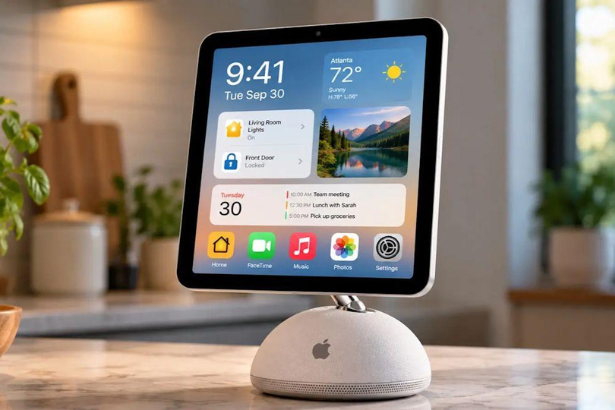
Apple HomeView is no longer just a rumor. On October 13, 2026, Apple officially introduced its new smart home hub, confirming a $299 starting price, a 7-inch Liquid Retina display and integration with Apple Intelligence-powered Siri AI. The company says HomeView is designed to bring entertainment, communication and smart home management together in one place.
The announcement helps explain the sudden spike in searches for “apple homeview” shown in Google Trends. The search screenshot also lists coverage from Apple, Bloomberg and CNBC, reflecting a shift from speculation about Apple’s smart home plans to questions about the product’s features, availability and usefulness.
HomeView is only one part of the announcement. Apple also introduced a new Apple TV 4K with Siri AI and announced Apple Home Collection, a new range of smart home accessories developed with LG Electronics and Schneider Electric. Together, these products show Apple pursuing a more integrated home experience rather than relying on the iPhone and Home app alone.
Background and Context: Why Apple Wants a Dedicated Home Hub
Apple already has a smart home foundation. The Home app lets people manage compatible accessories, while HomePod and Apple TV can play roles in voice control, entertainment and home automation. But a phone is a personal device, and not everyone in a household necessarily wants to reach for one to adjust the lights, check a camera or make a call.
HomeView is designed to fill that gap with a shared screen that can also personalize information for individual household members. Apple says the device can recognize up to six people and surface their personal content in apps such as Messages, FaceTime, Calendar, Reminders and Find My.
The move also puts Siri at the center of Apple’s home strategy. The company is presenting HomeView as a device powered by Apple Intelligence and its newer Siri AI experience. That makes the assistant’s usefulness, accuracy and availability just as important as the display and speaker hardware.
Apple’s official HomeView announcement describes a product built to support entertainment, connection and home management while keeping privacy and security central to the experience.
Latest Update: What Apple Confirmed on October 13
1. Apple HomeView costs $299
Apple has confirmed a US starting price of $299 for both the standard HomeView and the wall-mounted model. The standard version comes in silver, starlight, rose pink and space gray. The wall-mounted version is available in silver and space gray.
Pre-orders opened on October 13 in the United States, Australia, Canada, India, New Zealand and the United Kingdom, with availability scheduled to begin on November 13. Singapore pre-orders are scheduled to begin on October 15, while availability in South Africa is through Apple Authorized Resellers.
Apple says HomeView will not be sold in the European Union for now because Siri AI is not currently available in iOS there. The company says it is working with the EU to find a path forward.
Those dates and regional restrictions matter for buyers. Availability is not identical across all markets, and the US price should not be treated as the final local price in every country.
2. A 7-inch display and A18 chip
The official technical specifications confirm a 7-inch Liquid Retina display with a resolution of 1088 by 1088 pixels, True Tone and a maximum brightness of 500 nits. The device is powered by Apple’s A18 chip.
The standard model has an adjustable display attached to a domed aluminum base. The wall-mounted version has a slimmer profile designed for places such as an entrance or hallway. Apple says compatible mounting and power accessories are sold separately for the wall-mounted device.
For video calls, HomeView includes a 12-megapixel Center Stage camera. Its speaker system supports Spatial Audio with Dolby Atmos for music and video, and its four-microphone design supports hands-free Siri interaction.
The official HomeView technical specifications provide the confirmed hardware details and supported features.
3. Siri AI and household personalization
Apple says HomeView supports a new version of Siri powered by Apple Intelligence. The company describes capabilities including personal context understanding, broad world knowledge and expressive voices when a paired iPhone or iPad is nearby.
The device can recognize up to six household members, allowing each person to access personalized content. Apple also lists built-in apps including Calendar, FaceTime, Find My, Home, Intercom, Messages, Music, Podcasts, Reminders, Safari, Settings, Timers, Weather and World Clock.
However, software availability has limits. Siri AI on HomeView is initially available in English in the United States, Australia, Canada, India, New Zealand, Singapore, South Africa and the United Kingdom. Apple says Canadian French support will arrive later through a free software update.
4. Apple TV 4K gets Siri AI too
Apple also announced a new Apple TV 4K with faster performance and a full-screen, conversational Siri AI experience for finding movies and shows. The new model includes far-field microphones for hands-free voice interaction.
Apple says the device can serve as a home hub, allowing people to control compatible accessories and scenes. It also supports Apple Intelligence-generated descriptions of camera activity and summarized notifications in the Home app.
Pre-orders began October 13, with availability scheduled for November 13. Apple’s official Apple TV 4K announcement has the confirmed feature and availability details.
5. Apple Home Collection expands the accessory lineup
The company also introduced Apple Home Collection, a new range of smart home accessories developed with LG Electronics and Schneider Electric. The announced products include indoor and outdoor cameras, thermostats, temperature sensors, a video doorbell and a door lock.
Apple says compatible products can be set up using an iPhone and managed through the Home app without requiring a separate app or account for those accessories.
This matters because a home hub is only as useful as the devices it can control. A larger selection of compatible accessories could make HomeView more than an expensive screen on a kitchen counter.
Apple’s Home Collection announcement outlines the partners, products and regional availability details.
Expert Insights and Analysis: The Ecosystem Is the Real Product
HomeView’s hardware is relatively easy to describe: a 7-inch screen, A18 chip, camera, microphones and speakers. Its larger strategic value depends on how effectively Apple combines those components with Siri, the Home app and compatible accessories.
Three factors will determine whether the device earns a place in people’s homes.
Siri must be genuinely useful. Voice assistants are most valuable when people can ask naturally, receive relevant responses and complete tasks without repeating themselves. Apple is positioning Siri AI as a central feature, but real-world performance will matter more than the marketing language. Users should also distinguish announced features from those that may require later software updates.
The shared screen must offer an advantage over a phone. Personalized calendars, video calls, home controls and glanceable information could be convenient in a shared space. The question is whether those features are useful enough to justify a dedicated device, particularly for households that already own an iPad, HomePod or Apple TV.
Accessory support needs to be broad and dependable. Apple’s new Home Collection adds to its hardware options, but buyers will still want clarity about compatibility with existing smart home devices. Support for standards and accessories is important because consumers rarely replace every connected product at once.
HomeView is therefore best understood as a new interface for Apple’s home ecosystem. The screen matters, but the experience depends on the software, the accessory network and the reliability of everyday interactions.
Broader Implications: Apple Is Building a More Complete Smart Home
The announcement gives Apple a more visible entry point into the home. An iPhone belongs to one person, while a smart home hub can become shared household infrastructure. That could increase engagement with Apple’s services and encourage users to add more compatible accessories over time.
The launch also creates a stronger link between entertainment and home automation. Apple TV handles the television, HomePod products handle audio, and HomeView offers a dedicated place for household information and controls. If the devices work smoothly together, Apple can offer a coherent experience across rooms rather than a collection of disconnected products.
But the strategy comes with trade-offs. A dedicated hub costs more than many basic smart speakers, and some features depend on language, region and compatible Apple devices. The EU restriction on HomeView availability also shows that the product’s reach is tied to software availability and regulatory circumstances, not just hardware distribution.
Privacy will be another important test. Apple emphasizes that HomeView is designed with privacy and security at its core, but users should still understand how face recognition, personalized information, cameras and voice interactions work in practice. Clear settings and meaningful user control are essential for a device designed to sit in shared spaces.
Internal link suggestion: Link the phrase “Apple’s smart home ecosystem” to a related Apple Home, Matter or smart home automation explainer on The Tech Marketer. Replace the homepage link with the exact published article URL before publishing.
Related History: From HomeKit to Apple HomeView
Apple’s smart home effort has developed over years through HomeKit, the Home app, HomePod and Apple TV. Those products established ways to manage compatible accessories, use voice commands and connect home entertainment to the broader Apple ecosystem.
HomeView represents a shift toward a dedicated, always-available interface. Rather than requiring a person to open an app on a personal device, the hub can present controls and information in a shared location. That approach resembles the smart displays popularized by Amazon and Google, but Apple’s implementation leans on its existing accounts, devices, services and privacy positioning.
The new Home Collection adds another layer. Cameras, thermostats, sensors and door locks make a control hub more useful, while the hub gives those accessories a more visible interface. The success of the overall strategy will depend on how well Apple combines its own devices with third-party hardware and software.
What Happens Next?
The next phase begins with pre-orders and the scheduled November 13 availability date. Early reviews should help establish whether the display is responsive, whether Siri AI works reliably in everyday situations and whether the product provides enough value beyond existing Apple devices.
Potential buyers should pay attention to:
- Local pricing: The confirmed US price is $299, but taxes and regional pricing can differ.
- Availability: The standard and wall-mounted versions share the same US starting price, but the wall-mounted setup may require additional accessories.
- Software support: Siri AI is initially limited to specified countries and English-language support, with some language capabilities planned for later.
- Compatibility: Check whether existing smart home accessories and routines work as expected.
- Privacy controls: Review how household recognition, cameras, personal content and voice features can be configured.
- Practical value: Compare HomeView with a HomePod, Apple TV or an iPad already used for home controls.
The key question is no longer whether Apple is entering this product category. It has. The question is whether HomeView can make smart home control simple enough that households use it every day.
Conclusion
Apple HomeView is now an official part of Apple’s smart home strategy, with a confirmed $299 starting price, a 7-inch display, an A18 chip and Siri AI integration. The simultaneous announcements of a new Apple TV 4K and Apple Home Collection show that Apple is expanding the ecosystem around the hub, not launching it in isolation.
The opportunity is clear: a shared interface for entertainment, communication and home automation. The challenge is making it useful, compatible and trustworthy enough to justify another device in the home. Reviews, software updates and the November launch will reveal whether HomeView delivers on that promise.
FAQ
What is Apple HomeView?
Apple HomeView is a new smart home hub with a 7-inch Liquid Retina display. It combines entertainment, FaceTime, personalized information, Siri AI and control of compatible smart home accessories.
How much does Apple HomeView cost?
Apple has confirmed a US starting price of $299 for both the standard HomeView and the wall-mounted version. Local pricing may vary by market.
When does Apple HomeView go on sale?
Pre-orders began October 13, 2026, in several markets, including the United States and India. Availability in those markets is scheduled to begin November 13, 2026.
What are the main Apple HomeView specifications?
HomeView has a 7-inch Liquid Retina display, an A18 chip, a 12-megapixel Center Stage camera, four microphones, built-in speakers, Wi-Fi 6E, Bluetooth 6.0 and Thread networking support.
Does Apple HomeView support Siri AI?
Yes. Apple says HomeView is powered by Apple Intelligence and Siri AI. Availability initially depends on supported countries and English-language support, with additional language support planned later.
Can Apple HomeView control smart home devices?
Yes. HomeView works with the Apple Home app to manage compatible accessories. Apple’s new Home Collection adds products such as cameras, thermostats, sensors, a video doorbell and a door lock.
Is Apple HomeView available in India?
Apple lists India among the markets where pre-orders opened on October 13 and availability is scheduled to begin November 13, 2026. Check Apple’s local store for the final Indian price and current stock.
Sources & References
- Apple, “Meet Apple HomeView, a new way to enjoy entertainment, stay connected, and manage the home.” Apple Newsroom, October 13, 2026. Read the announcement.
- Apple, “Apple HomeView and Apple HomeView (Wall Mounted) Technical Specifications.” View official specifications.
- Apple, “Apple unveils the new Apple TV 4K, supercharged by Siri AI.” Apple Newsroom, October 13, 2026. Read the announcement.
- Apple, “Introducing Apple Home Collection, a new lineup of smart home accessories.” Apple Newsroom, October 13, 2026. Read the announcement.
- Mark Gurman, “Apple unveils $299 HomeView smart home hub, new Apple TV 4K, HomePod mini 2.” Bloomberg, October 13, 2026. Read the report.
- “Apple HomeView smart home hub and Siri AI.” CNBC, October 13, 2026. Read the report.