Introduction
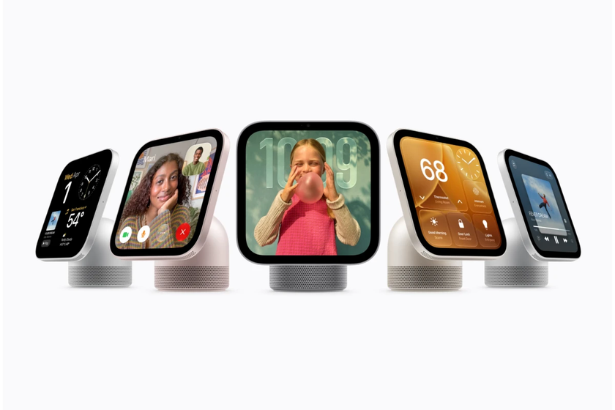
Apple HomeView marks a significant expansion of Apple’s smart home strategy. Announced on October 13, 2026, the new device combines a 7-inch Liquid Retina display, Siri AI, FaceTime, entertainment and smart home controls in a single device designed for shared household spaces.
The idea is straightforward: instead of reaching for an iPhone whenever someone wants to adjust the lights, check a camera feed or make a video call, family members can interact with a dedicated screen in the kitchen, hallway or living room.
Apple is also introducing the Apple Home Collection, a range of smart home accessories developed with LG Electronics and Schneider Electric. The lineup includes cameras, thermostats, temperature sensors, a video doorbell and a smart door lock.
According to Apple’s official HomeView announcement, the device is built around Apple Intelligence, a new version of Siri AI and privacy-focused processing. Preorders begin October 14 in supported markets, with availability starting November 13.
In India, Apple’s website lists the starting price at ₹39,900. That puts HomeView in a premium category where its success will depend on more than attractive hardware. Apple must show that an AI-powered screen can make everyday household tasks meaningfully easier.
Background and Context
Why Apple is moving deeper into the smart home
Apple has spent years building the foundations of a connected home through the Home app, HomePod speakers, Apple TV and compatibility with HomeKit accessories.
Yet its approach has largely depended on existing devices. People typically control lights, thermostats, locks and cameras through an iPhone, iPad, voice assistant or dedicated interface from another manufacturer.
HomeView changes that model by giving Apple Home a permanent physical presence in the house.
A dedicated display can serve multiple people, remain available without someone locating a phone and provide a convenient way to view camera feeds or adjust settings at a glance.
The timing also reflects a broader industry shift. Companies are trying to move AI assistants beyond text-based chatbots and into devices that can respond to the context of everyday life.
As Axios reported in its October 14 analysis, Apple is betting that AI can make smart home products more useful, addressing a category that has historically struggled with setup complexity and inconsistent experiences.
The challenge is familiar. Smart speakers and connected appliances promised convenience years ago, but many households still find that managing multiple devices and applications can be frustrating.
Apple’s opportunity is to reduce that friction through tighter integration between its hardware, software and services.
What is Apple HomeView?
HomeView is a dedicated smart home display with a 7-inch Liquid Retina screen and an integrated speaker base.
Its aluminum body, stainless steel hinge and adjustable viewing angle are designed to suit locations such as kitchen counters, bedside tables and hallways. Apple also offers a wall-mounted version for spaces where a tabletop device would be inconvenient.
The device combines several functions:
- Smart home control: Adjust lights, thermostats, blinds and compatible locks.
- Camera monitoring: View compatible security camera feeds and supported video notifications.
- FaceTime: Make video calls using the device’s camera and Center Stage features.
- Entertainment: Access music, photos and other supported content.
- Personalized information: View relevant messages, calendar information, reminders and other personal content.
- Voice assistance: Use Siri AI for hands-free commands and conversational requests.
The central design decision is to make the display a shared household device that can still offer personalized experiences to individual users.
That distinction matters. A screen in a common area should not automatically expose every person’s private messages or calendar entries to everyone else in the house.
Latest Update: Apple HomeView Launch, Features and Price
Apple’s new 7-inch smart display
The headline feature is the 7-inch Liquid Retina display, which gives HomeView a dedicated interface for smart home management and everyday communication.
Apple says the screen can display controls for compatible accessories, camera feeds and personal information. Its Home Camera interface can show up to nine video feeds simultaneously, allowing users to monitor multiple areas of a property from one location.
The device also supports tabletop and wall-mounted placement, making it possible to install it near an entrance or in a frequently used room.
For households already using Apple devices, the appeal is the prospect of having a persistent interface that complements the iPhone rather than replacing it.
Siri AI is the real selling point
The hardware is only part of Apple’s pitch. Siri AI is central to the HomeView experience.
Apple describes the assistant as a more capable and conversational version of Siri, with broader world knowledge, richer music discovery and onscreen awareness. When paired with an Apple Intelligence-enabled device, it can also draw on relevant personal context to provide more tailored responses.
In practical terms, this could mean asking for information, controlling compatible devices or finding relevant household details without navigating several separate apps.
The distinction between a conventional voice assistant and a more context-aware AI assistant will be important.
A useful smart home assistant must understand what the user means, identify the relevant device and carry out the request reliably. A conversational interface is only valuable if it consistently completes the task.
Apple’s announcement outlines its intended capabilities, but real-world performance will need to be assessed through hands-on testing after launch.
Personalized experiences for up to six people
HomeView uses facial recognition to recognize household members and adapt the experience to each person.
Apple says the device can recognize up to six people, personalizing access to supported features such as Messages, FaceTime, Calendar, Reminders and Find My.
This could make a shared display more useful for families. A person approaching the device may see their own information instead of a generic dashboard.
However, personalization introduces an important privacy question: how does the device prevent one household member from seeing another person’s sensitive information?
Apple says personal content is surfaced only when the enrolled user is recognized and their paired iPhone or iPad is present and has been recently unlocked, subject to the conditions outlined in its privacy documentation.
That additional requirement is designed to help protect information on a device that multiple people can physically access.
Home security goes beyond camera feeds
HomeView is also designed to work with compatible security accessories and supported iCloud+ features.
Apple says compatible HomeKit Secure Video cameras can provide encrypted recognition of people, familiar faces, pets, packages and vehicles. The system can also offer descriptions of recorded video events.
Another feature is sound detection for smoke and carbon monoxide alarms, with notifications sent to compatible Apple devices.
These functions could make HomeView a useful household monitoring center, particularly for people who already use Apple Home.
But users should distinguish between receiving an alert and having a complete security system. Camera placement, connectivity, subscription requirements, compatible accessories and backup arrangements still matter.
Apple HomeView price and availability in India
Apple’s Indian product page lists both the standard and wall-mounted versions at ₹39,900.
| Detail | Apple HomeView |
|---|---|
| Display | 7-inch Liquid Retina |
| Processor | Apple A18 |
| Assistant | Siri AI with Apple Intelligence |
| Personalization | Facial recognition for up to six people |
| Video calling | FaceTime with Center Stage |
| Smart home integration | Apple Home and compatible Matter accessories |
| India price | ₹39,900 |
| Preorders | October 14, 2026, in supported markets |
| Availability | November 13, 2026 |
| Mounting options | Tabletop and wall-mounted |
Source: Apple HomeView India. Features and availability may vary by market.
Apple’s official India page confirms the ₹39,900 starting price and November 13 availability date. Siri AI is initially available in English in supported markets, including India.
For buyers, the price comparison should include the cost of any additional cameras, thermostats, locks, mounting accessories or subscriptions required for the intended setup.
Expert Insights and Analysis
Can Apple make the smart display feel essential?
The smart display category has been around for years. Amazon’s Echo Show and Google’s Nest Hub already provide screens for voice commands, video calls, media and connected home controls.
Apple therefore needs to offer more than a screen attached to a speaker.
Its strongest potential advantage is integration. HomeView is designed to work with Apple Home, Apple Intelligence, FaceTime, personal information and compatible accessories through a unified interface.
That could be particularly attractive to households that already own iPhones, use iCloud and rely on Apple’s services.
However, integration can become a limitation if users must purchase additional Apple-compatible hardware or subscribe to services to access the features they want.
The question is whether HomeView solves enough everyday problems to justify a dedicated device in a market where smartphones already provide many of the same functions.
Privacy is an advantage, but it must be demonstrated
HomeView places cameras, microphones, facial recognition and personal information in a shared physical space. That makes privacy central to the product rather than a secondary feature.
Apple says the A18 chip includes Secure Exclaves, which isolate certain sensitive processing tasks. It also says Siri requests can be handled on-device or through Private Cloud Compute, where processed data is not stored or made accessible to Apple or other parties under its stated architecture.
These are meaningful design commitments, but the complete privacy picture depends on implementation, settings, supported accessories and how users configure their homes.
Buyers should examine what information is processed locally, which features require iCloud+, how household members are enrolled and what happens when a device is shared by guests.
A smart home display must be convenient without turning the home into a place where personal data is unnecessarily exposed.
The AI assistant must work reliably
Apple’s announcement positions Siri AI as a more conversational assistant with improved contextual understanding.
That raises expectations. Consumers increasingly compare voice assistants with advanced AI chatbots, which can answer complex questions but do not necessarily control household hardware reliably.
HomeView needs to bridge those capabilities.
It must understand ordinary language, identify the right accessory, handle ambiguous commands and report clearly when a task cannot be completed. In a smart home, mistakes can be more disruptive than an imperfect chatbot response.
For example, a request to turn off a particular light should not affect every light in the house. A command involving a door lock should require dependable execution and clear confirmation.
The hardware creates an opportunity. Software reliability will determine whether the device becomes part of daily life.
Broader Implications
Apple is expanding its home ecosystem
HomeView arrives alongside Apple Home Collection, a new range of accessories developed with LG Electronics and Schneider Electric.
The collection includes indoor and outdoor cameras, thermostats, temperature sensors, a video doorbell and a smart deadbolt lock.
Apple says the accessories are designed to integrate with the Apple Home app, with simplified setup and end-to-end encryption for home data. The products also build on compatibility with existing Works with Apple Home and Matter accessories.
This is important because a smart home hub is only as useful as the devices it can control.
By combining its own interface with partner-developed hardware, Apple can expand the number of everyday tasks managed through its ecosystem without manufacturing every component itself.
For readers tracking Apple’s wider product strategy, see The Tech Marketer’s technology coverage.
The competition extends beyond Amazon and Google
HomeView enters a market shaped by Amazon Echo Show, Google Nest Hub and other connected displays.
Amazon has experience combining voice assistants with household devices, while Google has developed a broad smart home ecosystem around its Assistant and Nest products.
Apple’s strategy emphasizes personal information, hardware integration and privacy-focused design.
That approach may appeal to existing Apple users, but the competitive comparison will ultimately come down to practical factors: price, device compatibility, responsiveness, reliability and the usefulness of the assistant.
A polished interface will not compensate for weak automation support or inconsistent voice recognition.
The smart home could become an AI interface
The broader significance of HomeView is that AI is moving into shared physical spaces.
Instead of interacting with a model through a browser or phone, users can ask for help while cooking, checking a delivery or preparing to leave the house.
If these systems become reliable, they could reduce the need to navigate multiple applications for routine tasks. They could also help people understand activity across several connected devices.
But the benefits depend on thoughtful design. Household technology must accommodate different users, protect sensitive information and remain usable when internet connectivity or cloud services are unavailable.
HomeView is Apple’s attempt to bring those requirements together in a dedicated product.
Related History and Comparable Technologies
From HomePod to HomeView
Apple’s smart home ambitions did not begin with HomeView.
HomePod introduced a speaker-first approach, combining music playback with voice assistance and smart home control. Apple TV and the HomePod ecosystem also helped establish the idea of a connected home managed through Apple devices.
HomeView takes a different approach by making the screen a central part of the experience.
A display can present information that would otherwise require a spoken response, while also offering a visual interface for cameras, settings and personal content.
This creates a more direct comparison with the Echo Show and Nest Hub than with a conventional smart speaker.
Why Matter compatibility matters
Smart home products have historically been divided across different ecosystems, creating compatibility problems for consumers.
Matter was developed to improve interoperability among compatible smart home devices and platforms.
Apple says HomeView works with Matter accessories as well as supported Apple Home products. That could give buyers more flexibility than relying exclusively on a single manufacturer’s hardware.
However, Matter compatibility does not guarantee that every feature of every accessory will work identically across platforms. Users should check the specific functions supported by each product before purchasing.
What Happens Next?
Apple’s next challenge is to turn the announcement into a reliable product experience.
HomeView is scheduled to become available on November 13, 2026, following preorders in supported markets. Early hands-on reviews will help establish how well Siri AI performs, how quickly the device recognizes household members and whether the interface makes routine tasks easier.
The rollout of Apple Home Collection will also matter. Apple says the accessories will begin arriving in December, with select products following in early 2027.
That staggered availability means buyers may need to wait for particular accessories or check compatibility before planning a complete installation.
Several questions remain open:
- How well does Siri AI handle complicated, multi-step household requests?
- Can HomeView reliably distinguish between household members without creating privacy friction?
- How much functionality is available without an iCloud+ subscription?
- How broadly will the device support third-party smart home accessories?
- Will the dedicated display provide enough value compared with an iPhone, HomePod or competing smart display?
The answers will determine whether HomeView becomes a central household device or remains an expensive addition for a narrower group of Apple enthusiasts.
Conclusion
Apple HomeView represents a more ambitious approach to the smart home. By combining a 7-inch display, Siri AI, FaceTime, personalized information and device controls, Apple is trying to turn its connected home ecosystem into something people can interact with throughout the day.
The accompanying Apple Home Collection expands the proposition beyond the screen, adding cameras, thermostats, sensors and a smart lock through partnerships with LG Electronics and Schneider Electric.
The ₹39,900 India price places HomeView firmly in the premium segment. Its appeal will depend on whether AI improves everyday convenience, whether privacy safeguards work as intended and whether the ecosystem offers enough flexibility for different households.
Apple has presented a clear vision. The real test begins when customers put the device to work.
Frequently Asked Questions
1. What is Apple HomeView?
Apple HomeView is a smart home display that combines a 7-inch Liquid Retina screen, Siri AI, FaceTime, entertainment and controls for compatible smart home devices.
2. What is the Apple HomeView price in India?
Apple’s India website lists the starting price at ₹39,900 for both the standard and wall-mounted versions.
3. When will Apple HomeView launch in India?
Apple lists November 13, 2026, as the availability date. Preorders begin October 14 in supported markets.
4. Does Apple HomeView support Siri AI?
Yes. Apple says HomeView is powered by Apple Intelligence with Siri AI, offering conversational assistance, smart home controls and personalized features.
5. Can Apple HomeView recognize different family members?
Yes. Apple says HomeView can recognize up to six people and personalize supported experiences for each user.
6. What is Apple Home Collection?
Apple Home Collection is a lineup of smart home accessories developed with LG Electronics and Schneider Electric. It includes cameras, thermostats, temperature sensors, a video doorbell and a smart lock.
7. Is Apple HomeView compatible with Matter devices?
Apple says HomeView supports compatible Matter accessories alongside Apple Home products. Specific functions depend on the accessory and its compatibility.
8. Is Apple HomeView available in the European Union?
Apple says HomeView is not currently available for sale in the European Union because Siri AI is unavailable in iOS in that market. Apple says it is working to find a path forward.
Sources & References
- Apple Newsroom: Meet Apple HomeView, a new way to enjoy entertainment, stay connected, and manage the home
- Apple India: Apple HomeView product page, pricing and availability
- Apple Newsroom: Introducing Apple Home Collection, a new lineup of smart home accessories
- Axios: Apple bets AI can finally make us want a smart home
- WIRED: We Tried Out Apple’s New HomeView Smart Display