Introduction
American Airlines first class is entering a new era, and the change is bigger than a simple seat redesign.
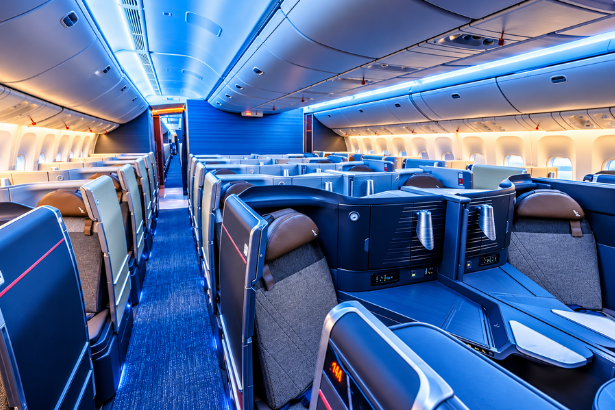
American Airlines is eliminating its international Flagship First cabin from its Boeing 777-300ER aircraft and replacing that space with a much larger business-class operation. The revamped aircraft has 70 Flagship Suites, 44 premium economy seats and 30 Main Cabin Extra seats, giving the aircraft 144 premium seats overall.
The first retrofitted 777-300ER entered service on September 2, flying from New York to Buenos Aires. American plans to retrofit all 20 of its 777-300ER aircraft by 2027.
The message is clear: instead of selling a tiny amount of ultra-premium first-class inventory, American wants to put more passengers into products they are actually willing to pay for.
Background and Context
For years, international first class represented the top of the commercial aviation hierarchy.
But the economics of long-haul flying have changed.
Airlines have increasingly discovered that passengers will spend heavily on business class, particularly when the product includes a private suite, a lie-flat bed, direct aisle access and better connectivity. At the same time, traditional international first-class cabins can consume valuable aircraft space while serving relatively few customers.
American’s latest 777 configuration reflects that shift.
The airline is removing Flagship First while significantly increasing the number of premium seats. Reuters reported that the redesigned aircraft has 144 premium seats, compared with 116 previously, while total passenger capacity rises to 330.
The move also puts American more directly in competition with airlines such as Delta and United, which have already moved away from traditional international first-class cabins in favor of premium business products.
Latest Update: What Happened to American Airlines First Class?
The biggest change is straightforward.
There is no traditional Flagship First cabin on the redesigned 777-300ER.
Instead, the aircraft gets 70 Flagship Suites, each designed as a private business-class space with a sliding door. Travel + Leisure reported that the seats convert into lie-flat beds and include personal storage, wireless charging and other upgraded amenities.
The Business Insider comparison also highlights several technology and comfort upgrades, including 17.5-inch 4K displays, Bluetooth connectivity, additional storage and chaise-lounge mode.
That makes the new cabin less like conventional business class and more like what many travelers previously expected from international first class.
The distinction is now largely about the service and overall product rather than simply the name printed on the ticket.
The New Premium Layout
The redesigned 777-300ER includes:
- 70 Flagship Suite business-class seats
- 44 premium economy seats
- 30 Main Cabin Extra seats
- 186 standard economy seats
- 330 total seats
Travel + Leisure describes the aircraft as having 114 premium seats across business and premium economy, while Reuters uses a broader definition that counts Main Cabin Extra among premium seating, bringing the total to 144.
That distinction is worth noting because “premium seats” can mean different things depending on how an airline or publication defines the category.
Expert Insights or Analysis
The real story here is not that American Airlines suddenly decided luxury travel was unimportant.
It is almost the opposite.
American is betting that premium travel is important enough to deserve more seats.
Reuters reported that the airline is pursuing higher-spending travelers as it tries to improve profitability and close the gap with rivals such as Delta and United.
That is a significant strategic shift.
A traditional first-class cabin might contain only a handful of seats. A business-class cabin can contain dozens. If the airline can sell those seats at strong fares, the economics can be considerably more attractive.
The new 777 therefore turns premium travel into a much larger portion of the aircraft’s business model.
And American is not relying on the seat alone.
The new cabin includes upgraded entertainment, charging, storage, connectivity and food and beverage touches. Travel + Leisure highlighted Lavazza espresso drinks and free high-speed Wi-Fi for AAdvantage members as part of the broader premium experience.
That matters because airline passengers increasingly judge premium cabins as ecosystems rather than individual seats.
A private door is valuable.
A private door plus reliable Wi-Fi, charging, storage, a high-quality screen, better food and a comfortable bed is a much stronger proposition.
Broader Implications
The Airline Industry Is Selling Privacy
One of the biggest trends in premium aviation is the transformation of privacy from an exclusive first-class feature into a core business-class selling point.
The Flagship Suite follows that pattern.
Sliding doors create a physical boundary between passengers and the aisle. That can make a business-class seat feel dramatically more private without requiring an entirely separate first-class cabin.
The strategy is visible across the industry.
Airlines are competing over doors, direct aisle access, larger screens, wireless charging, bedding and increasingly sophisticated seat designs.
In other words, the premium cabin has become a technology product.
American Is Making Premium Economy More Important
The 44-seat premium economy cabin is another major part of the strategy.
Travel + Leisure calls it the largest premium economy section on a U.S. airline, with privacy headrest wings, adjustable calf and footrests and wireless charging.
That creates a useful middle tier.
Passengers who cannot justify a Flagship Suite can still pay more for additional space and comfort.
For airlines, that creates more opportunities to monetize passengers without forcing them into the full price of business class.
The New Cabin Also Changes Upgrade Economics
There is another important development for frequent flyers.
American recently changed some upgrade rules on select transcontinental and Hawaii routes, meaning certain elite travelers booked in the main cabin may be upgraded only to premium economy rather than Flagship business.
That is part of the same broader strategy.
American increasingly wants passengers to buy into premium cabins, rather than relying entirely on complimentary upgrades to fill them.
For frequent flyers, that could make the gap between elite benefits and paid premium travel more important than it was in the past.
The Business Model Is Bigger Than the Seat
The new 777 also shows how airlines are using loyalty programs and connectivity as part of the premium product.
Free high-speed Wi-Fi for AAdvantage members is a particularly important example.
A seat is a one-time product.
A loyalty relationship can generate revenue repeatedly through future flights, credit cards, upgrades and ancillary spending.
For more coverage of technology-driven changes in consumer businesses, readers can explore The Tech Marketer’s broader technology and business coverage.
Related History or Comparable Technologies
The disappearance of international first class is not unique to American.
For years, airlines have experimented with reducing or eliminating traditional first-class cabins as business class became increasingly sophisticated.
The evolution is easy to see.
Older business-class products were often simply wider seats with better meals. Modern flagship business cabins can include private doors, lie-flat beds, premium dining, fast connectivity, large displays and dedicated storage.
That makes the difference between business and first class considerably less obvious.
American’s new Flagship Suite sits directly in that space.
It does not carry the traditional Flagship First label, but the physical product attempts to preserve some of the exclusivity associated with first class.
There is also a technological dimension.
Modern airline seats increasingly resemble high-end consumer electronics. Screens have become larger and higher resolution. Wireless charging is becoming standard. Bluetooth allows passengers to use their own headphones. Connectivity is becoming an expectation rather than a bonus.
The cabin itself is becoming a connected device.
What Happens Next
American plans to retrofit all 20 Boeing 777-300ER aircraft by 2027. The aircraft will serve major long-haul markets including London, Tokyo, São Paulo, Buenos Aires and Sydney.
The first commercial operation began with New York to Buenos Aires on September 2.
That means the new cabin is no longer just a concept or promotional rendering. Travelers are already flying it.
The bigger question is whether American can translate the new premium product into stronger financial performance.
If customers consistently choose the new suites and premium economy seats at profitable fares, the strategy could accelerate.
If demand proves weaker than expected, American will have invested heavily in a product that occupies more of the aircraft.
There is also a competitive question.
Delta and United are investing heavily in premium cabins of their own, while even historically low-cost carriers are moving toward premium products. Reuters reported that the industry is increasingly targeting travelers willing to pay more for better experiences.
The result could be a commercial aviation market in which the battle is no longer simply about who has the cheapest seat.
It is about who can make passengers pay more for a better one.
Conclusion
The era of American Airlines first class on the 777-300ER is effectively coming to an end, but American is not walking away from luxury travel.
It is doing something more commercially aggressive.
The airline is replacing a small first-class cabin with 70 private Flagship Suites, expanding premium economy and improving technology throughout the aircraft.
That tells us where the airline industry believes the money is.
Travelers still want luxury. They simply may not care whether the ticket says “first class” if the business-class suite offers privacy, a lie-flat bed, fast Wi-Fi, charging and a premium experience.
American’s new 777 is therefore less a retreat from first class than a redefinition of it.
The name is disappearing.
The premium ambition is not.
FAQ
Is American Airlines first class being eliminated?
American is eliminating its traditional Flagship First cabin from the redesigned Boeing 777-300ER. It is replacing that space with a much larger Flagship Business cabin featuring 70 private suites.
What replaced American Airlines first class on the 777-300ER?
The traditional first-class cabin is being replaced by Flagship Suites in business class. The redesigned aircraft has 70 lie-flat business-class suites with sliding privacy doors.
How many premium seats does the new American 777 have?
The aircraft has 70 Flagship Suite business-class seats, 44 premium economy seats and 30 Main Cabin Extra seats. Reuters therefore counts 144 premium seats in the aircraft’s broader premium configuration.
Does American Airlines’ new Flagship Suite have a door?
Yes. The new business-class suites feature sliding privacy doors, creating a more private experience than the airline’s previous business-class seats.
Does the new American 777 have lie-flat seats?
Yes. The 70 Flagship Suite business-class seats convert into lie-flat beds.
What happened to Flagship First?
American is moving away from the traditional international first-class model on the 777-300ER. The airline is instead putting more capacity into business class and premium economy, where it sees stronger demand and revenue opportunities.
Where will the new American 777 fly?
The retrofitted 777-300ER aircraft are expected to serve long-haul destinations including London, Tokyo, São Paulo, Buenos Aires and Sydney. The first aircraft entered commercial service between New York and Buenos Aires.
Sources & References
- Reuters, “American Airlines boosts premium seating on 777 jets as carriers chase higher-spending travelers”
Read the Reuters report - Travel + Leisure, “American Airlines Just Debuted Its Most Premium Plane Ever With 70 Private Lie-flat Suites”
Read the Travel + Leisure report - Business Insider, “American just gave its largest Boeing jets a major business class makeover. See how the cabin changed.”
Read the Business Insider comparison - Travel + Leisure, “American Airlines Is Making a Major Change to Free Upgrades”
Read the upgrade-policy report