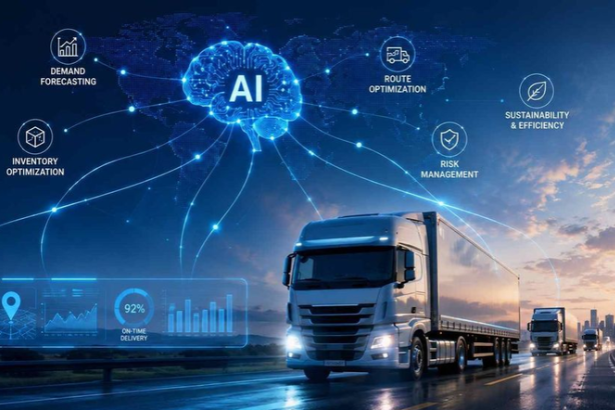
Introduction
AI in logistics industry is entering a new phase of digital transformation. Rising operating expenses, changing customer expectations, transportation capacity challenges and supply chain disruptions are pushing logistics providers to reconsider how they manage everyday operations.
Artificial intelligence (AI) is becoming an important part of that transition.
Across the United States, logistics companies are exploring AI-powered transportation management systems, automated warehouse operations, predictive analytics and intelligent route planning. These technologies are changing how freight moves, how inventory is managed and how businesses respond to unexpected disruptions.
The opportunity is substantial. According to McKinsey’s 2026 State of Digital Logistics Survey, nearly 90% of surveyed shippers have adopted at least one transportation-related AI use case. In warehousing, 96% have deployed at least one surveyed AI or digital use case.
However, adoption does not automatically translate into better business performance. Companies still need reliable data, effective implementation strategies and employees who understand how to work alongside intelligent systems.
For US logistics operators, the question is no longer whether AI belongs in the industry. It is how to implement it in ways that deliver measurable improvements in cost, service quality and operational resilience.
The Changing Landscape of US Logistics
Logistics remains essential to the American economy, connecting manufacturers, retailers, distributors, ports, warehouses and consumers.
The 2026 State of Logistics Report from the Council of Supply Chain Management Professionals (CSCMP), produced with Kearney, places US business logistics costs at approximately $2.4 trillion, equivalent to 7.8% of national GDP.
The report also highlights several structural challenges affecting the industry, including labor and productivity constraints, geopolitical realignment, financial pressures and energy price volatility.
These pressures are encouraging companies to invest in technologies that improve how transportation networks and distribution operations function.
Traditional logistics management often depends on historical information, manual coordination and separate software systems. While these methods can support established operations, they become increasingly difficult to manage as shipment volumes, delivery expectations and network complexity grow.
AI introduces a different approach.
Instead of simply reporting what has happened, intelligent systems can analyze operational data, identify emerging problems, forecast demand and recommend actions before disruptions become more expensive.
This shift from reactive management to predictive decision-making is one of the most important developments in modern logistics.
1. AI-Powered Route Optimization Is Improving Freight Transportation
Transportation represents a major operational expense for logistics companies.
Fuel, driver availability, vehicle utilization, traffic congestion and delivery schedules all influence the cost of moving freight.
AI-powered route optimization helps transportation managers evaluate these factors together.
Modern routing systems can analyze:
- Traffic conditions and congestion.
- Weather forecasts.
- Delivery windows.
- Vehicle capacity.
- Driver availability.
- Fuel consumption.
- Customer delivery priorities.
- Road restrictions and operational constraints.
Based on this information, algorithms can recommend more efficient routes and adjust schedules when conditions change.
For example, a freight carrier operating across several US states may use AI to identify the most efficient combination of delivery stops while considering vehicle capacity and customer deadlines.
If severe weather disrupts a planned route, the system can evaluate alternative roads and estimate how the change affects delivery schedules.
This gives transportation managers more flexibility than relying exclusively on static routing plans.
The role of Transportation Management Systems
Transportation Management Systems (TMS) are becoming increasingly important as companies integrate AI into freight operations.
A modern TMS can connect shipment planning, carrier selection, freight procurement, tracking, documentation and transportation performance reporting.
AI capabilities can extend these functions by identifying patterns in historical freight data and recommending operational improvements.
According to Descartes’ 2026 Transportation Management Benchmark Survey, transportation optimization is among the leading AI use cases being explored by logistics organizations.
The survey also identifies data quality as the biggest barrier to scaling AI.
This suggests that successful transportation automation requires more than installing new software. Companies need accurate shipment information, standardized processes and integration between operational systems.
2. Smart Warehousing Is Changing Distribution Center Operations
Warehouses are becoming increasingly automated environments where software, robotics and connected equipment work together.
AI is helping warehouse operators improve inventory management, picking operations, space utilization and labor planning.
Traditional warehouse processes often involve significant manual coordination. Employees must locate products, prioritize orders, manage replenishment and ensure shipments are ready for dispatch.
AI-powered warehouse management systems can analyze inventory movement and operational demand to help coordinate these activities.
Intelligent inventory management
AI systems can analyze historical sales, seasonal patterns, supplier lead times and current inventory levels.
This helps warehouse managers identify products that may require replenishment before shortages occur.
Predictive inventory management can also help reduce excess stock and improve the use of available warehouse space.
For retailers handling thousands of products, even small improvements in inventory accuracy can support better fulfillment performance.
Robotics and automated picking
Warehouse robotics are another important part of the transformation.
Automated guided vehicles, autonomous mobile robots and robotic picking systems can support repetitive material-handling tasks.
AI helps these systems navigate warehouse environments, recognize objects and coordinate movements.
Gartner identified polyfunctional robots and physical AI among its leading supply chain technology trends for 2026.
Physical AI combines intelligent software with sensors, robotics and connected equipment to help systems interact with real-world environments.
The technology has applications across warehousing, transportation and manufacturing.
However, robotics should complement warehouse employees rather than be treated as an automatic replacement for the entire workforce.
Human supervision remains important for safety, exception handling and complex operational decisions.
3. Predictive Analytics Is Helping Companies Anticipate Supply Chain Disruptions
Unexpected disruptions can create significant costs for logistics operators.
Severe weather, port congestion, equipment failures, supplier delays and transportation capacity shortages can affect delivery schedules.
Predictive analytics gives logistics managers a way to identify potential problems earlier.
AI systems can analyze multiple information sources, including:
- Historical delivery performance.
- Weather information.
- Carrier tracking data.
- Port and terminal activity.
- Inventory movement.
- Transportation capacity.
- Supplier delivery records.
By identifying patterns across these datasets, predictive models can estimate where delays or shortages may occur.
For example, if a shipment is approaching a congested distribution hub, an AI-powered system may identify the risk before the scheduled delivery date.
A transportation manager can then evaluate alternative routes, carriers or delivery schedules.
The objective is to reduce the time between identifying a disruption and taking action.
Building more resilient transportation networks
The 2026 National Freight Strategic Plan from the US Department of Transportation emphasizes resilience, improved freight visibility and stronger coordination across the country’s multimodal transportation network.
It also highlights the importance of modernizing freight infrastructure and improving the availability of data.
AI can support these objectives by helping organizations understand how disruptions in one part of the transportation network affect other operations.
However, predictive systems depend on reliable information. Incomplete tracking data or inconsistent reporting can reduce forecast accuracy.
Companies therefore need to invest in data integration alongside AI adoption.
4. Real-Time Shipment Visibility Is Becoming a Competitive Advantage
Customers increasingly expect accurate information about where their shipments are and when they will arrive.
For manufacturers, retailers and distributors, limited shipment visibility can create uncertainty around inventory planning and production schedules.
Real-time visibility platforms address this problem by collecting information from GPS devices, carrier systems, telematics platforms and warehouse applications.
AI can analyze the incoming data to identify unusual patterns and highlight shipments requiring attention.
For example, an intelligent tracking platform may identify:
- A shipment moving outside its planned route.
- An unexpected delivery delay.
- A temperature excursion involving sensitive goods.
- A potential cargo theft event.
- A missed transportation milestone.
Some newer systems can also recommend or initiate predefined responses.
McKinsey’s September 2026 research on digital logistics describes how agentic AI can monitor shipments, identify exceptions and intervene when issues arise.
This creates an opportunity for logistics providers to move beyond basic tracking toward more proactive shipment management.
For 3PL providers, visibility can also improve customer communication and strengthen service differentiation.
5. How AI Is Transforming Third-Party Logistics Providers
Third-party logistics providers operate in a competitive environment where customers expect reliable transportation, flexible warehousing and transparent shipment management.
AI offers opportunities to improve each of these functions.
Better carrier selection
AI-powered systems can evaluate carrier performance using historical delivery times, service reliability, transportation costs and capacity availability.
This helps logistics managers make more informed carrier selection decisions.
Automated documentation
Logistics operations involve substantial documentation, including bills of lading, invoices, shipping records and customs paperwork.
AI-powered document processing can extract information, identify inconsistencies and reduce repetitive data-entry tasks.
Human review remains necessary for important compliance decisions and exceptions.
More efficient customer service
AI assistants can help customer service teams respond to common shipment inquiries, retrieve tracking information and summarize delivery exceptions.
Instead of manually checking multiple platforms, employees can use integrated systems to access relevant information more quickly.
Improved operational planning
AI can help 3PL providers forecast demand, allocate warehouse capacity and evaluate transportation requirements.
These capabilities are particularly useful when managing multiple customers with different shipping schedules and service expectations.
For smaller logistics providers, however, implementation costs and technology integration remain important considerations.
6. The Rise of Agentic AI in Logistics Operations
One of the emerging developments in logistics technology is agentic AI.
Traditional AI systems typically analyze information and provide recommendations.
Agentic AI can go further by planning and executing defined tasks within an authorized workflow.
For example, a logistics AI agent could monitor a shipment, detect a delivery delay, identify alternative carrier options and prepare a revised transportation plan for approval.
Multiple agents could also coordinate tasks across different systems.
One agent might monitor inventory, another could evaluate transportation capacity, and a third could assist with customer communication.
Gartner identified agentic AI and collaborative multiagent systems among its major supply chain technology trends for 2026.
However, organizations need appropriate controls before allowing AI systems to make operational decisions.
Important safeguards include:
- Clear approval requirements.
- Defined decision-making permissions.
- Audit trails.
- Data security controls.
- Human escalation procedures.
- Performance monitoring.
In logistics, an incorrect automated decision can affect deliveries, inventory availability and customer commitments.
The most practical approach is to introduce autonomy gradually, starting with low-risk and well-defined processes.
7. Challenges Preventing Wider AI Adoption in US Logistics
Despite the opportunities, implementing AI across logistics operations is not straightforward.
Several challenges continue to affect adoption.
Data quality and integration
Many logistics companies operate multiple systems that do not communicate effectively.
A warehouse management system, TMS, enterprise resource planning platform and carrier tracking application may all contain different versions of operational information.
AI requires reliable and consistent data to produce useful recommendations.
Organizations should prioritize system integration and data governance before scaling complex AI projects.
Implementation costs
Technology investments can involve software licensing, equipment, integration, employee training and ongoing maintenance.
Smaller carriers and independent warehouse operators may find these costs difficult to justify.
Companies should therefore evaluate expected returns before committing to large-scale automation projects.
Workforce training
AI adoption changes how logistics employees perform their jobs.
Transportation planners may need to interpret algorithmic recommendations, while warehouse supervisors may need to manage automated equipment.
Training programs are important for ensuring that employees understand both the capabilities and limitations of new systems.
Cybersecurity and operational risk
Connected logistics systems create additional cybersecurity considerations.
Companies must protect shipment information, customer records, financial data and operational technology.
Access controls, secure integrations, monitoring and incident-response planning should form part of every AI implementation strategy.
8. How Logistics Companies Can Implement AI Successfully
A successful AI strategy does not necessarily begin with a large technology investment.
Companies should identify operational problems that can be measured and improved.
A practical implementation roadmap includes five steps.
Step 1: Identify a specific operational challenge.
Start with a clearly defined issue, such as inefficient routing, frequent delivery delays or inaccurate inventory records.
Step 2: Evaluate existing data.
Review the accuracy, completeness and accessibility of the information used in the selected workflow.
Step 3: Run a controlled pilot.
Test the technology on a limited number of routes, warehouse operations or customer accounts.
Step 4: Measure business performance.
Compare results using indicators such as transportation cost per shipment, on-time delivery, picking accuracy, inventory turnover and labor productivity.
Step 5: Scale successful applications.
Expand only after the pilot demonstrates measurable value and the organization has established appropriate operational controls.
This approach reduces implementation risk and helps businesses focus on practical outcomes rather than technology adoption for its own sake.
What Happens Next: The Future of AI in US Logistics
AI adoption is likely to become increasingly integrated into transportation and warehouse management.
Several developments deserve attention over the coming years.
First, agentic AI may take on more responsibility for routine operational coordination, including shipment monitoring and exception management.
Second, warehouse robotics and physical AI could support increasingly flexible material-handling operations.
Third, digital twins may allow companies to simulate warehouse layouts, transportation networks and distribution strategies before investing in physical changes.
Fourth, integrated visibility platforms may help logistics companies connect suppliers, carriers, warehouses and customers through more consistent information systems.
Finally, workforce development will become increasingly important as logistics employees work alongside automated systems.
The companies most likely to benefit will be those that combine technology investment with reliable data, skilled employees and measurable operating objectives.
Conclusion: AI Is Becoming an Essential Part of Modern Logistics
Artificial intelligence is changing how US logistics companies plan transportation, manage warehouses and respond to supply chain disruptions.
Route optimization can improve freight planning. Predictive analytics can identify potential delays. Warehouse automation can support more efficient fulfillment. Real-time visibility can help logistics providers communicate with customers and manage exceptions.
But technology alone does not guarantee operational success.
Companies must address data quality, integration costs, employee training and cybersecurity before expecting meaningful returns.
The next stage of logistics transformation will not simply be about introducing more automation. It will be about connecting intelligent systems with everyday operational decisions.
For US logistics providers, the competitive advantage will come from using AI to move freight more reliably, manage resources more effectively and deliver better service to customers.
The future of logistics will remain a human-led industry, but increasingly supported by intelligent technology.
Frequently Asked Questions
1. How is AI being used in logistics?
AI is used in logistics for route optimization, shipment tracking, demand forecasting, inventory management, warehouse automation, carrier selection and transportation planning.
2. How does AI improve freight transportation?
AI analyzes traffic, weather, vehicle capacity, delivery schedules and historical transportation data to recommend more efficient routes and improve freight planning.
3. What is AI-powered warehouse management?
AI-powered warehouse management uses intelligent software, analytics and connected equipment to improve inventory accuracy, picking operations, replenishment and warehouse productivity.
4. How can AI help 3PL companies?
Third-party logistics providers can use AI to improve carrier selection, shipment visibility, customer service, warehouse capacity planning and operational efficiency.
5. What is agentic AI in logistics?
Agentic AI refers to systems that can plan and execute defined tasks with varying levels of autonomy. In logistics, applications include shipment monitoring, exception management and transportation coordination.
6. What are the biggest challenges of AI adoption in logistics?
Common challenges include poor data quality, system integration, implementation costs, cybersecurity risks, employee training and the need for human oversight.
7. Can AI reduce logistics costs?
AI can help identify opportunities to reduce transportation expenses, improve asset utilization and optimize inventory. Actual savings depend on implementation quality, operating conditions and the specific application.
8. What is the difference between a TMS and an AI-powered TMS?
A traditional transportation management system supports transportation planning and execution. An AI-enabled TMS adds predictive analytics, intelligent optimization and automated decision support.
9. Is AI replacing logistics employees?
AI is primarily changing how logistics work is performed. Automation can handle repetitive activities, while employees continue to manage complex decisions, customer relationships, safety and exceptions.
10. What is the future of AI in US logistics?
Future developments include agentic AI, autonomous warehouse systems, predictive transportation planning, digital twins and more connected shipment visibility platforms.
Sources and References
- McKinsey & Company: Creating Value from AI and Digital Capabilities in Logistics Operations. September 8, 2026.
- Gartner: Gartner Identifies Top Supply Chain Technology Trends for 2026. June 30, 2026.
- Council of Supply Chain Management Professionals: 2026 State of Logistics Report. June 2026.
- US Department of Transportation: 2026 National Freight Strategic Plan. 2026.
- Descartes: 2026 Transportation Management Benchmark Survey. 2026.
- Boston Consulting Group: AI Is Already Moving the Logistics Industry Forward. March 27, 2026.
- DHL Group: AI Takes Action While People Remain at the Center of Logistics. September 24, 2026.
- KPMG: 2026 US Supply Chain Survey: Key Findings. 2026.