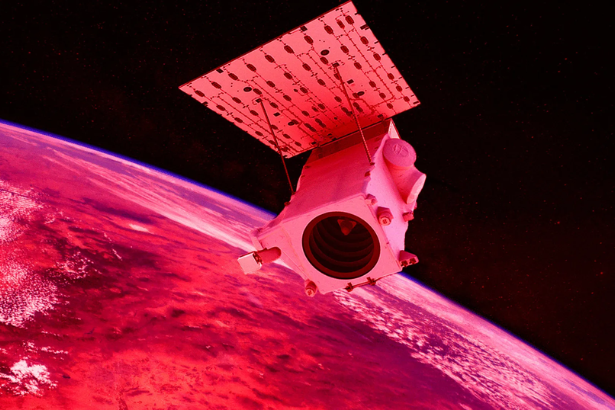
China’s secret spaceplane has suddenly become one of the most talked-about subjects in international space technology. A photograph included in a newly released US Defense Intelligence Agency (DIA) report shows a Chinese orbital vehicle with remarkable clarity, revealing its winged design, open payload-bay doors and what appears to be another spacecraft attached nearby.
The image was captured in 2024 by a commercial satellite operated by Maxar Technologies, now known as Vantor. It became publicly available when the DIA published its 2026 edition of Challenges to Security in Space on October 26.
The spacecraft is widely believed to be China’s experimental Shenlong spaceplane, although the DIA’s image caption identifies it only as a Chinese spaceplane. That distinction matters because Beijing has disclosed very little about the vehicle’s official identity, design specifications or operational purpose.
The Google Trends screenshot supplied for this article shows a sharp rise in interest for the Spanish search phrase “avión espacial”, meaning “spaceplane”. The news cards connect the spike to the newly released satellite photograph and growing attention surrounding China’s increasingly sophisticated space programme.
The photograph is more than an unusual view of a spacecraft. It provides a new opportunity to examine a programme that sits at the intersection of reusable launch technology, satellite operations and international space security.
Background and Context: China’s Secret Spaceplane Programme
China has been developing reusable experimental spacecraft since at least 2020. The programme is designed to test technologies that could make repeated journeys between Earth and orbit more practical.
The vehicle is commonly called Shenlong, which translates to “Divine Dragon”. However, this name is not firmly established as its official designation. WIRED’s report, which republishes reporting from Ars Technica, explains that Chinese state media have referred to the vehicle as a reusable experimental spacecraft rather than consistently using the Shenlong name. WIRED+1
The programme has attracted attention because the spacecraft resembles the American X-37B, an uncrewed reusable spaceplane operated by the US Space Force.
Unlike a conventional satellite, a spaceplane is designed to operate in orbit and eventually return to Earth. Its reusable configuration could allow engineers to test equipment, conduct experiments and potentially deploy or retrieve objects during multiple missions.
China has not publicly disclosed the complete capabilities of its spacecraft. Official statements have described the programme as a technology demonstration intended to support more convenient and affordable spaceflight for peaceful purposes. Reuters+1
Four Missions Since 2020
Public reporting identifies four launches of China’s reusable experimental spacecraft since the programme began.
| Mission | Reported timeline | Duration or status |
|---|---|---|
| First mission | September 2020 | Approximately 2 days |
| Second mission | August 2022 to May 2023 | 276 days |
| Third mission | September 2024 | 268 days |
| Fourth mission | February 7, 2026 | Mission duration not publicly confirmed in the cited launch report |
Reuters reported that the fourth spacecraft launched aboard a Long March-2F rocket from the Jiuquan Satellite Launch Center on February 7, 2026. Chinese state media described the mission as another test of reusable spacecraft technology but did not disclose its planned duration, altitude or specific experiments. Reuters
The extended duration of earlier missions suggests that China is testing more than basic launch and landing procedures. However, the exact experiments performed during those flights remain largely undisclosed.
Latest Update: The Pentagon Releases a Rare Image of China’s Secret Spaceplane
China’s Shenlong Spaceplane Reportedly Released an Unknown Object in Orbit, LeoLabs Says – CRBC News
The major development came on October 26, 2026, when the DIA released its latest unclassified report, Challenges to Security in Space.
The 130-page assessment examines space-related capabilities and security concerns involving China, Russia, Iran and North Korea. One of its most interesting inclusions is a satellite photograph of a Chinese spaceplane. space4peace.org+1
The photograph was captured by a commercial imaging satellite operated by Vantor, formerly Maxar Technologies. Space.com reports that the WorldView-3 satellite photographed the spacecraft from approximately 90 kilometres away, with an image resolution of around 4.5 centimetres per pixel. Space
The image gives researchers a much clearer view of the vehicle than the lower-resolution observations previously available.
What Does the Satellite Image Actually Show?
There are several visible details worth examining.
1. Delta-shaped wings
The spacecraft has a compact winged configuration, with a design that resembles a miniature version of the US Space Shuttle and the American X-37B.
The wings are an important part of its atmospheric return configuration, allowing the uncrewed vehicle to glide toward a runway after completing its orbital mission.
2. Open payload-bay doors
One of the most noticeable details is the apparent open payload-bay compartment.
A payload bay can carry experimental equipment, instruments or other objects. However, the photograph does not reveal what the spacecraft was carrying or what operation was taking place when the image was captured.
3. A spacecraft or module attached nearby
The photograph appears to show another object connected to the spaceplane, with solar panels deployed.
The identity and function of this object have not been established publicly. It could be related to the spacecraft’s service or payload configuration, but the available image does not provide enough information to confirm that interpretation. Space+1
4. A dark thermal-protection surface
The visible underside includes a dark surface consistent with the thermal protection required by a spacecraft returning through Earth’s atmosphere.
This is an important design feature for reusable vehicles because atmospheric reentry exposes the spacecraft to intense heating.
Why the Image Matters
Before this release, researchers relied on limited observations, orbital tracking and less detailed images.
A high-resolution photograph allows analysts to examine the spacecraft’s physical configuration more closely. It also demonstrates the growing importance of commercial satellite imaging in monitoring objects that operate in orbit.
The image does not reveal everything about the spacecraft, but it adds a valuable piece of evidence to an otherwise incomplete public picture.
Expert Analysis: Is Shenlong China’s Answer to America’s X-37B?
The comparison with the American X-37B is almost unavoidable.
Both vehicles are uncrewed, reusable spacecraft with winged configurations. Both are designed to operate in orbit and return to Earth. And both programmes maintain significant secrecy around their missions.
The US X-37B is operated by the Space Force and has completed multiple long-duration orbital missions. Its activities include classified operations and publicly acknowledged technology experiments.
China’s programme appears to follow a broadly similar reusable-spacecraft concept. However, there is no public evidence establishing that Shenlong and the X-37B have identical technical capabilities, payload capacities or mission objectives.
The distinction is important. Similar-looking spacecraft can perform very different tasks.
The Bigger Technical Question: What Can It Do in Orbit?
The most interesting aspect of the Chinese programme may not be its ability to launch and land. It may be what the spacecraft can do while it is in orbit.
According to Ars Technica’s reporting published through WIRED, the DIA has discussed the Chinese spaceplane’s ability to deploy objects and conduct orbital manoeuvres. Open-source orbital tracking analysis has also identified releases and subsequent interactions involving objects associated with the spacecraft. WIRED+1
These activities are relevant because rendezvous and proximity operations allow spacecraft to approach and interact with other objects in orbit.
Potential applications include:
- Inspecting satellites.
- Testing satellite deployment systems.
- Demonstrating spacecraft servicing technologies.
- Experimenting with orbital capture and retrieval.
- Testing systems that could support future space infrastructure.
These are potential applications of the underlying technologies, not a confirmed list of Shenlong’s operational missions.
The same capabilities can have both civilian and military applications. A spacecraft able to approach another satellite could potentially inspect it or assist with servicing. In a military context, similar capabilities could also raise concerns about interference with another country’s space assets.
Broader Implications: Why China’s Secret Spaceplane Matters for Global Security
The release of the photograph comes at a time when governments increasingly view space as a strategic domain.
Satellites support communications, navigation, weather forecasting, financial systems, intelligence gathering and military operations. Disruption to these systems could affect both national security and everyday economic activity.
The DIA’s 2026 Challenges to Security in Space report examines these wider concerns, including the development of counterspace technologies by countries such as China and Russia. space4peace.org+1
1. Space Is Becoming More Competitive
China’s growing space capabilities are part of a broader international competition involving reusable spacecraft, satellite networks, orbital servicing and advanced launch systems.
The United States also operates classified spacecraft and satellite systems. Russia and other spacefaring countries are developing capabilities that could influence the security of orbital infrastructure.
2. Reusable Spacecraft Could Change Orbital Operations
Reusable spacecraft may offer more flexibility than conventional satellites.
Depending on their design, they could transport experimental equipment, deploy smaller satellites and return payloads to Earth. These capabilities could eventually support more complex orbital servicing operations.
However, the cost advantages and practical capabilities of individual programmes still need to be demonstrated.
3. Commercial Satellites Are Becoming Intelligence Tools
Perhaps one of the most interesting aspects of this story is that the photograph came from a commercial imaging company.
Companies such as Vantor operate sophisticated satellites capable of observing objects and locations around Earth. Their technology can also contribute to monitoring activity in space.
This creates a new relationship between commercial space companies and national intelligence agencies. Information that was once difficult for independent researchers to obtain may increasingly become available through commercial observation.
For The Tech Marketer, this story connects naturally with wider reporting on satellite technology, AI-powered intelligence and emerging defence technologies. Suggested internal link: How Satellite Technology Is Transforming Modern Intelligence. Replace this with a relevant published article URL after checking the site’s content.
Related History: From NASA’s Space Shuttle to the X-37B and Shenlong
File:STS115 Atlantis undock ISS.jpg – Wikimedia Commons
The development of reusable spaceplanes did not begin with China.
NASA’s Space Shuttle programme demonstrated that a winged spacecraft could launch into orbit, conduct missions and return to Earth for another flight. Although the Shuttle required a large crew and substantial ground infrastructure, it established an important foundation for reusable orbital transportation.
The United States later developed the X-37 programme, initially associated with NASA before responsibility moved to the Department of Defense. The X-37B became an uncrewed orbital test vehicle capable of conducting long-duration missions.
China’s reusable experimental spacecraft represents another approach to the same broad engineering challenge.
| Spacecraft | Country | Main characteristic |
|---|---|---|
| Space Shuttle | United States | Crewed reusable orbital spacecraft |
| X-37B | United States | Uncrewed reusable orbital test vehicle |
| Shenlong / Chinese reusable spacecraft | China | Uncrewed experimental reusable spacecraft |
The comparison illustrates how reusable spacecraft have evolved from large crewed vehicles toward smaller autonomous systems.
It also highlights why countries are interested in technologies that can repeatedly access orbit without building an entirely new spacecraft for every mission.
What Happens Next: Five Questions to Watch
The new photograph has created more visibility around China’s spaceplane programme, but several important questions remain unanswered.
1. Will China publish official photographs?
China has not released a detailed public technical presentation of the spacecraft. Additional photographs or official documentation would help researchers understand its design and capabilities.
2. What is the purpose of the attached object?
The apparent spacecraft or module visible near Shenlong is one of the most intriguing features in the photograph. Its identity and function remain unknown.
3. How advanced are its orbital manoeuvres?
Future tracking observations could reveal more about the spacecraft’s ability to approach, release, retrieve or interact with other objects.
4. Will reusable spacecraft become more commercially important?
Reusable orbital vehicles could eventually support experiments, cargo transportation and satellite servicing. Their commercial usefulness will depend on reliability, operating costs and demonstrated capabilities.
5. How will the United States respond?
The US already operates the X-37B and continues developing space-monitoring and satellite-protection capabilities. Further developments in China’s programme may influence American space policy and future technology investments.
The most important developments may come not from another photograph, but from evidence of what these spacecraft actually accomplish during their missions.
Conclusion
China’s secret spaceplane has moved from a largely mysterious orbital programme into the centre of a growing international discussion about reusable spacecraft and space security.
The newly released DIA photograph offers a rare opportunity to examine the vehicle’s physical design. Its winged configuration, apparent open payload bay and nearby spacecraft provide useful clues, but they do not establish the full purpose of the mission.
The comparison with America’s X-37B highlights how reusable orbital vehicles are becoming an important part of modern space technology. Both countries are exploring systems that can operate in orbit for extended periods and return to Earth.
For now, the biggest mystery is not what the Chinese spaceplane looks like. It is what the spacecraft is doing when nobody is watching.
Frequently Asked Questions
1. What is China’s secret spaceplane?
It is an experimental reusable spacecraft developed by China. It is widely known as Shenlong, or “Divine Dragon”, although its official designation has not been clearly confirmed publicly.
2. Why has China’s secret spaceplane attracted attention?
A high-resolution satellite photograph released in the DIA’s October 2026 space security report offers an unusually clear view of the spacecraft. It appears to show open payload-bay doors and another object attached nearby.
3. Who photographed the Chinese spaceplane?
The photograph was captured in 2024 by a WorldView-3 satellite operated by Maxar Technologies, now known as Vantor. It was subsequently included in the DIA’s 2026 report. Space
4. Is Shenlong similar to the American X-37B?
Yes. Both spacecraft have winged configurations and are designed for uncrewed orbital missions followed by a return to Earth. Their exact technical capabilities and missions are not publicly established as equivalent.
5. Can China’s spaceplane capture other satellites?
The programme has been associated with orbital proximity operations and interactions with released objects. However, the exact capabilities and operational purpose of the spacecraft have not been fully confirmed.
6. Is China’s spaceplane a military weapon?
The photograph does not establish that the spacecraft is armed or functions as a weapon. The DIA discusses wider Chinese counterspace capabilities, but those assessments should not be treated as proof that Shenlong itself is an offensive weapon.
7. When did China first launch its reusable spaceplane?
China’s first reported reusable experimental spacecraft mission took place in September 2020. It remained in orbit for approximately two days before returning to Earth. Reuters
8. What is the purpose of a reusable spaceplane?
A reusable spaceplane can potentially conduct orbital experiments, carry equipment, deploy objects and return to Earth. Reusability may also help reduce the need to build a new spacecraft for every mission.
Sources & References
- Stephen Clark, Esta es la primera imagen nítida del avión espacial secreto de China, WIRED en Español, October 29, 2026. Originally published by Ars Technica.
- La inteligencia militar de EE. UU. muestra por primera vez desde el espacio el avión espacial chino Shenlong, Yahoo Noticias.
- El Pentágono muestra la primera imagen del avión secreto chino ‘Shenlong’, 20minutos.
- China’s secretive space plane caught on camera in incredible new photo released by US military, Space.com, October 2026.
- China launches reusable spacecraft for fourth time since 2020, Reuters, February 7, 2026.
- Challenges to Security in Space 2026, Defense Intelligence Agency, October 26, 2026.