Introduction
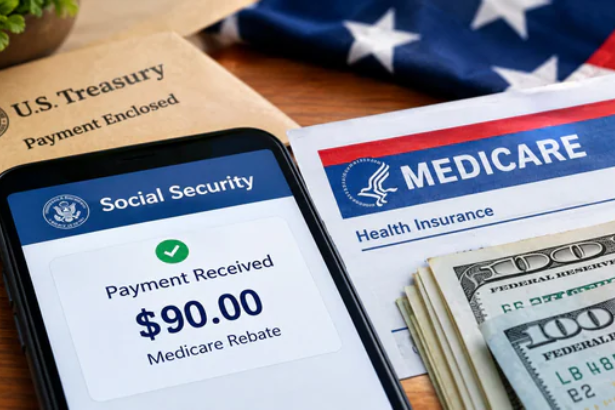
Why did I get $90 from Social Security? If you noticed a new $90 deposit in your bank account this week, it is not a new monthly Social Security benefit or a permanent increase in your retirement check. The payment is a one-time Medicare Part B premium rebate being distributed to eligible beneficiaries through the Medicare Improvement Fund. CBS News
The Centers for Medicare & Medicaid Services says 20.8 million Americans are eligible for the payment. Most are receiving the money by direct deposit around October 8, while some beneficiaries will receive paper checks later in October. Centers for Medicare & Medicaid Services
That distinction matters because the payment is arriving through channels many recipients associate with Social Security. In most cases, however, the money is connected to Medicare, not a new Social Security payment.
Background and Context
The $90 payment comes from the Medicare Improvement Fund, a federal fund created by Congress in 2008 to support improvements to the original Medicare fee-for-service program.
The White House announced on October 2 that the administration would use the fund to provide one-time $90 payments to more than 20 million Medicare beneficiaries to help offset their Part B premiums. The White House
CMS subsequently published detailed eligibility rules.
The payment is intended for people enrolled in Original Medicare Part B who:
- Live in the United States
- Are not receiving Medicaid assistance that pays their Part B premium
- Do not pay an Income-Related Monthly Adjustment Amount, known as IRMAA
- Are not enrolled in Medicare Advantage
CMS estimates that 20.8 million people qualify. Centers for Medicare & Medicaid Services
The timing is significant because Medicare Part B costs increased in 2026. The standard Part B premium is $202.90 per month, compared with $185 in 2025. The annual Part B deductible also increased to $283. Centers for Medicare & Medicaid Services
The $90 payment therefore covers less than half of the standard monthly premium. It is financial relief for one month, not a permanent reduction in what beneficiaries owe.
Latest Update: Why Did I Get $90 From Social Security?
The simplest answer is this:
You probably received the $90 because you are an eligible Original Medicare Part B beneficiary.
CMS says most eligible beneficiaries receive the rebate through a direct deposit from the Social Security Administration. People without direct deposit will receive a paper check at the mailing address registered with Medicare. Centers for Medicare & Medicaid Services
That explains why some recipients initially assume the money is a new Social Security benefit.
It is not.
The payment is formally the Medicare Improvement Fund Premium Rebate, and CMS says each eligible person receives one $90 rebate in October 2026. Centers for Medicare & Medicaid Services
The agency says most direct deposits should arrive on or around October 8. Paper checks are scheduled to arrive later in October.
If you received the money, there is generally nothing you need to apply for or claim.
Who qualifies for the $90 payment?
The eligibility rules are narrower than the phrase “senior payment” might suggest.
You generally qualify if you have:
Original Medicare + Part B + no Medicaid premium assistance + no IRMAA.
People enrolled in Medicare Advantage do not qualify, even though Medicare Advantage enrollees generally still have Part B coverage. Higher-income beneficiaries who pay IRMAA also do not qualify. Centers for Medicare & Medicaid Services
Why didn’t I get the $90?
Not receiving the payment does not necessarily mean something went wrong.
There are roughly 62.9 million Medicare Part B enrollees, according to the CBS report, while only about one-third qualify for the new payment. CBS News
You may not qualify if:
- You are enrolled in Medicare Advantage
- Medicaid already pays your Part B premium
- You pay an income-related Part B surcharge
- You otherwise fall outside the CMS eligibility requirements
So the absence of a $90 payment is not, by itself, evidence that your Social Security account has a problem.
Expert Insights and Analysis
The unusual part of this payment is not simply the $90 amount. It is how the federal government is using the Medicare Improvement Fund.
CMS says the fund was established to make improvements under original Medicare Parts A and B. The administration is now using it for a direct premium rebate to beneficiaries. Centers for Medicare & Medicaid Services
The White House describes the move as putting Medicare dollars directly into beneficiaries’ hands. Critics and outside analysts have focused instead on the limited size of the payment relative to broader healthcare costs. CBS reported that experts view the $90 as helpful but insufficient to fully offset rising Medicare expenses. CBS News
There is also a political context that readers should understand without confusing it with the mechanics of the payment.
The announcement comes weeks before the November 2026 midterm elections. Reuters and the Associated Press have reported that the payment is part of a broader series of financial initiatives and promises from the Trump administration. Reuters
That timing has generated political debate. But regardless of those arguments, the eligibility rules and payment mechanism are administrative questions that can be answered separately.
Broader Implications
The $90 is not a Social Security increase
This may be the most important takeaway.
If your regular Social Security benefit was $2,000, for example, this payment does not mean your new monthly benefit is $2,090.
The $90 is a one-time Medicare-related payment.
It should not be interpreted as a permanent cost-of-living adjustment, a new Social Security benefit or a recurring monthly payment. Hindustan Times
Medicare costs remain substantially higher
The rebate arrives against a backdrop of higher Part B costs.
The standard 2026 Part B premium is $202.90 per month, meaning the $90 payment represents roughly 44% of one month’s standard premium. Centers for Medicare & Medicaid Services
That makes the payment noticeable for beneficiaries, but it does not fundamentally change the underlying Medicare premium structure.
Why the delivery method is causing confusion
The Social Security Administration is handling direct deposits for most eligible beneficiaries, according to CMS. That creates a natural source of confusion for people who normally associate SSA deposits with their retirement or disability benefits. Centers for Medicare & Medicaid Services
For more coverage of Social Security, Medicare and how technology is changing the way Americans manage money and government benefits, see The Tech Marketer.
Related History or Comparable Payments
The $90 rebate is different from several other payments that have recently been discussed by the Trump administration.
It is not the same as the separate $500 payments associated with Affordable Care Act premiums. Reuters reports that those payments involve a different program and a separate group of recipients. Investing.com
It is also different from the proposed $5,000 payment that Trump has discussed for American adults if Republicans retain control of Congress. That proposal would require a separate process and should not be confused with the Medicare payment already being distributed. Investing.com
In other words, seeing $90 in your account does not mean you are receiving one of those other payments.
What Happens Next
For eligible beneficiaries, the immediate question is whether the payment has arrived.
CMS says most eligible people should receive their $90 direct deposit around October 8. Those without direct deposit will receive a paper check later in October. Centers for Medicare & Medicaid Services
The agency says people who want to check eligibility can contact 1-800-MEDICARE.
For payment-status questions, CMS says beneficiaries can contact the Social Security Administration at 1-800-772-1213 beginning October 15, 2026. Centers for Medicare & Medicaid Services
And there is one important fraud warning: you should not need to pay anyone to receive the $90 payment or provide banking information to a caller claiming they need to “activate” it.
Conclusion
So, why did I get $90 from Social Security?
Because the federal government is distributing a one-time Medicare Improvement Fund Premium Rebate to 20.8 million eligible Original Medicare Part B beneficiaries.
The payment is being delivered through Social Security’s direct-deposit system for most recipients, which explains why it can appear to be a Social Security payment.
It is not a new monthly benefit.
It is not a permanent Social Security increase.
And it is not going to every senior on Medicare.
If you received the $90, the money is intended to offset part of your October Medicare Part B premium. If you did not receive it, Medicare Advantage enrollment, Medicaid premium assistance or an income-related premium could explain why.
The simplest way to think about it is: $90 once, Medicare Part B, October 2026.
FAQ
1. Why did I get $90 from Social Security?
The $90 is a one-time Medicare Improvement Fund Premium Rebate for eligible Original Medicare Part B beneficiaries. Most eligible recipients receive it through a direct deposit handled by the Social Security Administration. Centers for Medicare & Medicaid Services
2. Is the $90 payment a new Social Security benefit?
No. It is a one-time Medicare Part B premium rebate, not a permanent increase in Social Security benefits. Hindustan Times
3. Who gets the $90 Medicare payment?
CMS says 20.8 million people qualify. They must generally have Original Medicare Part B, live in the United States, not receive Medicaid premium assistance and not pay IRMAA. Medicare Advantage beneficiaries are excluded. Centers for Medicare & Medicaid Services
4. Is the $90 payment every month?
No. CMS describes it as one $90 rebate in October 2026. Centers for Medicare & Medicaid Services
5. Why didn’t I get the $90 payment?
You may not qualify if you have Medicare Advantage, receive Medicaid assistance that covers your Part B premium, pay IRMAA or otherwise fail the eligibility requirements.
6. When will the $90 payment arrive?
Most eligible beneficiaries should receive a direct deposit on or around October 8, 2026. Paper checks are scheduled to arrive later in October. Centers for Medicare & Medicaid Services
7. How much is Medicare Part B in 2026?
The standard monthly Part B premium is $202.90 in 2026, up from $185 in 2025. Centers for Medicare & Medicaid Services
8. Is the $90 Medicare payment legitimate?
Yes. The payment has been formally announced by the federal government and detailed in CMS guidance. Eligible beneficiaries do not need to pay someone or submit a separate application to receive it. The White House
Sources & References
- Centers for Medicare & Medicaid Services: “Medicare Improvement Fund Premium Rebate Frequently Asked Questions.” Read the CMS guidance
- The White House: “Fact Sheet: President Donald J. Trump Announces Medicare Improvement Fund Payments for Seniors.” Read the White House fact sheet
- CBS News: “Why you just got a $90 Social Security check, and why 40 million seniors didn’t.” Read the CBS News report
- Reuters: “Trump says US to send one-time $90 payment to 20 million seniors enrolled in Medicare.” Read the Reuters report
- Centers for Medicare & Medicaid Services: “2026 Medicare Parts A & B Premiums and Deductibles.” Read the CMS premium information