


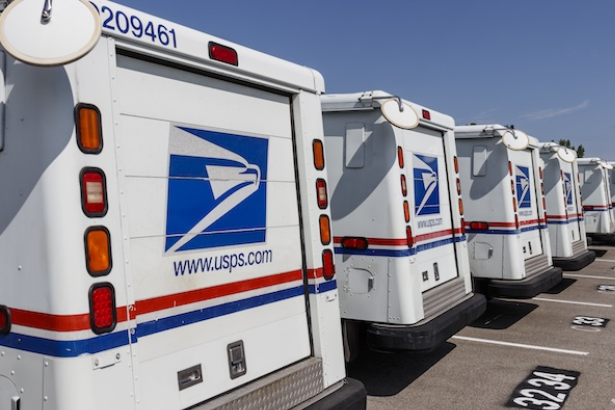
The USPS FY2026 results released this month show a postal service making real financial progress, even as leadership insists the underlying crisis remains far from resolved.
Revenue Growth and a Smaller Net Loss
Operating revenue was $82.9 billion, a 3.0 percent increase compared to the prior year, while net loss decreased by $2.5 billion and controllable loss decreased by $344 million compared to the prior year. Net loss for the year under generally accepted accounting principles (GAAP) totaled $6.5 billion, compared to $9.0 billion for the prior year. uspsusps
Controllable loss, which excludes certain expenses that are not controllable by management, was $2.4 billion for the year, compared to controllable loss of $2.7 billion for the prior year. That distinction between GAAP net loss and controllable loss matters for understanding USPS’s finances: it separates expenses the agency can actually influence, like staffing and operations, from structural costs like retiree benefits that are set largely by federal policy. usps
What Drove the Improvement
The $2.5 billion decrease in net loss is attributed to a $2.4 billion increase in operating revenue, along with a $2.4 billion decrease in workers’ compensation expense and a $277 million decrease in retirement expenses. A net decrease in interest income (expense) of $252 million and a decrease in other revenue of $106 million also factored into the year’s results. uspsusps
Revenue strength came from multiple mail categories. First-Class Mail revenue reached $26,161 million, up from $25,850 million the prior year, while Marketing Mail revenue climbed to $16,695 million from $15,852 million, even as First-Class Mail volume declined from 42,014 million pieces to 39,852 million pieces, underscoring how price increases and service mix shifts are offsetting ongoing volume erosion. usps
A Temporary Fix With Real Cash Implications
Part of the improvement relied on a deferred federal obligation rather than pure operational gains. The organization elected to suspend payments for the bi-weekly normal cost contributions for employees covered under the Federal Employee Retirement System (FERS) and deferred approximately $2.6 billion this year. That move traces back to earlier in the fiscal year, when the Postal Service suspended its portion of payments to the Office of Personnel Management for FERS contributions effective April 10, 2026, conserving approximately $200 million in cash each pay period and approximately $2.5 billion for the remainder of fiscal year 2026. uspsusps
Leadership’s Mixed Message on Progress
USPS leadership struck a cautiously positive tone on the results while stopping short of declaring the financial crisis resolved. “The results we are reporting for the year demonstrate solid improvements in revenue generation, cost control and service performance,” said Postmaster General David Steiner. Yet the agency’s own framing of the announcement makes clear the underlying structural problems persist: a “financial crisis continues in spite of self-help efforts, with reforms now urgently needed”. uspsusps
How This Fits the Longer Trend
This year’s results continue a pattern of year-over-year improvement that still leaves USPS deeply in the red. Fiscal year 2025 earnings saw further declines, with operating revenue at $80.5 billion, a 1.2% annual gain over fiscal year 2024, and a net loss under GAAP of $9.0 billion, trailing the $9.5 billion fiscal 2024 net loss. The trajectory, from a $9.5 billion loss two years ago to $9.0 billion last year to $6.5 billion this year, shows meaningful year-over-year improvement even as the agency’s own messaging insists structural reform, not incremental cost-cutting, is what’s actually needed. logisticsmgmt
Broader Implications for Shippers and Mail Customers
For businesses and shippers that depend on USPS for last-mile delivery, a shrinking net loss paired with rising Shipping and Packages revenue suggests continued investment in parcel capacity even as the agency manages a still-massive structural deficit. The deferred FERS payment, however, signals that some of this year’s improvement rests on temporary accounting relief rather than a fully resolved cost structure, meaning further rate increases or service changes remain a real possibility if Congress doesn’t act on the broader reforms USPS leadership says are urgently needed.
FAQ
1. What was USPS’s net loss for fiscal year 2026?
USPS reported a GAAP net loss of $6.5 billion for fiscal year 2026, down from $9.0 billion the prior year, a $2.5 billion improvement.
2. How much revenue did USPS generate in FY2026?
Operating revenue was $82.9 billion, a 3.0 percent increase compared to the prior fiscal year.
3. What drove the improvement in USPS’s financial results?
The improvement came from a $2.4 billion increase in operating revenue, a $2.4 billion decrease in workers’ compensation expense, and lower retirement expenses.
4. Did USPS cut any costs by deferring payments?
Yes. USPS suspended bi-weekly FERS retirement contributions, deferring approximately $2.6 billion during the fiscal year.
5. Does USPS consider its financial crisis resolved?
No. Despite the improved numbers, USPS leadership stated that its financial crisis continues and that urgent reforms are still needed.
Sources and References
- USPS Newsroom (National Release): about.usps.com/newsroom/national-releases/2026/1110-usps-reports-fiscal-year-2026-results.htm
- USPS Newsroom (Regional Release, PA): about.usps.com/newsroom/local-releases/pa/2026/1110-usps-reports-fiscal-year-2026-results.htm
- Logistics Management: logisticsmgmt.com/article/usps_reports_9.0b_loss_for_fiscal_year_2025/Express