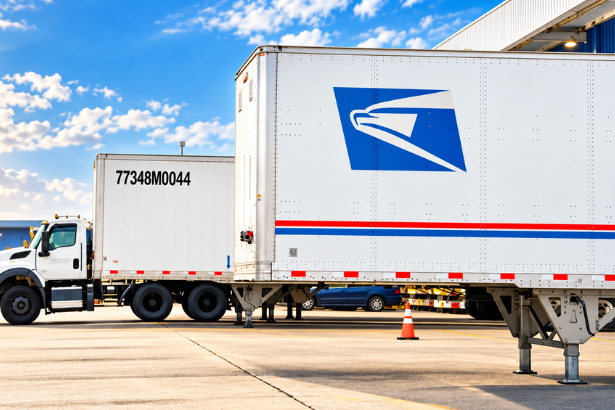
A major case of USPS freight auction fraud is raising fresh questions about how transportation companies verify deliveries and how public agencies protect payments on digital freight platforms. An Orlando, Florida, trucking and freight brokerage owner has pleaded guilty after collecting more than $1 million through a scheme involving mail transportation contracts that his company did not fulfill.
According to the U.S. Department of Justice, Khayyam Arif Oglu Farajov, 40, operated Talishco LLC and participated in the U.S. Postal Service’s Freight Auction program. Prosecutors said he secured hundreds of contracts, failed to transport many of the assigned loads, and then entered false delivery information to trigger payments.
The case is more than a story about one trucking business. It highlights a critical vulnerability in modern logistics: a digital record can show a shipment as completed even when the physical movement of goods never happened.
Background and Context: How the USPS Freight Auction Program Works
The U.S. Postal Service moves mail across the country using a broad transportation network that includes contracted trucking providers. Its Freight Auction program was designed to obtain transportation capacity through competitive bidding, allowing suppliers to bid on available routes.
The program began in October 2021. Talishco LLC enrolled in May 2022, according to the Justice Department. Between June 2022 and January 2023, Farajov won hundreds of contracts to transport mail on behalf of USPS.
Freight auction platforms can help logistics organizations match available capacity with transportation demand. They can also make contracting more flexible by allowing carriers and brokers to compete for work.
But digital efficiency creates a corresponding responsibility. The organization paying for a shipment needs reliable evidence that the service was performed. A contract award is not proof of pickup, and a delivery status entered into a system is not necessarily proof that freight reached its destination.
That distinction is central to the case.
Latest Update: What Happened in the USPS Freight Auction Fraud Case?
The Department of Justice announced the guilty plea on October 9, 2026. FreightWaves published its report on October 11, 2026.
Hundreds of contracts, but no trucks for many routes
According to the plea agreement summarized by federal prosecutors, Farajov routinely failed to send trucks for the transportation jobs his company had won.
When USPS employees asked why vehicles had not arrived, he allegedly offered excuses, including claims that drivers were delayed or that he had lost contact with them. USPS then reassigned the transportation work to other carriers.
The alleged scheme did not end when those replacement carriers took over.
Farajov returned to the Freight Auction platform and falsely marked the loads as delivered. Those entries triggered payments even though Talishco had not performed the contracted transportation.
The Justice Department said the scheme generated more than $1 million. The money was subsequently transferred through bank accounts associated with shell companies controlled by Farajov before being consolidated into two personal investment brokerage accounts.
The guilty plea and financial consequences
Farajov pleaded guilty to one count of wire fraud and one count of money laundering. He agreed to forfeit the seized brokerage accounts and pay an additional $993,979 in restitution to USPS.
Each offense carries a maximum possible federal prison sentence of 20 years. That is the statutory maximum, not a statement of the sentence he will receive. As of the October 9 announcement, a sentencing date had not been set.
The case was investigated by the U.S. Postal Service Office of Inspector General and is being prosecuted in the Middle District of Florida.
Readers can review the official Justice Department announcement for the legal details and agreed financial consequences.
Why proof of delivery matters
Freight transportation depends on records that connect a shipment’s digital status with what actually happened on the road. Those records can include tracking events, delivery confirmations and other supporting documentation.
When a payment system accepts inaccurate information, it risks paying for work that was never completed. The exposure can extend beyond one transaction if the same weakness affects multiple routes or suppliers.
The FreightWaves report also discusses a 2024 federal audit that identified weaknesses in USPS verification of proof-of-delivery records. USPS disputed a substantial portion of the audit’s initial findings, so the audit figures should not be treated as proof that every questioned payment was fraudulent.
The available reporting does not establish that the audit findings caused or directly enabled Farajov’s conduct. The two issues are relevant to the broader discussion of payment verification, but they should not be conflated.
Expert Insights and Analysis: Three Lessons for Logistics Operators
The case illustrates several operational risks that freight brokers, carriers, shippers and logistics technology providers should take seriously. The following are industry implications drawn from the reported facts, rather than claims that prosecutors made about every logistics platform.
1. A delivery status should not be the only evidence of delivery
A shipment management system may display a completed status, but that status is only as reliable as the process used to create and verify it.
Logistics teams should consider whether their controls compare delivery records with independent evidence, such as carrier tracking data, time-stamped events, recipient confirmations and route information. The appropriate combination depends on the shipment, the platform and the operational environment.
2. Repeated exceptions need more than manual follow-up
In the reported case, USPS employees were alerted when trucks did not arrive. The alleged fraud continued because the loads were reassigned and later marked as delivered by the original contractor.
That sequence suggests an important control question: does a failed pickup automatically prevent the original contractor from claiming successful completion?
A well-designed workflow should preserve the connection between a missed pickup, a reassigned route and the final payment decision. When those events are handled in separate systems, the organization may need additional checks to ensure the records agree.
3. Payment controls must follow the entire transaction
Fraud prevention cannot stop when a carrier is approved or a bid is accepted. It should continue through contract assignment, pickup, transit, delivery confirmation, invoice approval and payment.
Organizations can reduce exposure by applying risk-based reviews to unusual patterns, such as repeated missed pickups followed by successful delivery entries, inconsistent tracking data or payment claims that do not match the route history.
These controls do not eliminate fraud, but they can make suspicious transactions easier to detect before money is released.
Broader Implications: Freight Fraud Is an Industry-Wide Security Challenge
The logistics industry has increasingly adopted digital freight marketplaces, electronic documentation and automated payment processes. These tools can make operations faster, but they also create a need for stronger identity, data and transaction controls.
Freight fraud can take several forms. A criminal may impersonate a legitimate broker, redirect a shipment, submit false invoices or exploit gaps between a transportation event and the record used to approve payment. The USPS case illustrates a different risk: allegedly claiming payment for work that was not performed.
For shippers and public agencies, the financial impact is only part of the problem. Fraud can disrupt delivery schedules, create additional costs when replacement carriers are needed and undermine confidence in transportation procurement.
For legitimate carriers and brokers, stronger verification can help protect businesses from competitors using fraudulent practices. The challenge is to improve controls without creating unnecessary delays for compliant operators.
Companies reviewing their freight security processes should examine how carrier identities are verified, how shipment events are recorded, who can edit delivery information and whether payment systems independently validate critical events.
For more reporting on freight operations, transportation technology and logistics risk, visit The Tech Marketer.
Related History: Why Digital Freight Controls Matter
Digital freight marketplaces are intended to make transportation procurement more efficient. Rather than relying entirely on manual processes, shippers and logistics organizations can use online systems to award contracts, coordinate capacity and manage records.
Yet the same systems need to account for a fundamental limitation: digital activity and physical activity are not identical.
A booking confirms that a service was arranged. A tracking update may indicate movement. A proof-of-delivery record is meant to support the claim that the shipment reached its destination. Each serves a different purpose, and combining them without appropriate validation can create blind spots.
The broader logistics sector has also faced cargo theft, broker impersonation and fraudulent shipment instructions. These are different schemes, but they share a common problem: bad actors exploit gaps in the information that organizations use to trust a transaction.
The USPS case reinforces the importance of designing controls around the complete shipment lifecycle, not simply the electronic paperwork.
What Happens Next?
The immediate legal question is sentencing. According to the Justice Department’s October 9 announcement, no sentencing date had been set at the time of the release.
For logistics operators, the more enduring question is how to prevent a similar payment claim from passing through their own systems.
Organizations can begin by reviewing four areas:
- Delivery validation: Require credible supporting evidence before a shipment is treated as complete.
- Exception management: Link missed pickups and reassigned loads to the final payment decision.
- Access controls: Restrict who can change delivery statuses and retain an audit trail of edits.
- Payment review: Flag unusual patterns for further review before releasing funds.
These are practical risk-management measures, not a claim that any single control would have prevented this particular case. Their value depends on implementation, data quality and how consistently exceptions are investigated.
Conclusion
The USPS freight auction fraud case offers a clear warning for an increasingly digital transportation industry. When payment depends on a shipment’s recorded status, companies need confidence that the record reflects the physical movement of freight.
Federal prosecutors said the Orlando trucking company owner secured hundreds of USPS contracts, failed to perform many of the routes and entered false delivery information to obtain more than $1 million. His guilty plea, forfeiture agreement and restitution obligation underscore the financial and legal consequences of manipulating logistics transactions.
The broader lesson is straightforward: freight technology needs reliable verification behind the interface. Better links between route assignments, tracking records, delivery evidence and payment approval can help organizations identify suspicious activity and protect transportation budgets.
As freight marketplaces continue to automate more of the contracting process, the companies that treat data integrity as an operational priority will be better positioned to protect both their money and their customers’ trust.
FAQ
1. What is the USPS freight auction fraud case about?
Federal prosecutors said an Orlando trucking company owner obtained more than $1 million by claiming payments for USPS transportation routes his company had not performed. He pleaded guilty to wire fraud and money laundering.
2. Who was involved in the case?
The defendant was Khayyam Arif Oglu Farajov, who operated Talishco LLC, a trucking and freight brokerage business based in Orlando, Florida.
3. How did the alleged freight fraud work?
According to the Justice Department, the company won transportation contracts but failed to send trucks for many routes. After USPS reassigned the work, Farajov allegedly entered false delivery information into the freight platform, triggering payments.
4. How much money was involved?
Prosecutors said the scheme generated more than $1 million. Farajov also agreed to forfeit two seized brokerage accounts and pay an additional $993,979 in restitution to USPS.
5. What does the case mean for logistics companies?
It highlights the need to validate delivery records, monitor missed pickups, control edits to shipment statuses and ensure payment approval is supported by reliable evidence.
6. What is proof of delivery in freight transportation?
Proof of delivery is documentation or data used to support the claim that a shipment reached its intended destination. Depending on the system, it can include recipient confirmation, tracking events and other records. The evidence should be validated according to the shipment and payment requirements.
7. Has the defendant been sentenced?
The Justice Department’s October 9, 2026 announcement stated that a sentencing date had not yet been set. Each conviction carries a maximum possible sentence of 20 years, but that is not the same as the sentence ultimately imposed.
Sources & References
- U.S. Department of Justice, Middle District of Florida: Azerbaijani National Pleads Guilty to $1 Million Wire Fraud and Money Laundering Scheme Against the United States Postal Service
- FreightWaves: Orlando Trucking Owner Pleads Guilty in $1M USPS Freight Auction Fraud
- U.S. Department of Justice, Middle District of Florida: Azerbaijani National Indicted for $1 Million Wire Fraud and Money Laundering Offense Against the United States Postal Service