

Enterprise data environments have grown increasingly complex. Sales, service, marketing, commerce, and operations systems all generate critical information, yet much of it remains fragmented across warehouses, lakes, and external platforms. For CIOs, this fragmentation is more than an operational inconvenience. It is a strategic constraint that limits agility, innovation, and AI readiness.
As organizations accelerate digital transformation, integration challenges are emerging as one of the most significant barriers to progress. Traditional approaches that rely on copying, moving, and duplicating data across systems increase storage costs, introduce latency, and heighten security risks. Instead of creating clarity, they often compound fragmentation.
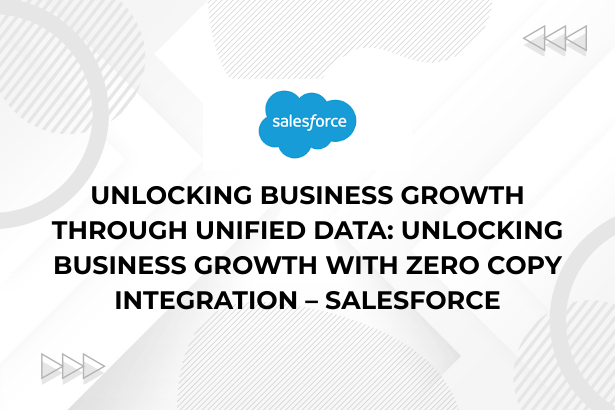
This CIO guide explores a different model. By leveraging zero copy integration, organizations can securely access data directly from its source without physically duplicating it. The result is real-time visibility, stronger governance, reduced redundancy, and a unified foundation for analytics and AI.
You Will Learn:
• Why data fragmentation is slowing digital transformation initiatives
• How traditional ETL-based architectures increase cost and complexity
• What zero copy integration is and how it differs from conventional data pipelines
• How Salesforce Data Cloud enables secure, bi-directional access to federated data
• Why eliminating redundant data copies improves governance and compliance
• How unified metadata frameworks orchestrate structured and unstructured data
• Practical use cases for modernizing data management without disruptive overhauls
• How zero copy architecture enhances operational resilience and data consistency
• Ways to streamline application development with secure, virtualized data access
• How to improve cross-team collaboration through a single source of truth
• Why unstructured data is essential for advancing AI and machine learning initiatives
Strategic Insight: Zero Copy Architecture Is a Catalyst for AI-Ready Enterprises
The shift toward zero copy integration represents more than a technical optimization. It signals a new philosophy of enterprise data management.
Traditional architectures depend on extracting, transforming, and loading data into multiple systems. While effective in earlier eras, this model struggles to keep pace with today’s AI-driven demands. Each duplicated dataset increases governance complexity, expands security exposure, and delays insight generation.
Zero copy integration removes these bottlenecks. By enabling secure, virtual access to data stored in external warehouses and lakes, organizations eliminate unnecessary replication. Data remains in its original environment while being accessible in real time across applications and workflows.
This approach delivers immediate operational advantages:
Reduced redundancy lowers storage costs and simplifies oversight.
Real-time accessibility accelerates decision-making across departments.
Centralized governance strengthens compliance with evolving regulatory standards.
The impact becomes even more powerful when combined with a unified metadata framework. External data sources are harmonized within a shared system of engagement, enabling sales, service, marketing, and commerce teams to act on a comprehensive 360-degree view. Rather than operating in silos, departments collaborate around a consistent and trustworthy dataset.
For application development teams, zero copy architecture streamlines sandbox testing and production environments. Developers gain secure access to both structured and unstructured data without complex replication pipelines, accelerating innovation while maintaining governance standards.
AI initiatives benefit significantly as well. Machine learning models require large, diverse datasets to generate meaningful predictions. Virtualized access to unstructured data such as documents, notes, images, and transactional records ensures models are trained on comprehensive and up-to-date information. This reduces model drift, improves accuracy, and supports scalable AI adoption.
Perhaps most importantly, zero copy integration strengthens organizational resilience. By reducing dependencies on multiple storage environments and eliminating synchronization delays, enterprises can adapt more quickly to changing market conditions.
CIOs who adopt this model transform data from a fragmented liability into a strategic asset. Instead of managing complexity, they enable agility. Instead of duplicating data, they activate it.
Who Should Read This CIO Guide?
This guide is designed for CIOs, Chief Data Officers, IT leaders, enterprise architects, digital transformation executives, and technology strategists responsible for modernizing data infrastructure and enabling AI-driven growth. It is particularly valuable for organizations seeking to reduce integration complexity while improving governance, collaboration, and innovation velocity.
Download Unlocking Business Growth with Zero Copy Integration from Salesforce to learn how unified, secure, and real-time data access can accelerate AI initiatives, modernize architecture, and position your organization for sustained competitive advantage.