Introduction
The Trump Bombardier dispute has quickly become one of the most striking examples of how the latest U.S.-Canada trade confrontation is moving beyond tariffs and into individual companies.
On Monday, Trump said Bombardier should no longer be allowed to sell aircraft in the United States unless it builds them there. The warning came just hours before Canada was due to impose retaliatory tariffs on billions of dollars of U.S. goods.
Bombardier’s response highlighted a key complication: the Montreal-based aerospace company already has a substantial American footprint, including thousands of U.S. employees, facilities across multiple states and a supply chain that depends heavily on American companies.
The result is a trade dispute that now reaches deep into North America’s highly integrated aerospace industry.
Background and Context
Bombardier is one of Canada’s most important aerospace companies and a major player in the business jet market.
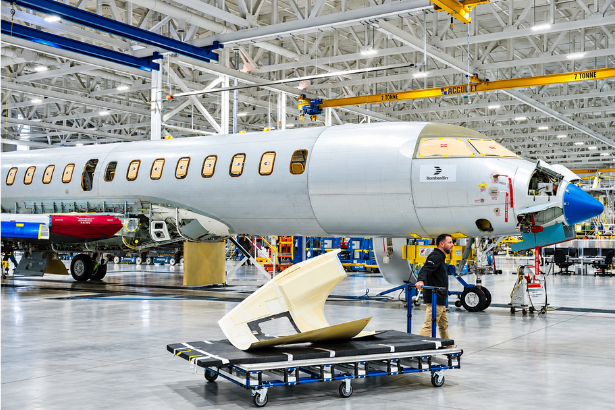
Its aircraft are manufactured through a North American production network rather than within a single country. Bombardier has facilities in Canada, the United States and Mexico, while its aircraft incorporate major components supplied by American companies.
That makes the latest demand from Trump particularly complicated.
According to reporting based on Bombardier’s response, the company employs approximately 3,500 people in the United States and has operations in states including Kansas, Texas, Arizona, Florida, Connecticut, Illinois, Delaware, California and New Jersey. About half of Bombardier’s roughly 5,100 aircraft fleet is operated by U.S.-based customers.
Bombardier also operates a U.S. manufacturing facility in Kansas that builds special-mission aircraft.
The company has emphasized that its American operations support tens of thousands of jobs and that its aircraft use American-made engines, avionics and other systems.
That existing footprint is now at the center of the argument.
Latest Update or News Breakdown
Trump Targets Bombardier Directly
Trump’s latest warning was unusually direct.
In a social media post, he said there should be “no more selling Bombardier in the United States” unless the company builds in America. He also criticized the company’s relationship with the U.S. market and argued that Bombardier benefits heavily from American buyers and infrastructure.
The threat does not appear to be accompanied by a detailed public mechanism explaining exactly how such a restriction would be imposed.
That is one of the biggest unanswered questions in the story.
The BBC report on the Bombardier dispute notes that it remains unclear how the Trump administration would actually prevent Bombardier from doing business in the United States.
Bombardier Highlights Its American Footprint
Bombardier did not respond by announcing a new U.S. production shift.
Instead, the company pointed to what it already does in America.
Bombardier said it has direct employment in more than 20 states and sites in 10 states. It also emphasized its relationships with American suppliers and the use of U.S.-made components in its aircraft.
The company also has plans to expand its defense activities and service network in the United States, including a new facility in Fort Wayne, Indiana.
That response effectively reframes the dispute.
From Bombardier’s perspective, the company is not simply a foreign manufacturer selling products into America. It is already deeply embedded in the U.S. industrial economy.
The Threat Comes as Canadian Tariffs Take Effect
The timing is crucial.
Canada’s retaliatory tariffs took effect on Sept. 8, targeting approximately $20 billion of U.S. goods after trade negotiations between Washington and Ottawa stalled. The measures cover a range of products and represent another escalation in the broader dispute.
The Bombardier threat therefore arrived at exactly the moment when the wider trade conflict was intensifying.
That makes the aerospace company more than just another corporate name in the dispute.
Bombardier has become a symbol of the broader argument over whether Canadian companies should retain access to the U.S. market while maintaining production in Canada.
Expert Insights or Analysis
The central problem with the Trump Bombardier confrontation is that modern aerospace manufacturing does not fit neatly into national borders.
A business jet may be assembled in one country, contain engines and avionics from U.S. suppliers, rely on components from multiple countries and then be serviced by a network spread across North America.
Trying to force that entire system into a simple “build in America or lose the market” framework could have consequences beyond Bombardier itself.
Bombardier Already Depends on the U.S.
Reuters reported that Bombardier has roughly 3,500 U.S. employees, relationships with about 2,800 American suppliers and annual spending of more than $2.5 billion with U.S. suppliers.
Those numbers explain why the company’s response has focused heavily on its existing American presence.
The aerospace sector itself also has an unusually complicated trade relationship with the United States. Reuters reported that the U.S. aerospace industry maintains a substantial trade surplus, while Bombardier’s operations are intertwined with American suppliers and customers.
That means any attempt to restrict Bombardier sales could potentially affect American companies as well.
There Is Also a Precedent
This is not the first time Bombardier has found itself caught in a U.S.-Canada political dispute.
The company was at the center of a major trade confrontation during Trump’s first administration, when Boeing accused Bombardier of receiving unfair government support.
The U.S. Commerce Department imposed proposed duties on Bombardier’s C Series aircraft before the U.S. International Trade Commission rejected Boeing’s complaint and the duties were ultimately not imposed.
The current dispute is different, but the history shows how quickly aerospace companies can become proxies for broader industrial policy battles.
Bombardier Is Expanding Its U.S. Presence Anyway
There is another important piece of context.
Bombardier recently announced plans to acquire a Canadian factory from Mitsubishi Heavy Industries that manufactures wings for its Global 5500 and 6500 business jets. The move shows that Bombardier is simultaneously bringing more production capabilities in-house while continuing to operate a large North American network.
That makes the company’s long-term manufacturing strategy particularly relevant.
The question is no longer simply whether Bombardier has American operations.
It is how much additional production the company might be willing to move or establish in the United States if market access becomes conditional on local manufacturing.
Broader Implications
The Trump Bombardier confrontation could matter well beyond one aerospace manufacturer.
It introduces a new possibility in the U.S.-Canada trade war: market access itself could become a bargaining tool against individual companies.
That would represent a significant shift from traditional tariff policy.
Tariffs raise the cost of imported products. A market-access restriction can potentially prevent a product from being sold altogether.
For multinational manufacturers, that distinction is enormous.
Aerospace Supply Chains Could Face More Pressure
Aerospace supply chains are particularly sensitive because aircraft programs involve long development cycles, strict certification requirements and highly specialized suppliers.
A manufacturer cannot necessarily move production from one country to another overnight.
Factories require investment. Workers need specialized training. Suppliers need certification. Aircraft production lines must meet regulatory requirements.
That means a sudden market-access requirement could create costs for the manufacturer while also affecting suppliers, airlines, corporate aircraft buyers and maintenance organizations.
The Dispute Could Influence Other Companies
Bombardier is not the only Canadian company with a major U.S. customer base.
Canada and the United States maintain one of the world’s most integrated cross-border economies. Energy, automobiles, aerospace, agriculture, technology and manufacturing all depend on supply chains that cross the border.
If the Bombardier threat becomes a broader template for trade negotiations, other Canadian manufacturers could face similar pressure to expand U.S. production.
For businesses watching this closely, The Tech Marketer can provide additional coverage of how technology, manufacturing and geopolitics are reshaping global supply chains.
Related History or Comparable Technologies
The Bombardier dispute fits into a much larger history of governments attempting to use trade policy to influence where companies manufacture products.
Aircraft are particularly attractive targets because aerospace manufacturing is strategically important, highly skilled and closely connected to defense.
The United States has long used procurement rules, tariffs, export controls and domestic-content requirements to encourage manufacturing within the country.
Canada has also pursued industrial policies designed to protect and develop domestic aerospace capabilities.
The difference today is the degree of integration between the two economies.
Bombardier’s American employees, U.S. suppliers and American customers mean that a restriction targeting a Canadian manufacturer can quickly become an issue for American businesses too.
That is the central tension.
The more integrated the supply chain becomes, the harder it is to draw a clean line between foreign production and domestic economic activity.
What Happens Next
Several questions will determine where the Trump Bombardier dispute goes from here.
1. Will the administration explain how a sales ban would work?
Trump has threatened to prevent Bombardier from selling aircraft in the United States, but the precise legal and regulatory mechanism remains unclear.
That will be one of the first things businesses and investors watch.
2. Will Bombardier offer additional U.S. investment?
Bombardier already has significant U.S. operations, and the company says it intends to continue investing in its American workforce, customers and communities.
Whether that translates into additional final assembly or other aircraft manufacturing in the United States remains an open question.
3. Will Canada retaliate further?
Canada has already implemented new countermeasures against U.S. goods. The broader trade dispute could escalate further if negotiations remain frozen.
Bombardier could therefore find itself caught between pressure from Washington and potential Canadian expectations to maintain domestic manufacturing.
4. Will the aerospace industry push back?
Industry groups and U.S. suppliers have an incentive to make the economic costs of restricting Bombardier visible.
If American companies lose business because of restrictions on a Canadian manufacturer, the political calculation becomes more complicated.
Conclusion
The latest Trump Bombardier confrontation is about much more than private jets.
It represents a new stage in the U.S.-Canada trade dispute, where Washington is threatening to condition market access for a major Canadian manufacturer on increased production inside the United States.
Bombardier’s response highlights the central contradiction: the company is Canadian, but its business is already deeply American.
It employs thousands of Americans, works with thousands of U.S. suppliers, operates facilities across the country and sells a significant share of its aircraft to U.S. customers.
That makes the next move especially important.
If Trump follows through with a formal restriction, Bombardier could face a major strategic decision over where it builds aircraft and how it organizes its North American operations.
If the threat remains a negotiating tactic, the episode could instead become another pressure point in a broader attempt to reshape the U.S.-Canada trade relationship.
Either way, Bombardier has become one of the most visible corporate casualties of a trade war that is becoming increasingly difficult to contain.
FAQ
What is the Trump Bombardier dispute about?
President Donald Trump has threatened to prevent Bombardier from selling aircraft in the United States unless the Canadian company builds aircraft in America. The threat comes amid a wider U.S.-Canada trade dispute.
Is Bombardier already operating in the United States?
Yes. Bombardier has facilities and employees across the United States, including a manufacturing operation in Kansas. The company says it has direct employment in more than 20 states and sites in 10 states.
Why is Trump targeting Bombardier?
Trump has argued that Bombardier benefits heavily from access to the U.S. market while maintaining much of its manufacturing footprint in Canada. His demand is part of the wider push for more production inside the United States.
Could Trump actually stop Bombardier from selling jets in the U.S.?
The exact mechanism is not clear. Reporting on Trump’s announcement says it remains uncertain how the administration would legally or practically block Bombardier aircraft from the U.S. market.
How many Americans work for Bombardier?
Recent reporting puts Bombardier’s direct U.S. employment at about 3,500 workers, with the company saying its wider American footprint supports tens of thousands of jobs.
What tariffs is Canada imposing on the United States?
Canada has implemented retaliatory tariffs on billions of dollars of U.S. goods after negotiations with Washington stalled. Reuters reported that the latest measures target approximately $20 billion in U.S. products, with rates varying by product.
Sources & References
- “Trump says Canada’s Bombardier must build jets in US or lose market access”, Reuters. Read the Reuters report
- “Bombardier points out U.S. footprint after Trump says aerospace giant must build in America”, CNBC. Read the CNBC report
- “Trump threatens to stop sale of Canadian Bombardier jets in US”, BBC. Read the BBC report
- “Canada’s retaliatory tariffs take effect as US trade talks stall”, Reuters. Read the Reuters tariff report
- Bombardier economic footprint report, Bombardier. Read Bombardier’s economic footprint report