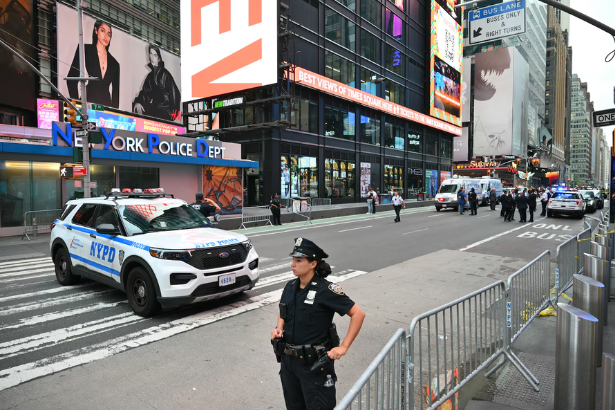
A deadly afternoon attack in the heart of Manhattan has put public safety, mental health intervention and the limits of security in crowded public spaces back under the spotlight.
The Times Square stabbing that killed 32-year-old Bank of America vice president Erin Piacenti unfolded in broad daylight on August 31, 2026, in one of New York City’s busiest tourist districts. Police say a 49-year-old Queens woman, Pamela Cisneros, attacked two strangers with knives before confronting officers and being fatally shot. Piacenti later died at Bellevue Hospital, while the other victim, a 68-year-old man, survived. Police have described the attack as random and unprovoked.
The incident has since generated a sharp spike in online searches. The supplied Google Trends screenshot shows searches around “Erin Piacenti,” “Bank of America vice president,” “Times Square stabbing” and related terms rising rapidly before beginning to fall. That search pattern reflects how quickly a local crime story can become a national information event.
Background and Context
Times Square is more than a tourist attraction. It is a dense intersection of commuters, office workers, theatergoers, tourists and law enforcement, making violent incidents there particularly visible.
According to police accounts, the attack happened shortly after 4:20 p.m. near West 42nd Street and Seventh Avenue. Cisneros allegedly approached a 68-year-old man who had just exited the subway and was waiting to cross the street with his wife. Police say she pulled two large knives from a shopping bag and stabbed him. She then moved toward Piacenti and stabbed her in the abdomen. The two attacks happened roughly 20 seconds apart.
The attacker then moved north toward the area of an NYPD substation.
Officers confronted her and spent approximately four minutes ordering her to drop the knives. According to the police account reported by Fox Business, she refused and threatened the officers. Officers used Tasers, but police said the devices did not stop her advance. Two officers then fired their weapons, striking Cisneros. She was taken to a hospital and later died.
Police Commissioner Jessica Tisch described the incident as a rapidly evolving threat in a crowded area.
There is also an important distinction in the reporting: police said Cisneros had a documented history of mental health-related encounters, but that history should not be treated as an explanation for the violence by itself. Mental illness is not synonymous with violent behavior, and authorities have not publicly established a medical cause for the attack.
Latest Update: What Happened in the Times Square Stabbing
The latest reporting identifies Piacenti as the woman killed in the attack.
NBC New York’s report on the Times Square stabbing reports that Piacenti was a New Jersey resident who worked for Bank of America. Police said Cisneros had a documented history of mental health concerns dating to 2018 and 2019, but no criminal history.
The victim’s professional background has also emerged. Piacenti worked as a vice president in Bank of America’s business selection and conflicts unit. She had earned an undergraduate degree from the University of Pennsylvania and graduated from Fordham Law School in 2021. Fordham confirmed that Piacenti and her husband, Frank, were members of the law school’s community.
Bank of America confirmed her death and expressed condolences to her family and loved ones. Reuters reported that the bank described Piacenti as a valued teammate and said its security teams were supporting the police investigation.
The other victim, a 68-year-old man, was hospitalized and reported in stable condition. His identity has not been publicly released in the major reports reviewed for this article.
What Police Say About the Suspect
Police identified the suspect as Pamela Cisneros, 49, of Queens.
According to the reporting, Cisneros had prior interactions with police connected to mental health episodes but did not have a criminal record. NBC New York reported that the documented history went back to 2018 and 2019.
Family members have also spoken publicly. Gothamist and other outlets reported that relatives described a long-running struggle with mental health. However, those family accounts remain separate from any official determination of what caused the attack.
Gothamist’s reporting on the suspect and her family provides additional context about those family statements.
The distinction matters because a documented mental health history does not establish motive. Investigators still have to determine what happened immediately before the attack and whether there were other contributing factors.
Expert Insights and Analysis
The Times Square stabbing raises a difficult question for modern cities: How do you protect millions of people moving through public spaces without turning those spaces into fortified zones?
There is no simple technological answer.
Security cameras can document an attack but cannot necessarily prevent it. Police substations can shorten response times but cannot eliminate threats that unfold within seconds. Screening systems can detect some weapons, but deploying airport-style security across an open urban district would fundamentally change how public spaces operate.
The Times Square case illustrates the value of rapid response.
Police were able to reach the suspect quickly, confront her and prevent the attack from continuing after she moved toward officers. According to police, officers attempted verbal commands and less-lethal measures before opening fire when she advanced while armed.
That sequence will likely receive close scrutiny as the NYPD investigates the officer-involved shooting. The investigation will examine the officers’ actions, available video footage, witness accounts and the precise timeline of the confrontation.
The Mental Health Question
The case is also likely to reignite debate around mental health services and interactions between police and people experiencing psychiatric crises.
But the discussion needs to avoid a familiar trap.
It is tempting to look at a violent incident involving someone with a mental health history and conclude that the diagnosis explains the crime. The evidence does not support that shortcut.
Instead, the more useful policy question is whether existing systems identified warning signs, whether appropriate treatment was available, whether family members had meaningful avenues for intervention and how police should respond when someone in crisis becomes an immediate threat.
That is a much harder question, but it is also the one that can lead to practical improvements.
Broader Implications
Public Safety in High-Density Urban Spaces
The Times Square stabbing occurred in a location where thousands of people can be within a few blocks at any given time.
That density creates a unique security problem. A single person carrying a weapon can move through a crowd faster than traditional security systems can react.
Cities are therefore increasingly relying on layers of protection rather than one single solution:
- Visible police presence
- Fixed and mobile cameras
- Emergency communications
- Rapid-response patrols
- Transit security
- Crowd monitoring
- Behavioral threat assessment
- Public reporting systems
The objective is not to eliminate every possible threat. That is unrealistic. The objective is to shorten the time between an incident beginning and authorities gaining control of the situation.
Technology’s Role in Urban Security
Technology can help, but it comes with tradeoffs.
Artificial intelligence-powered video analytics, for example, can potentially identify unusual movements, abandoned objects or weapons. Connected cameras can give officers a broader view of a developing incident. Emergency systems can distribute alerts across transportation networks and public agencies.
But automated surveillance also raises questions about privacy, false positives and civil liberties.
The Times Square stabbing therefore belongs to a larger technology debate: How much surveillance should a city deploy in exchange for greater public safety?
That question will become increasingly important as cities add AI-based monitoring systems.
For readers following the intersection of technology, policy and public safety, an internal link opportunity for The Tech Marketer would be an explainer on AI-powered surveillance in smart cities:
A Search Story as Well as a Crime Story
The Google Trends data supplied for this article adds another layer.
The screenshot shows a sharp rise in searches for “Erin Piacenti” and related terms, with associated searches including:
- Bank of America vice president
- Bank of America
- Times Square stabbing
- Bank of America VP
- Vice president of Bank of America
- New York stabbing suspect
- Bank of America VP killed
- BofA
- Erin Piacenti
This is a classic breaking-news search curve.
People initially search for the broad event. As the identity of the victim becomes known, searches become more specific. Users then search for the suspect, employer, background and unanswered questions.
The pattern demonstrates why search behavior has become an important part of modern news distribution. A story can move from local reporting to national discovery within hours.
Related History or Comparable Technologies
The Times Square stabbing is not the first violent incident to trigger questions about security in the area.
CBS New York reported that a man was fatally stabbed in Times Square in May 2026. Police later arrested a teenager in connection with that killing, and investigators said the incident was connected to a social-media trend.
The two incidents are not directly connected, but their proximity in time is significant for public perception.
Times Square has also become a recurring case study in how public spaces respond to sudden violence. The area combines dense pedestrian traffic, transportation infrastructure, commercial buildings, surveillance systems and a large police presence.
That makes it an unusually useful environment for studying urban security technology.
The comparable technologies fall into several categories:
Computer vision: Cameras can help authorities reconstruct events and potentially identify suspicious activity.
Real-time communications: Faster information sharing between patrol officers and command centers can reduce response times.
Weapons detection: Some transit and public-space systems are experimenting with technologies capable of detecting weapons without traditional physical searches.
Predictive analytics: Algorithms can identify patterns in crime data, although predictive policing remains controversial because of concerns about bias and accuracy.
The lesson is that technology works best as an additional layer. It cannot replace trained officers, emergency medical services, community intervention or effective mental health care.
What Happens Next
Several investigations are now likely to continue in parallel.
First, authorities will reconstruct the stabbing itself. Investigators will review surveillance footage, witness statements, emergency calls and physical evidence.
Second, the NYPD will investigate the officer-involved shooting that killed Cisneros.
Third, investigators will continue examining Cisneros’ background, including her previous interactions with police and any available medical or family information that could help establish what happened before the attack.
Fourth, Piacenti’s family, colleagues and wider professional community will begin the difficult process of dealing with her death.
Bank of America has already expressed its condolences, while Fordham Law has also mourned her loss.
The larger public debate will probably continue beyond this individual case.
New York has experienced a decline in several major crime categories this year, according to police data cited by Forbes and NBC New York, yet highly visible attacks in crowded places can have an outsized effect on public perception.
That gap between overall statistics and individual experiences is important.
A city can become statistically safer while residents and visitors still feel vulnerable when a random attack happens in a location they associate with safety, tourism and police visibility.
Conclusion
The Times Square stabbing that killed Erin Piacenti is first and foremost a human tragedy. A 32-year-old professional was killed during an apparently random attack in the middle of one of New York City’s busiest districts, while another victim was seriously injured.
The case also exposes several difficult questions about modern urban life.
How quickly can police respond to unpredictable violence? How should officers handle people experiencing severe crises? What role should surveillance and AI play in public safety? And how can cities make crowded public spaces safer without fundamentally changing their character?
Those questions do not have easy answers.
What is clear from the available reporting is that the attack was described by police as random and unprovoked, that Cisneros had a documented history of mental health-related police encounters, and that officers ultimately confronted her after she allegedly refused repeated commands to drop two knives.
As investigators reconstruct the incident, the focus should remain on facts rather than speculation.
The online search surge captured in the supplied Google Trends screenshot shows how quickly the public is looking for those facts. People want to know who Erin Piacenti was, what happened in Times Square, who the suspect was and whether anything could have prevented the attack.
Those questions will continue to shape the story long after the search spike fades.
FAQ
1. What happened in the Times Square stabbing?
A woman identified by police as 49-year-old Pamela Cisneros allegedly stabbed two people in Times Square on August 31, 2026. One victim, 32-year-old Bank of America vice president Erin Piacenti, died at Bellevue Hospital. A 68-year-old man survived and was hospitalized.
2. Who was Erin Piacenti?
Erin Piacenti was a 32-year-old New Jersey resident and Bank of America vice president. She worked in the bank’s business selection and conflicts unit and had graduated from Fordham Law School in 2021.
3. Who was responsible for the Times Square stabbing?
Police identified Pamela Cisneros, 49, of Queens, as the alleged attacker. Police said she was carrying two knives and attacked two strangers before confronting officers. She was fatally shot by police after refusing orders to drop the weapons and advancing toward officers.
4. Did the suspect have a mental health history?
Yes. Police said Cisneros had a documented history of mental health-related encounters with the NYPD dating back to 2018 and 2019. However, the existence of a mental health history does not by itself establish the cause or motive of the attack.
5. Was the Times Square stabbing considered random?
Yes. NYPD Commissioner Jessica Tisch described the attacks as random and unprovoked. Authorities have not publicly established a specific motive.
6. Was the attack terrorism?
The reporting reviewed for this article indicates there was no evidence that the incident was a terrorist attack. Authorities have described it as a random act of violence.
7. How did police stop the attacker?
Officers confronted Cisneros after she moved toward the NYPD substation. Police said officers spent approximately four minutes ordering her to drop the knives. After Tasers failed to stop her advance, two officers fired their weapons when she moved toward them while still armed.
8. Why did Google searches for Erin Piacenti spike?
The supplied Google Trends screenshot shows a sharp increase in searches for Piacenti and related terms following news of the attack and identification of the victim. Associated searches included her Bank of America role, the Times Square stabbing and the suspect’s identity.
Sources & References
- NBC New York, “Times Square stabber had mental health history with police before deadly attack.”
Read the NBC New York report - Gothamist, “Woman NYPD killed after Times Square stabbings had long mental health struggle, brother says.”
Read the Gothamist report - FOX Business, “Bank of America VP killed in Times Square stabbing attack.”
Read the FOX Business report - Reuters, “BofA vice president killed in Times Square stabbing.”
Read the Reuters report - Associated Press, “Woman randomly stabs 2 people in New York City’s Times Square, killing 1, then is killed by police.”
Read the Associated Press report