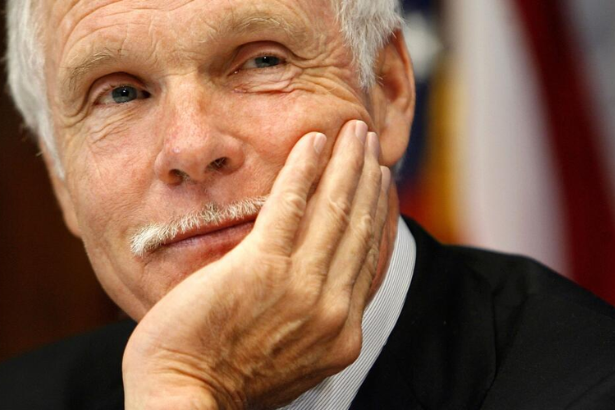
He started CNN in a converted country club in Atlanta with a team nobody had heard of. He changed the world anyway. On May 6, 2026, Ted Turner died at 87.
The Ted Turner death tribute the media world owes this man begins with the simplest fact: no Ted Turner, no 24-hour news cycle. Turner died peacefully on Wednesday, May 6, 2026, at his home near Tallahassee, Florida, surrounded by his family. The cause was Lewy body dementia, a progressive brain disorder he had publicly acknowledged in 2018. He was 87. Turner is survived by his five children, 14 grandchildren, and two great-grandchildren. “Ted was an intensely involved and committed leader, intrepid, fearless and always willing to back a hunch and trust his own judgment,” CNN Chairman and CEO Mark Thompson said in a statement. “He was and always will be the presiding spirit of CNN.” Jane Fonda, his third wife from 1991 to 2001, wrote on Instagram: “Ted Turner swept into my life, a gloriously handsome, deeply romantic, swashbuckling pirate, and I’ve never been the same.” Turner was, depending on the moment, the most infuriating and most visionary person in any room he entered. He was almost always right.
If you or someone you know is experiencing grief or emotional distress related to a loss, the 988 Suicide and Crisis Lifeline is available by calling or texting 988.
Background and Context
Robert Edward Turner III was born on November 19, 1938, in Cincinnati, Ohio, and grew up in Savannah and Cincinnati in a household shaped by his father’s advertising business and his father’s depression. At 24, following his father’s suicide, Turner inherited Turner Outdoor Advertising and made the company whole within a year.
Turner was not content to push other people’s products. He bought radio stations. Then he bought a struggling television station in Atlanta in 1970, Channel 17, and began airing old sitcoms and classic films. He once hosted a program called “Academy Award Theatre” himself to boost ratings.
What followed was one of the most consequential media entrepreneurial careers in American history. Turner turned a local Atlanta station into the nation’s first cable superstation, WTBS, by beaming his signal via satellite to cable systems across the country in 1976. He bought the Atlanta Braves in 1977 and managed himself, notoriously spending time in the dugout and making decisions that horrified baseball traditionalists. He launched CNN on June 1, 1980, at what had been a Jewish country club in Atlanta, with a team of largely unknown on-air personalities and the conviction that the world needed news 24 hours a day.
Nobody believed him. He was right.
Why the Ted Turner Death Tribute Is the Media Story of the Year
Latest Update
Turner’s death was announced Wednesday evening, with coverage from all three major reference publications and every major US news outlet within the hour.
Full coverage from the announcement:
- Ted Turner, Creator of CNN and the 24-Hour News Cycle, Dies at 87 — The New York Times
- Ted Turner Changed News. America Is Paying the Price — USA Today Opinion
- Jane Fonda Pays Heartfelt Tribute to ‘Gloriously Handsome’ Ex-Husband Ted Turner — People
Key confirmed details from the announcement:
- Turner died Wednesday at his home near Lamont, Florida, east of Tallahassee, after a long battle with Lewy body dementia, a progressive brain disorder he disclosed publicly in 2018. Wolf Blitzer announced the death on CNN on air, reading from a family statement that Turner passed away peacefully surrounded by his family.
- Turner is survived by five children, 14 grandchildren, and two great-grandchildren. In early 2025, he had been hospitalized with a mild case of pneumonia before recovering at a rehabilitation facility.
- In 2012, Turner told CNN that Jane Fonda was probably the great love of his life, he hadn’t gotten over her, and he doubted he ever would. “When you love somebody, and you really love ’em, you never stop loving ’em,” he said.
- Fonda wrote on Instagram: “Ted Turner swept into my life, a gloriously handsome, deeply romantic, swashbuckling pirate, and I’ve never been the same. Ted Turner helped me believe in myself. He gave me confidence. I think I did the same for him.”
- President Trump reacted on social media, calling Turner “one of the Greats of Broadcast History, and a friend of mine.” CNN Chairman Mark Thompson called him “the giant on whose shoulders we stand.”
The Five Powerful Ways Ted Turner Changed Television Forever
Change 1: He invented the 24-hour news cycle. CNN launched on June 1, 1980, and nothing in journalism was the same after it. Turner took inspiration from 24-hour radio stations and the continuous highlights model of ESPN and applied it to television news. Critics called it “Chicken Noodle News.” When the Gulf War began in 1991, CNN had a team of reporters inside Baghdad providing live coverage that no other network could match. The phrase “as seen on CNN” entered the language. The concept of breaking news as a continuous broadcast event rather than an interrupted bulletin is Turner’s legacy more than anyone else’s.
Change 2: He created the superstation and made cable television viable. Before Turner, cable was a distribution method for movies and local programming. Turner saw it as a national broadcasting system waiting to be activated. By transmitting WTBS via satellite in 1976, he transformed a local Atlanta station into a channel available to cable systems from coast to coast. That model, applied to news with CNN and entertainment with TNT, Cartoon Network, and Turner Classic Movies, demonstrated that cable could deliver original and distinctive programming at scale. Cable television’s viability as a national medium traces directly to Turner.
Change 3: He sold at the peak and lost it all in the merger. In 1996, Turner sold Turner Broadcasting System to Time Warner for approximately $7.34 billion, a deal he deeply regretted. He became vice chairman. Then in 2000, Time Warner sold itself to AOL, against Turner’s explicit wishes, in what became one of the worst mergers in American corporate history. The AOL deal sustained a record $99 billion loss in 2002. Turner’s fortune, mostly company stock, lost more than $7 billion in three years. He resigned as vice chairman in 2003. He lost control of CNN, the Braves, the Hawks, and the channels he built. The lesson he drew was that he should have kept control, a lesson he carried forward into everything else he did.
Change 4: He became the largest private landowner in America and saved 2 million acres. After losing the media empire, Turner redirected his energy toward conservation at a scale no private individual had matched. He became the largest private landowner in the United States, accumulating approximately 2 million acres of land across Montana, New Mexico, Nebraska, Kansas, and other states. He reintroduced bison to his properties, eventually maintaining the largest private bison herd in the world. His Ted’s Montana Grill restaurant chain served bison burgers. His Turner Foundation funded environmental organizations. CNN Chairman Thompson noted that Turner’s legacy will always be paired with CNN, but the gift he seemed most proud of was the natural habitats he saved by buying and protecting more wild acreage than almost anyone in the US.
Change 5: He dedicated $1 billion to the United Nations. In 1997, Turner pledged $1 billion to the United Nations Foundation, then the largest single charitable gift in history, to fund global health, environment, and poverty programs. He made the pledge at a time when his own wealth was substantially impaired by the Time Warner deal’s aftermath, and he followed through. He later co-founded the Nuclear Threat Initiative with Sam Nunn to reduce the threat of nuclear weapons and materials, an organization he described as the most important work he ever did.
Jane Fonda’s Tribute: The Most Honest Statement of the Day
Jane Fonda’s Instagram post after Turner’s death is the most emotionally direct piece of writing to emerge from the announcements, and it captures something true about Turner that formal tributes tend to flatten.
“Ted Turner swept into my life, a gloriously handsome, deeply romantic, swashbuckling pirate, and I’ve never been the same,” she wrote. “Ted Turner helped me believe in myself. He gave me confidence. I think I did the same for him, but that’s what women are raised to do.”
In 2012, years after their 2001 divorce, Turner told CNN that Fonda was probably the great love of his life, that he hadn’t gotten over her, and that he doubted he ever would. Their marriage lasted a decade and ended, by several accounts, because Fonda’s increasing religious faith and Turner’s aggressive atheism created an irreconcilable gap in their worldview. Turner, who was never subtle, was quoted describing organized religion in terms that left no room for diplomatic ambiguity.
The Fonda relationship is a window into what made Turner so compelling and so difficult: he was completely himself, at all times, without calculation or performance. That quality made him a genius innovator and a bruising personal companion, often simultaneously.
Expert Insights and Analysis
The USA Today opinion piece about Turner’s legacy captures the complicated inheritance of the 24-hour news cycle he created. Turner changed news. America is still reckoning with the consequences.
CNN created the template. Fox News monetized the template’s most partisan possibilities. MSNBC followed from the opposite direction. The original CNN vision, a network that broadcast the news as it happened to a global audience without partisan framing, was a genuinely idealistic project. Turner believed information was a public good. The media environment that grew from his innovation has been shaped by economic incentives that pulled far from that idealism.
Whether Turner is responsible for what his creation became is one of the more interesting debates in media history. He did not create Fox News. He did not choose to monetize outrage. He sold CNN in 1996 and lost control of it entirely by 2003. But he created the model, proved the audience existed, and established the business case that every subsequent all-news cable channel used.
“If Alexander the Great could conquer the known world, why couldn’t I start CNN?” Turner told Oprah Winfrey. The answer, in 1980, was that nobody thought it was possible. Turner did it anyway.
Broader Implications
The Ted Turner death tribute conversation will inevitably turn to what CNN and the 24-hour news model became after Turner lost control of it. That conversation is fair but incomplete without the starting point.
In 1980, the three broadcast networks, ABC, CBS, and NBC, controlled American television journalism. They ran 30-minute evening news broadcasts. They decided what was news. The journalism was serious, careful, and inaccessible outside of those scheduled windows. Turner’s conviction that people would watch news around the clock, not just at 6 and 11 PM, was genuinely radical.
He was right. The audience was there. The appetite for continuous information was real. The consequences of that discovery, both the democratization of information and the monetization of outrage, are still being worked out in 2026.
Turner’s conservation and philanthropic legacy will also be part of what history writes about him. The 2 million acres he protected, the bison herds he maintained, the $1 billion he gave to the UN, and the nuclear nonproliferation work he funded represent a second career that most media entrepreneurs never have and would not think to pursue.
For deeper coverage of media history, journalism, and the legacy institutions that shape how Americans receive information, The Tech Marketer covers the media and technology stories that define the information environment we all live in.
Related History and Comparable Figures
Ted Turner belongs to a category of media entrepreneurs who did not just build successful companies but changed what media was. William Randolph Hearst defined the newspaper era. David Sarnoff defined radio and early television. Rupert Murdoch defined partisan cable news. Turner defined continuous cable news as an independent category.
The closest comparison in terms of vision and personal style is probably Murdoch, his great rival. Both men built global media empires through debt-financed acquisition and personal conviction. Both men were right about the direction of media more often than they should have been. They disagreed profoundly about what journalism was for. Murdoch wanted to influence politics. Turner wanted to inform the world. That difference produced CNN and Fox News as opposite poles of a single innovation.
What Happens Next
Turner’s funeral arrangements have not been announced as of publication. A celebration of his life is expected at the family’s discretion. The Turner Foundation, Nuclear Threat Initiative, and Turner Enterprises will continue their operations.
CNN, which Turner founded and then watched from the outside for 23 years, will carry the tributes and retrospectives that mark the passing of a figure this large in the network’s history. Mark Thompson’s statement, calling Turner “the giant on whose shoulders we stand,” reflects an institution that knows the full weight of what it received.
His five children, his 14 grandchildren, and his 2 great-grandchildren carry forward a legacy that spans two centuries in scope and impact. The bison will still roam the Montana properties. The UN Foundation will still disperse the pledge he kept when he didn’t have to. And the news will still run, 24 hours a day, as it has since June 1, 1980.
Conclusion
Ted Turner invented the 24-hour news cycle, created cable television as a national medium, lost a $7 billion fortune in the worst merger in corporate history, protected 2 million acres of American wilderness, gave $1 billion to the United Nations, and still found time to race sailboats and own the Atlanta Braves. He was 87 years old and he had Lewy body dementia for the last eight years of his life, spending those years on his properties, riding horses and fishing, surrounded by what mattered to him.
Jane Fonda called him a swashbuckling pirate. CNN’s chairman called him a giant. His critics called him reckless. His admirers called him a visionary. All of them were right, often simultaneously, which is perhaps the most honest thing anyone can say about a life this large.
If you or someone you know is experiencing grief or emotional distress related to a loss, the 988 Suicide and Crisis Lifeline is available by calling or texting 988.
FAQ
1. How did Ted Turner die and what was his cause of death? Ted Turner died on Wednesday, May 6, 2026, at his home near Lamont, Florida, east of Tallahassee, after a long battle with Lewy body dementia, a progressive brain disorder. He was 87 years old. Turner had publicly disclosed his diagnosis in 2018 during an interview with Ted Koppel on CBS Sunday Morning. He died peacefully, surrounded by his family.
2. What was Ted Turner’s most important legacy in television? Turner’s most significant contribution was founding CNN on June 1, 1980, the nation’s first 24-hour all-news cable channel, which fundamentally changed how the world receives information. He also created the cable superstation model by transmitting WTBS nationally via satellite in 1976, proving that cable could deliver programming at national scale. He later launched TNT, Cartoon Network, and Turner Classic Movies, each of which became major media brands.
3. What happened to Ted Turner’s fortune after the Time Warner and AOL merger? In 1996, Turner sold Turner Broadcasting System to Time Warner for approximately $7.34 billion. Time Warner then sold itself to AOL in 2000 against Turner’s wishes in what became one of the worst mergers in corporate history. The AOL deal sustained a record $99 billion loss in 2002, and Turner’s personal fortune, which was mostly company stock, lost more than $7 billion in three years. He resigned as vice chairman of AOL Time Warner in 2003 and was no longer involved with CNN.
4. What did Jane Fonda say about Ted Turner’s death? Jane Fonda, who was married to Turner from 1991 to 2001, posted a tribute on Instagram saying: “Ted Turner swept into my life, a gloriously handsome, deeply romantic, swashbuckling pirate, and I’ve never been the same.” She added: “Ted Turner helped me believe in myself. He gave me confidence. I think I did the same for him.” Turner had said in 2012 that Fonda was probably the great love of his life and that he doubted he had ever gotten over her.
5. What was Ted Turner’s legacy beyond television and media? Turner became the largest private landowner in the United States, protecting approximately 2 million acres of land and reintroducing bison to his properties, maintaining the largest private bison herd in the world. In 1997 he pledged $1 billion to the United Nations Foundation, then the largest single charitable gift in history. He co-founded the Nuclear Threat Initiative with Sam Nunn to reduce global nuclear risk, which he described as the most important work he ever did.
Sources & References
- Ted Turner, Creator of CNN and the 24-Hour News Cycle, Dies at 87 — The New York Times
- Ted Turner Changed News. America Is Paying the Price — USA Today Opinion
- Jane Fonda Pays Heartfelt Tribute to ‘Gloriously Handsome’ Ex-Husband Ted Turner — People
- Ted Turner, Cable TV Visionary Who Created CNN, Dies at 87 — The Washington Post
- CNN Founder Ted Turner, a Pioneer of Cable TV News, Dies at 87 — CNN
- Ted Turner Dead: CNN Founder and Cable TV Pioneer Was 87 — Deadline
- Ted Turner, Media Tycoon Who Founded CNN, Dies at Age 87 — CBS News
- ‘A Trailblazer, a Rabble-Rouser, a Do-Gooder’: CNN Founder Ted Turner Dies at 87 — NPR