Google X spin-off pushes fiber-level speeds without laying a single cable as fingernail-sized chip promises to revolutionize wireless connectivity by end of 2026
Introduction
Taara Beam connectivity marks a major milestone in wireless infrastructure, delivering fiber-like internet speeds using invisible beams of light instead of physical cables. The breakthrough — developed over seven years under Google’s X “moonshot factory” and now an independent company — signals a potential shift in how high-speed networks are deployed in dense cities, rural areas, and difficult terrain.
Rather than relying on fiber optic cables buried underground, Taara transmits data through narrow, precisely aligned light beams between terminals. The current system, Taara Lightbridge, achieves up to 20 gigabits per second over distances of up to 20 kilometers. But the real breakthrough is coming: a fingernail-sized silicon photonic chip that has achieved 25 Gbps transmission speeds in tests and will launch by the end of 2026.
The chip, announced in February 2025 and detailed in a March 2025 X blog post by Taara CEO Mahesh Krishnaswamy, represents a quantum leap in miniaturization. “We’ve taken most of the core functionality of the Taara Lightbridge — which is the size of a traffic light — and shrunken it down to the size of a fingernail,” Krishnaswamy wrote.
Background and Context
Taara is part of Alphabet’s experimental connectivity initiatives, originally incubated under X, the company’s moonshot division. The technology traces its roots to Project Loon, Alphabet’s high-altitude balloon internet project that shut down in 2021. Loon established both radiofrequency connectivity and laser links between balloons in the Earth’s stratosphere. When Loon ended, the optical link component was reimagined for ground-based use — and Taara was born.
On March 17, 2025, Taara officially spun out as an independent company, attracting venture capital funding from Series X Capital (amount undisclosed). The team, which includes alumni from Google Fiber and Project Loon, is now deploying the technology in over a dozen countries.
Taara’s technology builds on free-space optical communication (FSO), which uses highly focused light beams to transmit data through the air. Unlike radio frequency wireless systems such as 5G or microwave links, optical beams can carry significantly higher bandwidth. The beams operate in the part of the electromagnetic spectrum between infrared and visible light — invisible to the naked eye but capable of carrying near-infinite bandwidth.
“The world is reaching a critical inflection point in data connectivity,” Krishnaswamy wrote. “As global demand for data surges — from streaming services to AI applications — the capacity of our existing infrastructure is struggling to keep pace. Fiber is high-speed connectivity’s gold standard, but it’s often unsuitable because it’s costly, impractical, or geographically impossible. Meanwhile, we’re hitting a wall on the electromagnetic spectrum: traditional radio frequency bands are congested and running out of available bandwidth.”
Latest Update or News Breakdown
Taara has two generations of technology: the current Lightbridge system and the next-generation chip launching end of 2026. Here is what is confirmed, based on reporting from X’s official blog, IEEE Spectrum, Optics.org, Engadget, Interesting Engineering, Futura Sciences, and Taara’s official website:
Current System: Taara Lightbridge
- Speed: Up to 20 Gbps
- Range: Up to 20 kilometers (12.4 miles)
- Size: Traffic light-sized terminal
- Technology: Physical beam steering using mirrors, sensors, precision optics, and smart software
- Deployment time: Hours instead of days, months, or years for fiber
- Energy: Uses the energy of a lightbulb
- Latency: Lower than fiber
- Weather resilience: Adaptive rate and hybrid architecture maintains connection even when atmospheric conditions disrupt the light, with minimal downtime
Next-Generation: Taara Chip (Silicon Photonic Chip)
- Speed: 25 Gbps transmission speeds achieved in tests (CEO Mahesh Krishnaswamy confirmed in corporate podcast)
- Test performance: 10 Gbps over 1 kilometer outdoors using two chips — “the first time silicon photonics chips have transmitted such high-capacity data outdoors at this distance,” per Krishnaswamy
- Size: Fingernail-sized
- Technology: Software-based beam steering — no moving mirrors or bulky parts
- Future iteration: Plans to extend range and capacity by creating a version with thousands of light emitters
- Availability: End of 2026
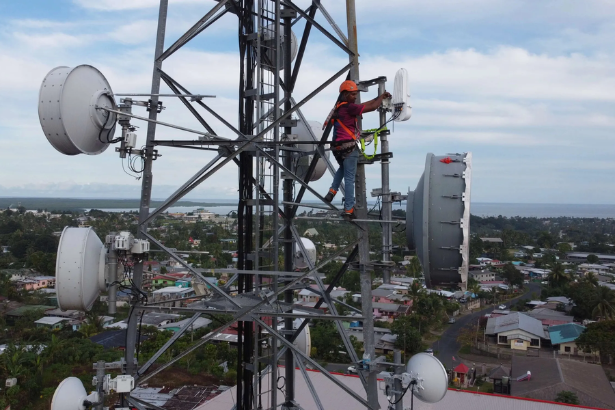
How It Works: Just as traditional fiber uses light to carry data through cables, Taara uses very narrow, invisible light beams to transmit data through the air. Two Taara units send beams to each other to create a link. The system uses mirrors, sensors, precision optics, and smart software to mechanically align the beam with exact precision. When two beams find each other, they lock together to form a secure link to transmit data.
The new chip replaces this mechanical system with software-based beam steering, eliminating moving parts entirely.
Real-World Deployments: Taara has deployed hundreds of optical links in more than a dozen countries, including:
- Congo River: High-speed laser connection between Kinshasa and Brazzaville, cities straddling the Congo — one of the world’s deepest rivers
- Nairobi, Kenya: City-wide installations and initial deployment where customers began reselling Taara bandwidth
- Zimbabwe
- Polynesian nation of Tonga (2022): Connecting regions inaccessible to fiber-optic lines
- United States: Coachella Valley Music and Arts Festival in California, T-Mobile and Vodafone partnerships
- Rio de Janeiro, Brazil
Commercial Partnerships: Taara is delivering commercial service in partnership with Airtel, Liquid Intelligent Technologies, and Liberty Networks, as well as pioneering new approaches with T-Mobile and Vodafone.
Lightbridge Pro: Taara announced Lightbridge Pro, a carrier-grade solution offering 99.999% uptime with lower total cost of ownership (TCO) for carriers and enterprises.
Taara Share: After seeing customers reselling Taara bandwidth during an early deployment in Kenya, the team created Taara Share — a software platform that makes it easy for internet service providers to divide connectivity into pay-as-you-go micro-transactions. This model allows local entrepreneurs to resell bandwidth directly to people in their communities and share the revenue.
Expert Insights or Analysis
Middle-Mile vs. Last-Mile: Taara CEO Mahesh Krishnaswamy explained to IEEE Spectrum that the company focuses on the “middle-mile” problem — crossing cities and tough terrain — rather than the old “last-mile” problem of connecting individual homes.
“Twenty years ago, Web-savvy folks were focused on solving the Internet’s ‘last-mile’ problem,” IEEE Spectrum reported. “Today, by contrast, one of the biggest bottlenecks to expanding Internet access is rather around a ‘middle-mile’ problem.”
Cost and Speed Advantage: Krishnaswamy told Futura Sciences: “We can offer a connection 10 to 100 times faster than a typical Starlink antenna, and at a much lower cost.”
Taara doesn’t compete directly with Starlink. Instead, it strengthens last-mile coverage in areas traditional providers overlook — particularly in difficult terrain where fiber is too costly or complex to install.
Miniaturization Breakthrough: The fingernail-sized chip represents a major simplification. Mike Allton, an industry observer, noted: “Going from a traffic light-sized device to a chip you can balance on your fingertip is transformative. It opens up applications nobody’s even thought of yet — autonomous vehicles, drone networks, smart cities.”
Weather Resilience: Earlier free-space optical systems (dating back to the late 1990s) were often hampered by bad weather and fragile alignment. Taara says its technology solves these problems through stronger design and smarter tracking of light beams. The adaptive rate and hybrid architecture maintains connections even when atmospheric conditions disrupt the light.
Bandwidth Reality: Taara operates in the optical domain, where bandwidth is virtually limitless. Traditional radio frequency bands are congested and running out of available bandwidth, making it harder to support 5G expansion and growing data demand. Optical communication bypasses these spectrum limitations entirely.
Broader Implications
For Telecom Infrastructure: If scalable, Taara could reduce fiber deployment costs while accelerating broadband expansion in underserved regions. That aligns with global efforts to close digital divides and connect the estimated 2.6 billion people who still cannot access the internet.
Network operators and service providers can rapidly deploy and redeploy Taara links to bring connectivity to new areas, provide backup to existing infrastructure, or deliver temporary bandwidth to crowded events.
For Urban Connectivity: Cities could deploy rooftop-to-rooftop links instead of digging up streets. Enterprises might use optical beams for secure campus networks. Mountains, rivers, and railroads might stop traditional networks, but Taara can bridge those gaps and deliver connectivity across rugged terrain.
For Disaster Recovery: Taara serves as a backup to fiber and a disaster recovery solution, ensuring uninterrupted connectivity during outages or emergencies.
For Future Applications: With the chip’s miniaturization, potential applications expand dramatically:
- Autonomous vehicles: Faster vehicle-to-vehicle communication
- Drone networks: High-bandwidth links between drones
- Smart cities: Rooftop networks connecting every building
- 5G and 6G backhaul: Wireless backhaul for cellular networks
“The possibilities are as boundless as light itself,” Krishnaswamy concluded.
For Space and Satellite Networks: Optical communication is also being explored in satellite constellations. Taara’s ground-based advancements reinforce the industry-wide shift toward laser-based data transmission.
Related History or Comparable Technologies
Project Loon (2013-2021): Alphabet’s high-altitude balloon internet project established both radiofrequency connectivity and laser links between balloons in the Earth’s stratosphere. When Loon shut down in 2021, the optical link component was reimagined for ground-based use as Taara.
Free-Space Optical Communication: Competitors in free-space optics have existed for years, but scalability and weather resilience were barriers. Earlier FSO systems from the late 1990s were often hampered by bad weather and fragile alignment. Taara’s 20 Gbps (Lightbridge) and 25 Gbps (chip) milestones suggest meaningful progress.
Aalyria: Another free-space optics company, Aalyria, is working with Singapore-based investment group HICO to establish a first-of-a-kind “marine internet” by deploying up to 200 free-space optical links for the shipping industry.
Fiber’s Gold Standard: Fiber remains the gold standard for bandwidth and reliability. Taara attempts to replicate fiber performance without physical constraints — delivering “fiber-like speeds” where fiber is too costly, difficult, or unsafe to install.
What Happens Next
Chip Launch (End of 2026): The fingernail-sized silicon photonic chip is expected to be available by the end of 2026. The team plans to extend both the chip’s range and capacity by creating an iteration with thousands of light emitters.
Key Questions:
- Weather performance: Can Taara maintain stable performance in diverse weather conditions at scale?
- Carrier adoption: Will telecom carriers adopt it for middle-mile connectivity?
- Cost-effectiveness: How does total cost of ownership compare to traditional fiber and wireless alternatives?
- 5G/6G backhaul: Can it support cellular network backhaul at scale?
- New applications: What unexpected use cases will emerge from miniaturization?
Commercialization: If Alphabet (and now independent Taara) commercializes the system aggressively, Taara could become a key player in next-generation infrastructure. The company is already delivering commercial service with major partners and has spun out with venture capital backing, signaling serious commercial intent.
Expansion: Taara has deployed in over a dozen countries. Expect continued expansion in Africa, Asia, Latin America, and underserved regions globally.
Conclusion
Taara Beam’s invisible light connectivity — 20 Gbps with current Lightbridge systems and 25 Gbps with the upcoming fingernail-sized chip — represents a serious challenge to conventional fiber expansion models. By transmitting data through precision optical beams, the technology promises rapid, high-speed deployment without cables.
The breakthrough underscores a broader industry transition toward optical and software-managed networks. The future of internet infrastructure may be less about digging trenches and more about aligning beams.
“We’ve been committed to providing abundant, fast, affordable internet connectivity using beams of light,” CEO Mahesh Krishnaswamy wrote. “From the bustling streets of Nairobi, to cities straddling the world’s deepest river, Taara’s wireless optical communication links have delivered fiber-like speeds to communities too remote, too expensive, or too geographically challenging to be served with traditional connectivity solutions.”
As the chip launches in late 2026, the real test begins: Can light beams replace cables at global scale?
FAQ
Q1: What is Taara Beam? Taara Beam is a free-space optical communication system that transmits high-speed internet via invisible beams of light. It was developed over seven years under Google’s X “moonshot factory” and spun out as an independent company in March 2025.
Q2: How fast is Taara’s connection? The current Taara Lightbridge system achieves up to 20 Gbps over distances of up to 20 kilometers (12.4 miles). The next-generation fingernail-sized silicon photonic chip has achieved 25 Gbps transmission speeds in tests and will be available by the end of 2026.
Q3: Is it replacing fiber optic cables? Not entirely, but it offers fiber-like speeds without physical cables. Taara focuses on the “middle-mile” problem — connecting cities, bridging rivers, crossing mountains, and serving areas where fiber is too costly, difficult, or impossible to deploy.
Q4: What are its limitations? Line-of-sight requirements and potential weather interference. However, Taara’s adaptive rate and hybrid architecture maintains connections even when atmospheric conditions disrupt the light, with minimal downtime.
Q5: Who developed Taara? Taara was developed under Alphabet’s X Development (formerly Google X) and spun out as an independent company on March 17, 2025, with venture capital funding from Series X Capital. The team includes alumni from Google Fiber and Project Loon.
Sources and References
X (Google’s Blog): Introducing the Taara Chip
Taara Official Website: High-Speed Wireless Internet Using Light Beam Technology
IEEE Spectrum: Taara’s Free Space Optical Communication Solution