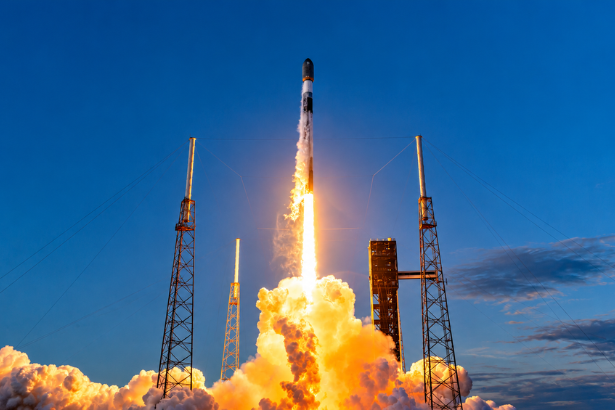
The SpaceX Starfall capsule launch is attracting attention after reports identified a reentry vehicle flying alongside dozens of customer payloads on the company’s Bandwagon-5 rideshare mission. The mission is a reminder that a single Falcon 9 launch can serve multiple customers while also carrying experimental or specialized hardware that attracts attention beyond the satellite industry.
The Google Trends screenshot supplied for this story shows a sharp rise in searches for “SpaceX Falcon 9 rocket launch” near the end of the displayed 24-hour period. The graph indicates a recent surge in interest, but it does not provide an exact search volume or establish why each person searched for the launch.
Background and Context: What Is SpaceX’s Bandwagon-5 Mission?
SpaceX’s rideshare model lets multiple customers share a rocket launch instead of purchasing an entire mission. That can make access to orbit more practical for organizations launching smaller satellites or technology demonstrations.
The Falcon 9 is central to this approach. Rather than organizing a separate rocket for every customer, SpaceX can deploy a collection of payloads during one mission. The arrangement creates a shared launch opportunity, although payloads may have different objectives and operational requirements.
According to the supplied Spaceflight Now live coverage, Bandwagon-5 was expected to carry 31 customer payloads alongside a Starfall reentry capsule. That combination is what makes the mission especially interesting to space watchers.
Latest Update: Starfall Reentry Capsule Draws Attention
The three linked reports frame Bandwagon-5 around two elements: the rideshare launch itself and the Starfall vehicle riding on the mission.
- Spaceflight Now’s live coverage focuses on the planned Falcon 9 mission, including the Starfall reentry capsule and 31 customer payloads.
- Tech-Insider’s report also highlights the capsule’s place on Bandwagon-5.
- Starlust’s coverage describes online interest in what it calls a secretive return vehicle associated with the launch.
The reporting has brought the capsule into public discussion, but the term “secret” should be treated carefully. A vehicle receiving limited public explanation is not, by itself, proof of a classified mission or an undisclosed military purpose. Its operator, mission goals, payload details, and recovery plans should be established through reliable reporting or official documentation before stronger conclusions are drawn.
The supplied links describe the capsule as a reentry or return vehicle. They do not, by themselves, establish every technical detail about its design, what it may carry back, or how it will be recovered.
Expert Insights and Analysis: Why a Reentry Vehicle Matters
The most consequential part of the Starfall story is not simply that another vehicle is going to space. It is the possibility of making research and manufacturing in microgravity more routine, with hardware designed to return materials to Earth.
In orbit, experiments can take advantage of microgravity conditions that are difficult or impossible to reproduce on the ground. But getting samples back safely is a major part of the process. A reentry vehicle could help close that loop by carrying material to orbit, supporting an experiment, and returning the result for analysis.
That is the broader technological context behind the attention on Starfall. However, the distinction between potential and proven capability matters. The supplied reports describe Starfall as a reentry or return vehicle, but they do not provide independently verified results from this mission. Until a mission report confirms what happened in orbit and during recovery, claims about its performance should remain provisional.
The Federal Aviation Administration’s environmental assessment, referenced by Starlust, is cited in that report for the vehicle’s approximate dimensions and mass. Those figures provide useful context, but technical specifications alone cannot establish whether the vehicle has met its mission objectives.
Broader Implications: A New Layer of Commercial Spaceflight
The SpaceX Starfall capsule launch story sits at the intersection of two changes in the space industry.
First, rideshare launches are making orbital access available to a larger range of satellite operators. Instead of arranging a dedicated rocket, customers can purchase space on a mission that carries many payloads. That approach can reduce barriers to entry, though the final cost and schedule depend on the mission, orbit, and customer requirements.
Second, commercial space companies are exploring ways to make activity in orbit more useful beyond deploying satellites. In-space manufacturing and the return of research materials could expand the commercial value of microgravity, provided that launch, operations, recovery, and regulatory costs can be brought within workable limits.
Starfall’s significance will depend on what the mission demonstrates, not simply on the attention surrounding its launch. If a vehicle of this kind can repeatedly return cargo safely and economically, it could become a useful tool for research organizations and companies that need to bring physical products or samples back from orbit. If the mission does not establish that capability, the program will need further development.
Internal link suggestion: Add a related article on The Tech Marketer, such as How Reusable Rockets Are Changing the Economics of Spaceflight, and link the phrase “commercial spaceflight and reusable rockets” to that article once the URL is available.
Related History: From Satellite Rideshares to Returnable Spacecraft
The commercial space industry has gradually moved from treating launch as a one-off event toward offering repeatable services. SpaceX’s rideshare missions reflect that shift by packaging access to orbit as a service for multiple customers.
Returning hardware from space is a different challenge. A payload must survive launch, function in its intended environment, and then tolerate the extreme heating and forces associated with atmospheric reentry. Recovery introduces additional requirements, including landing or splashdown operations and the handling of the returned cargo.
Spacecraft designed for human travel, such as SpaceX’s Dragon, should not automatically be treated as direct equivalents to a smaller uncrewed technology demonstrator. They serve different purposes and operate under different requirements. In Starfall’s case, the important questions are what the vehicle is designed to return, how it navigates reentry, and whether its recovery process can be repeated reliably.
For more context on the wider commercial return-to-Earth market, Space.com’s reporting on Varda Space Industries describes a separate effort to combine orbital manufacturing with the return of products to Earth. Varda is not the same program as Starfall, but it illustrates why reentry technology is attracting commercial interest.
What Happens Next?
The next meaningful milestone is confirmation of the Bandwagon-5 mission’s outcome. The mission was scheduled for October 19, 2026, with a launch window opening at 6:30 a.m. Eastern Time, according to Spaceflight Now’s launch schedule.
Readers following the launch should look for several developments:
- Launch confirmation: Whether Falcon 9 lifted off successfully and deployed its payloads.
- Vehicle-specific information: Whether SpaceX or another authoritative source confirms Starfall’s identity, mission objectives, and operating organization.
- Reentry and recovery details: Whether the capsule is expected to return to Earth, when that might happen, and whether a successful recovery is reported.
- Evidence of performance: Any confirmed results that show what the vehicle accomplished, rather than what it was designed to do.
The launch itself is only one stage of a reentry demonstration. If Starfall is intended to return material to Earth, the return and recovery phase will be essential to judging its value.
Conclusion
The SpaceX Starfall capsule launch has attracted attention because it combines a familiar Falcon 9 rideshare mission with a less-publicized vehicle reportedly designed for reentry. Bandwagon-5 also illustrates how a single rocket can serve dozens of customers while carrying specialized technology demonstrations.
The bigger story is the potential growth of commercial activity that depends on bringing materials back from orbit. But Starfall’s capabilities should be judged against verified mission results, not online speculation. As updates emerge, confirmation of deployment, reentry, and recovery will matter far more than the mystery surrounding the vehicle.
Frequently Asked Questions
1. What is the SpaceX Starfall capsule launch?
It refers to the Starfall vehicle reported to be flying on SpaceX’s Bandwagon-5 Falcon 9 rideshare mission. The supplied reports describe it as a reentry or return vehicle, although some details remain unconfirmed by SpaceX.
2. What is the Bandwagon-5 mission?
Bandwagon-5 is a SpaceX Falcon 9 rideshare mission intended to deploy numerous customer payloads into a mid-inclination low Earth orbit.
3. How many payloads is Bandwagon-5 carrying?
Spaceflight Now describes the mission as carrying 31 customer payloads alongside the Starfall capsule. Some coverage describes 32 payloads in total when the capsule is included, so the count depends on how the vehicle is categorized.
4. What is Starfall designed to do?
The linked reports describe Starfall as a reentry vehicle associated with returning goods or cargo from space. Its precise operational objectives and the results of this mission should be treated as unconfirmed until authoritative details are published.
5. Is Starfall the same as SpaceX Dragon?
The available reports do not describe Starfall as a crewed spacecraft. It should not be assumed to have the same role as Dragon, which is designed for human spaceflight and cargo missions.
6. Why are reentry capsules important for space research?
A return vehicle can potentially bring samples or manufactured materials from microgravity experiments back to Earth for analysis. The usefulness of any particular vehicle depends on its payload capacity, reliability, recovery method, and cost.
7. When was Bandwagon-5 scheduled to launch?
Spaceflight Now listed October 19, 2026, with the launch window opening at 6:30 a.m. Eastern Time, or 10:30 UTC. The schedule is not, by itself, confirmation that the launch occurred.
8. Where can readers follow SpaceX Starfall capsule launch updates?
Follow Spaceflight Now’s mission coverage and SpaceX’s official channels for launch updates. For technical claims about Starfall, prioritize official statements and independently corroborated mission reports.
Sources & References
1. “Live coverage: SpaceX to launch Starfall reentry capsule, 31 customer payloads on Bandwagon-5 rideshare mission” Spaceflight Now
2. “SpaceX Flies 2,100kg Starfall Capsule on Bandwagon-5” Tech-Insider
3. “SpaceX Starfall: Netizens spot secret return vehicle launching on Bandwagon-5 mission tomorrow” Starlust
4. “Launch Schedule” Spaceflight Now
5. “2 spacecraft in orbit and 8 more coming soon: Varda has big plans for in-space manufacturing” Space.com