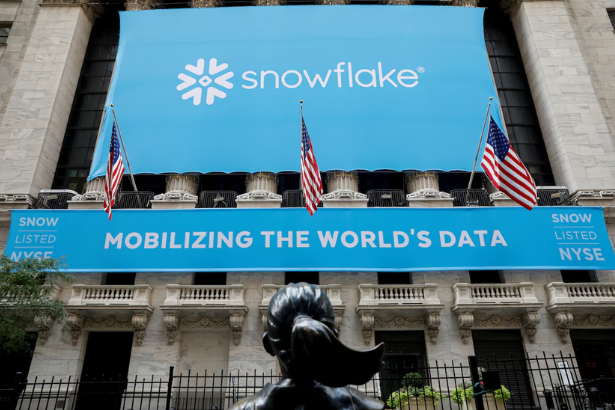
Snowflake SNOW stock 2026 delivered one of the most significant after-hours moves of the technology earnings season on Wednesday, May 27, when shares surged approximately 36% following a Q1 FY2027 earnings report that beat on every major metric and a simultaneous announcement of a $6 billion multi-year infrastructure commitment to Amazon Web Services. Snowflake reported Q1 revenue of $1.39 billion — a 33% year-over-year increase that beat the $1.32 billion analyst consensus by $70 million. Product revenue of $1.33 billion grew 34% year-over-year and represented the strongest sequential dollar growth in company history. EPS came in at $0.39 versus $0.32 expected. And the AWS deal — which includes Amazon’s custom Arm-based Graviton chips specifically for agentic AI workloads — signals that Snowflake is betting its next chapter on the enterprise agentic AI infrastructure build.
The Q1 FY2027 Numbers: A Beat Across Every Metric
The Snowflake SNOW stock 2026 after-hours surge was grounded in Q1 FY2027 financial results that came in above expectations across every major metric. Revenue of $1.39 billion for the quarter ended April 30, 2026 represented 33% year-over-year growth and beat the consensus of $1.32 billion by approximately $70 million — a 5.3% revenue beat that is substantial for a company at this scale.
Product revenue of $1.33 billion grew 34% year-over-year — the critical metric for a cloud data company where product consumption is the primary growth engine. CEO Sridhar Ramaswamy described the quarter in precise terms: “Snowflake delivered a milestone quarter, with product revenue of $1.33 billion, up 34% year-over-year, marking the strongest sequential dollar growth in our history.” That phrase — “strongest sequential dollar growth in our history” — is not marketing language. It is a specific financial claim that the SEC filing supports.
EPS of $0.39 beat the $0.32 consensus by $0.07 — a 21.9% positive surprise on the bottom line. Net revenue retention rate came in at 126%, meaning the average existing Snowflake customer is spending 26% more than they were a year ago. That metric, which reflects both expansion within existing accounts and the stickiness of the platform, is the clearest single indicator of product-market fit and customer satisfaction.
The Customer Base: 779 Million-Dollar Customers, 813 Forbes Global 2000
The Snowflake SNOW stock 2026 quarter also showed meaningful customer concentration metrics. Snowflake now has 779 customers with trailing 12-month product revenue exceeding $1 million — a 29% year-over-year increase that reflects enterprise-scale adoption rather than SMB experimentation. The 813 Forbes Global 2000 customers in Snowflake’s base is the most important enterprise penetration statistic: more than 800 of the world’s 2,000 largest companies are building their data and AI infrastructure on Snowflake.
Remaining performance obligations of $9.21 billion — up 38% year-over-year — represent the forward revenue visibility that institutional investors use to evaluate growth durability. A $9.21 billion RPO at 38% growth means Snowflake has nearly two years of current quarterly revenue already committed by customers. The pipeline is not speculative. It is contracted.
The $6 Billion AWS Deal: Graviton for Agentic AI
The Snowflake SNOW stock 2026 story’s most strategically significant announcement was not the earnings beat. It was the simultaneous revelation of a $6 billion multi-year infrastructure commitment to Amazon Web Services — the largest such commitment in Snowflake’s history.
Amazon said Snowflake has committed to spending $6 billion on AWS over five years. The commitment includes expanding Snowflake’s use of Amazon’s Graviton general-purpose CPU chips — custom Arm-based silicon — and GPU infrastructure for artificial intelligence workloads. Snowflake was founded on AWS eleven years ago, having surpassed $7 billion in lifetime sales and exceeded $2 billion in calendar year sales in 2025 on the platform, more than doubling transaction growth year-over-year.
The Graviton component is the technically specific detail that contextualizes why this deal matters for agentic AI. CPUs are experiencing renewed demand as AI adoption shifts from call-and-answer chatbots to task-oriented agentic applications. While GPUs like Nvidia’s excel at training AI models — where thousands of narrow cores run many simultaneous operations — CPUs have a smaller number of powerful cores running sequential general-purpose tasks. Agentic AI requires exactly that: general compute power to move large amounts of data through AI workflows and orchestrate across multiple AI agents simultaneously.
In April, Amazon CEO Andy Jassy specifically cited Graviton’s value for agentic workloads: “Graviton is our industry-leading CPU chip, which allows Meta to run the CPU-intensive workloads behind Agentic AI with the performance and efficiency they need at their scale.” Meta was using hundreds of thousands of Graviton chips. Snowflake’s $6 billion commitment puts it in the same infrastructure category as one of the world’s largest technology companies.
The Natoma Acquisition: MCP for Enterprise AI Agents
Alongside the earnings and the AWS deal, Snowflake SNOW stock 2026 announced the acquisition of Natoma — an enterprise Model Context Protocol (MCP) platform for AI agents. MCP, developed by Anthropic and adopted as an emerging industry standard, provides the protocol layer through which AI agents can safely access and interact with enterprise data systems.
Ramaswamy framed the acquisition’s strategic logic clearly: “Agents don’t just need access to data — they need the right context, permissions and policy guardrails to operate safely inside the enterprise.” The Natoma acquisition addresses the specific problem that enterprise AI agents face when attempting to operate at scale: not the absence of data, but the absence of governed, permissioned access to the right data at the right time with the right guardrails.
The Natoma acquisition fits directly into Snowflake’s broader thesis of becoming the “Agentic Enterprise” platform — the infrastructure layer that governs how AI agents operate on enterprise data. The $6 billion AWS Graviton commitment provides the compute. The Natoma MCP platform provides the governance. Together they form the two-layer infrastructure bet that Snowflake is making on the agentic AI era.
The Q2 Guidance and Full-Year Raise
The Snowflake SNOW stock 2026 guidance announcements compounded the earnings beat. For Q2 FY2027, Snowflake guided to product revenue of $1.42 billion — representing approximately 30% year-over-year growth from the comparable quarter. The full-year guidance was also raised, reflecting management’s confidence that the Q1 momentum is sustainable rather than a one-quarter anomaly.
The Q2 guidance of $1.42 billion in product revenue implies sequential growth from Q1’s $1.33 billion — a continuation of the acceleration trend rather than a reversion to mean. That forward guidance is what separates an earnings beat that drives a temporary pop from one that drives a sustained re-rating. The market’s 36% after-hours reaction suggests investors are pricing in the latter.
Ramaswamy’s “Inflection Point” Language
The Snowflake SNOW stock 2026 CEO Sridhar Ramaswamy used specific language that professional investors parse carefully. “AI continues to be a powerful tailwind for Snowflake, and Q1 marks a clear inflection point in that journey.” In corporate earnings communication, an “inflection point” is a specific claim — not that AI is helping at the margins, but that the relationship between AI adoption and Snowflake’s growth has fundamentally changed in character rather than degree.
The data appears to support the claim. The 34% year-over-year product revenue growth and the “strongest sequential dollar growth in company history” are not description language for a company growing steadily at the same rate. They are the language of acceleration — of a business where the external tailwind is now translating into financial performance at a rate that exceeds the baseline.
Broader Implications: What Snowflake’s Quarter Means for Enterprise AI Infrastructure
The Snowflake SNOW stock 2026 Q1 FY2027 results are the clearest financial evidence yet that the enterprise AI infrastructure buildout has begun generating durable, measurable revenue at scale. Snowflake sits at the intersection of the three requirements for enterprise AI: governed data access, scalable compute infrastructure, and the agent governance layer that makes AI safe to deploy inside complex organizations. The $6 billion AWS Graviton deal, the Natoma MCP acquisition, and the 126% net revenue retention rate collectively describe a company that has found the exact spot where enterprise AI investment is flowing and is building infrastructure that enterprises cannot easily replace once deployed. For more on the biggest stories in technology, AI, and investing, visit The Tech Marketer.
Latest Updates
Snowflake SNOW stock 2026’s 36% after-hours surge occurred May 27. Here is where to follow the full coverage:
- CNBC has the complete Snowflake story including the Amazon Graviton deal mechanics, Andy Jassy’s quote about Graviton’s role in agentic AI at Meta’s scale, and the technical context for why CPUs are experiencing renewed demand in the agentic AI era. Read more at CNBC
- Bloomberg has the complete Snowflake Q1 FY2027 earnings coverage including the raised sales outlook, CEO Sridhar Ramaswamy’s commentary on AI as a tailwind, and the full analyst reaction to the guidance raise. Read more at Bloomberg
- The Wall Street Journal has the exclusive coverage of the Amazon $6 billion deal with Snowflake for agentic computing chips, including the full terms of the multi-year AWS infrastructure commitment and its implications for Snowflake’s position in the enterprise AI stack. Read more at WSJ
FAQ: Snowflake SNOW Stock 2026
1. Why did Snowflake SNOW stock surge 36% in after-hours trading on May 27, 2026? Snowflake surged approximately 36% after-hours on May 27, 2026 driven by three simultaneous announcements: a Q1 FY2027 earnings beat (revenue $1.39B vs. $1.32B expected, EPS $0.39 vs. $0.32 expected), raised full-year guidance, and a $6 billion multi-year infrastructure commitment to Amazon AWS including Graviton CPUs and GPUs for agentic AI workloads.
2. What were Snowflake’s Q1 FY2027 earnings results? Snowflake reported Q1 FY2027 (ended April 30, 2026) revenue of $1.39 billion, representing 33% year-over-year growth and beating the $1.32 billion consensus. Product revenue of $1.33 billion grew 34% year-over-year — the strongest sequential dollar growth in company history. EPS was $0.39 versus $0.32 expected. Net revenue retention was 126%. Remaining performance obligations were $9.21 billion, up 38% year-over-year.
3. What is the $6 billion Amazon AWS deal that Snowflake announced? Snowflake committed to spending $6 billion on Amazon Web Services over five years — its largest AWS commitment in company history. The deal includes expanding Snowflake’s use of Amazon’s custom Arm-based Graviton CPU chips and GPU infrastructure specifically for agentic AI workloads. Amazon Graviton CPUs excel at the general-purpose compute that agentic AI systems require to orchestrate data across multiple AI agents.
4. What is Natoma and why did Snowflake acquire it? Natoma is an enterprise Model Context Protocol (MCP) platform for AI agents that Snowflake acquired alongside its Q1 earnings announcement. MCP is an emerging industry standard for how AI agents safely access enterprise data systems. CEO Sridhar Ramaswamy explained the acquisition: “Agents don’t just need access to data — they need the right context, permissions and policy guardrails to operate safely inside the enterprise.”
5. What is Snowflake’s guidance for Q2 FY2027? Snowflake guided to Q2 FY2027 product revenue of $1.42 billion, representing approximately 30% year-over-year growth. The company also raised its full-year guidance, signaling management confidence that Q1’s acceleration is sustainable. The Q2 guidance of $1.42 billion represents sequential growth from Q1’s $1.33 billion product revenue.