Introduction
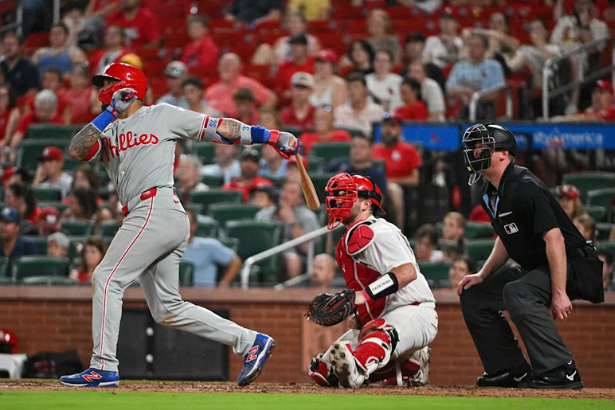
The Phillies vs Cardinals matchup on August 10 turned into a showcase for Andrew Painter before becoming a ninth-inning-style survival test for Philadelphia’s pitching staff. The Phillies beat St. Louis 6-5, with Painter carrying a no-hit bid into the sixth inning and Edmundo Sosa driving in three runs.
Painter ultimately worked 5⅓ innings, allowing two hits and two earned runs while striking out six. St. Louis mounted a three-run eighth-inning rally, but Philadelphia escaped with the victory.
Background and Context
The game at Busch Stadium presented an interesting test for Philadelphia.
The Phillies entered with limited bullpen availability, making a deep outing from the young Painter particularly valuable. MLB reported that the club needed length from its starter while also wanting to see one of its most intriguing young arms deliver a high-level performance.
Painter delivered for most of the night.
The 23-year-old right-hander kept St. Louis hitless for nearly six innings before Iván Herrera doubled in the sixth. That ended the no-hit bid, although Painter remained in position to earn the victory.
The Cardinals, however, never completely went away.
Latest Update: Phillies vs Cardinals Ends 6-5
Philadelphia’s offense built enough of a cushion to withstand the late Cardinals push.
The Phillies scored six runs on eight hits and committed no errors. St. Louis also collected eight hits, but two errors helped make the difference in a one-run game.
Sosa was the offensive standout, driving in three runs. Kyle Schwarber also reached base four times and helped provide the lineup pressure Philadelphia needed.
MLB’s full Andrew Painter game report
Painter’s No-Hit Bid Ends in the Sixth
Painter entered the sixth having largely silenced the Cardinals.
The bid ended when Herrera doubled into the left-field corner. MLB described the hit as ending the Cardinals’ opportunity to make history, although the Phillies still had the upper hand.
Painter finished with:
- 5⅓ innings
- 2 hits allowed
- 2 earned runs
- 6 strikeouts
- 3 walks
- Win
That performance was especially important because Philadelphia needed to protect a bullpen that was not operating with its full complement of options.
Sosa and Schwarber Provide the Offense
Edmundo Sosa drove in three of Philadelphia’s six runs, while Schwarber repeatedly reached base.
The Phillies’ offense did not need a huge night from one superstar. Instead, it generated enough traffic and timely production to establish a four-run advantage before St. Louis made its late push.
Expert Insights and Analysis
Painter’s development is the bigger story
The final score will be remembered as a Philadelphia victory, but Painter’s outing may be the more significant development.
A 23-year-old starter taking a no-hit bid into the sixth inning against a major-league lineup is a strong indicator of the upside the Phillies have in their rotation.
More importantly, Painter demonstrated the ability to work deep enough into a game to reduce pressure on a bullpen that needed protection.
St. Louis exploited Philadelphia’s bullpen limitations
The Cardinals recognized that Philadelphia did not have all of its normal bullpen options available.
St. Louis eventually attacked the relief pitching in the eighth. Three runs crossed the plate, reducing what had been a four-run deficit to one.
That comeback turned a comfortable Philadelphia lead into a genuine late-game scare.
Masyn Winn reached third during the rally, but the Cardinals could not produce the hit needed to complete the comeback.
Philadelphia’s margin disappeared quickly
The game illustrates an increasingly familiar baseball pattern.
A dominant starting pitcher can give a team control for five or six innings, but bullpen availability can completely change the strategic picture afterward.
Philadelphia had enough offense and enough pitching to win, but St. Louis demonstrated that the gap between a comfortable victory and a one-run game can disappear very quickly.
Broader Implications
Young pitching could be Philadelphia’s advantage
Painter’s performance gives the Phillies another reason to be optimistic about their pitching depth.
If he can consistently provide quality starts, Philadelphia gains flexibility with its bullpen and can manage difficult stretches of the schedule more effectively.
His outing also demonstrates why organizations invest heavily in pitching development. A young arm capable of missing bats and limiting hard contact can fundamentally change how a manager handles the later innings.
The bullpen remains an important variable
The Cardinals’ eighth-inning rally should not be dismissed.
Philadelphia’s relief situation was already constrained, and St. Louis successfully attacked that weakness.
For a team with postseason ambitions, bullpen depth can become just as important as frontline starting pitching once the schedule becomes compressed.
Baseball’s data story
Painter’s performance also illustrates how modern baseball evaluates young pitchers.
Six strikeouts, five-plus innings and only two hits allowed tell part of the story. Teams now combine those traditional numbers with pitch velocity, movement, spin, location and quality-of-contact data to determine whether a young starter’s performance is sustainable.
That analytical approach can help Philadelphia determine whether Painter is simply enjoying a strong stretch or establishing himself as a long-term rotation piece.
For more coverage of technology, analytics and the changing sports business, readers can explore The Tech Marketer.
Related History and Comparable Technologies
The evolution of baseball analytics has transformed how pitching performances are evaluated.
A pitcher taking a no-hitter into the sixth inning used to be judged primarily through the box score. Today, teams can examine every pitch and every ball in play.
That creates a much more detailed picture of performance.
For a pitcher such as Painter, analysts can examine whether strikeouts came from fastball velocity, breaking-ball movement or sequencing. They can also assess whether the pitcher generated weak contact when he was not getting swings and misses.
The same technology is used by opposing teams to identify weaknesses.
That means the competitive cycle never stops. A young pitcher learns from data, opponents study that data, and the pitcher must then adapt again.
What Happens Next
Philadelphia leaves the game with a victory, but the pitching staff remains something to watch.
Painter’s performance could earn him increased confidence and responsibility, while the bullpen’s workload will remain an important factor as the series continues.
For St. Louis, the late rally provides evidence that the offense can pressure a depleted pitching staff, even though the comeback ultimately fell short.
The Cardinals finished with eight hits and five runs, including four runs across the final two innings.
The next game will therefore offer another test of whether Philadelphia can maintain its advantage while managing its pitching resources.
Conclusion
The Phillies vs Cardinals game ended with Philadelphia on top, but the 6-5 score tells a more complicated story than a routine win.
Painter supplied the early dominance, taking a no-hit bid into the sixth and striking out six. Sosa provided three RBIs, while Schwarber repeatedly reached base. Then St. Louis exploited Philadelphia’s limited bullpen options and nearly erased a four-run deficit.
The Phillies ultimately held on.
For Philadelphia, the biggest takeaway is Painter. For St. Louis, the comeback showed that the Cardinals could make the game uncomfortable even after spending much of the night struggling to generate offense.
It was a 6-5 win, but the larger storyline may be the emergence of a young Phillies pitcher who looked capable of controlling a major-league lineup for most of an evening.
FAQ
What was the final score of the Phillies vs Cardinals game?
Philadelphia defeated St. Louis 6-5 on August 10, 2026.
How did Andrew Painter perform?
Painter pitched 5⅓ innings, allowed two hits and two earned runs, and struck out six while taking a no-hit bid into the sixth inning.
Who drove in three runs for Philadelphia?
Edmundo Sosa drove in three runs for the Phillies.
When did the Cardinals break up Painter’s no-hit bid?
Iván Herrera doubled in the sixth inning, ending Painter’s no-hit attempt.
Did the Cardinals come back?
Yes. St. Louis scored three runs in the eighth inning and cut Philadelphia’s lead to one run, but the Cardinals could not complete the comeback.
Why was Painter’s outing important?
Philadelphia entered the game with limited bullpen availability, so Painter’s five-plus innings helped protect the relief staff.
How many hits did each team have?
Both Philadelphia and St. Louis finished with eight hits. The Phillies committed no errors, while the Cardinals committed two.
Sources & References
Viva El Birdos, St. Louis Cardinals vs Philadelphia Phillies series preview
Read the series preview
MLB, Painter crafts work of art with no-hit bid into sixth inning
Read the MLB report
ESPN, Phillies 6-5 Cardinals (Aug. 10, 2026) Game Recap
Read the ESPN recap
MLB, Cardinals exploit Phillies’ limited bullpen options, but fall just short
Read the MLB analysis