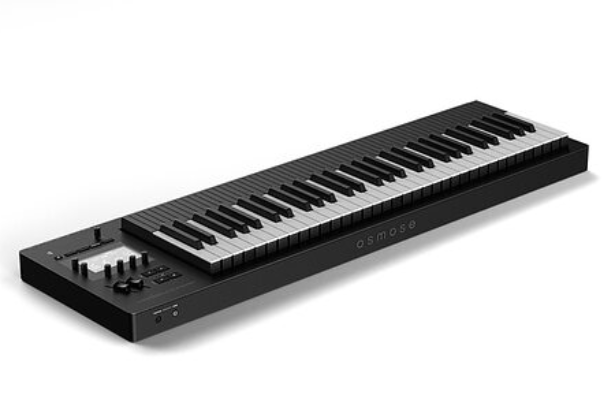
This keyboard doesn’t just play notes, it reshapes how digital music feels
The Osmose MPE MIDI controller is one of the rare pieces of music technology that feels genuinely new. Built by Expressive E, the Osmose pushes beyond traditional MIDI keyboards, introducing a level of touch sensitivity and expressiveness that blurs the line between acoustic and digital instruments.
At a time when software synths are more powerful than ever, Osmose flips the conversation. It’s not about what sounds you can create. It’s about how you control them.
Background and Context
For decades, MIDI controllers have followed a familiar formula: press a key, trigger a note. Velocity sensitivity added nuance, but the interaction remained fundamentally binary.
That limitation became more obvious as digital music evolved.
Musicians wanted:
- Continuous pitch control
- Dynamic pressure sensitivity
- Per-note modulation
This led to the rise of MPE (MIDI Polyphonic Expression), a standard that allows each note to carry its own expressive data like pitch bends and pressure changes.
Instruments like the ROLI Seaboard explored this idea with soft, touch-based surfaces. But they often required musicians to relearn how to play.
Osmose takes a different approach.
It keeps the familiar piano-style layout while embedding deep expressive capabilities beneath each key.
Latest Update or News Breakdown
According to coverage from The Verge, highlighted in this article, the Osmose is gaining attention for how naturally it integrates advanced expression into a traditional keyboard format.
Key innovations include:
- Three-dimensional key movement
Keys respond not just to velocity, but to pressure, side-to-side motion, and aftertouch - Built-in expressive sound engine
Powered by the EaganMatrix system, allowing real-time modulation of sound parameters - Seamless MPE integration
Compatible with modern DAWs and synths that support polyphonic expression
The result is a controller that feels less like a tool and more like an instrument.
Expert Insights or Analysis
The Osmose MPE MIDI controller solves a long-standing problem in digital music.
Traditional controllers prioritize precision. Acoustic instruments prioritize expression. Rarely do you get both.
Osmose bridges that gap.
Familiar Form, Radical Function
By keeping piano-style keys, Osmose reduces the learning curve. Musicians can immediately play it, but discover deeper expressive layers as they go.
Expression at the Note Level
Unlike standard MIDI, where modulation often affects all notes globally, MPE allows individual notes to behave independently.
This enables:
- Vibrato on a single note within a chord
- Independent pitch bends across multiple notes
- Organic, instrument-like phrasing
Hardware Matters Again
In an era dominated by software plugins, Osmose is a reminder that physical interfaces still matter.
The way you interact with sound shapes the music you create.
Broader Implications
1. A Shift Toward Expressive Interfaces
As AI and automation make music creation easier, differentiation will come from performance and expression.
Controllers like Osmose enable that.
2. MIDI Is Evolving
MPE represents a significant evolution of the MIDI standard, opening the door for more nuanced digital performances.
3. New Creative Workflows
Musicians can now approach digital instruments more like acoustic ones, focusing on feel rather than programming.
For more on how emerging tech is reshaping creative tools, explore:
https://www.thetechmarketer.com/creative-tech-innovation
Related History or Comparable Technologies
The Osmose sits within a lineage of expressive instruments:
- Traditional pianos and string instruments offering natural dynamics
- Early MIDI keyboards introducing digital control
- MPE pioneers like the ROLI Seaboard redefining interaction
What makes Osmose stand out is its hybrid approach.
It doesn’t force musicians to choose between familiarity and innovation.
What Happens Next
The success of the Osmose MPE MIDI controller could influence the broader music tech industry.
1. Wider MPE Adoption
More software and hardware will support polyphonic expression as demand grows.
2. Competitive Innovation
Other manufacturers may develop similar expressive controllers with different form factors.
3. Integration with AI Music Tools
Expressive input could become a key differentiator in AI-assisted music creation.
Conclusion
The Osmose MPE MIDI controller is not just another gadget. It is a statement about the future of music technology.
As digital tools become more powerful, the limiting factor is no longer sound generation. It is human expression.
Osmose brings that expression back to the forefront, offering a glimpse of a future where digital instruments feel as alive as the music they produce.
FAQ
What is the Osmose MPE MIDI controller?
The Osmose MPE MIDI controller is an expressive keyboard instrument that allows per-note control of pitch, pressure, and modulation using MPE technology.
How is the Osmose MPE MIDI controller different from regular MIDI keyboards?
Unlike traditional keyboards, it captures multiple dimensions of touch, enabling more expressive performances.
Does the Osmose support MPE?
Yes, the Osmose is fully designed around MPE, enabling polyphonic expression across notes.
Is the Osmose suitable for beginners?
While beginners can use it, its expressive capabilities are best utilized by musicians interested in nuanced performance.
What software works with the Osmose MPE MIDI controller?
It works with DAWs and synths that support MPE, including modern digital audio workstations and virtual instruments.
Sources & References
- The Verge: Osmose MPE MIDI controller hands-on and analysis
- Expressive E official product documentation
- MusicTech: MPE and expressive instrument evolution