

By using this site, you agree to the Privacy Policy and Terms of Use.
Accept
The Tech MarketerThe Tech MarketerThe Tech Marketer
  • Home
  • Technology
  • Entertainment
    • Memes
    • Quiz
  • Marketing
  • Politics
  • Visionary Vault
    • Whitepaper
Reading: Netflix’s Recommendation Engine — A Deep Dive into Personalization
Share
Notification Show More
Font ResizerAa
The Tech MarketerThe Tech Marketer
Font ResizerAa
  • Home
  • Technology
  • Entertainment
  • Marketing
  • Politics
  • Visionary Vault
  • Home
  • Technology
  • Entertainment
    • Memes
    • Quiz
  • Marketing
  • Politics
  • Visionary Vault
    • Whitepaper
Have an existing account? Sign In
Follow US
© The Tech Marketer. All Rights Reserved.
The Tech Marketer > Blog > Technology > Netflix’s Recommendation Engine — A Deep Dive into Personalization
Technology

Netflix’s Recommendation Engine — A Deep Dive into Personalization

Last updated:
2 years ago
Share
SHARE

Introduction

When it comes to understanding the unparalleled might of data-driven personalization, one cannot bypass the behemoth of bespoke content delivery: Netflix. With a subscriber base sprawling across 190 countries and an exhaustive library of content, the streaming giant continually excels at keeping its diverse audience engaged. The linchpin of this enviable engagement? A sophisticated recommendation engine that materializes the pinnacle of personalization.

Contents
IntroductionUnlocking Viewer PreferencesCollaborative Filtering a Confluence of Likes and DislikesDive into Deep LearningContextual Bandit Balancing Exploration and ExploitationThe Art and Science of ThumbnailsResults A Symphony of Science and SatisfactionConclusionOh hi there 👋It’s nice to meet you.Sign up to receive awesome content in your inbox, every week.

Unlocking Viewer Preferences

Netflix allocates a whopping $1 billion annually to its recommendation system, underscoring a commitment to understanding and predicting viewer preferences. This investment propels machine learning algorithms that delve into a complex web of user interactions, viewing histories, and content attributes. But the magic lies in interpreting this data in a way that, almost intuitively, knows a user’s next binge-worthy series or under-the-radar film gem.

Collaborative Filtering a Confluence of Likes and Dislikes

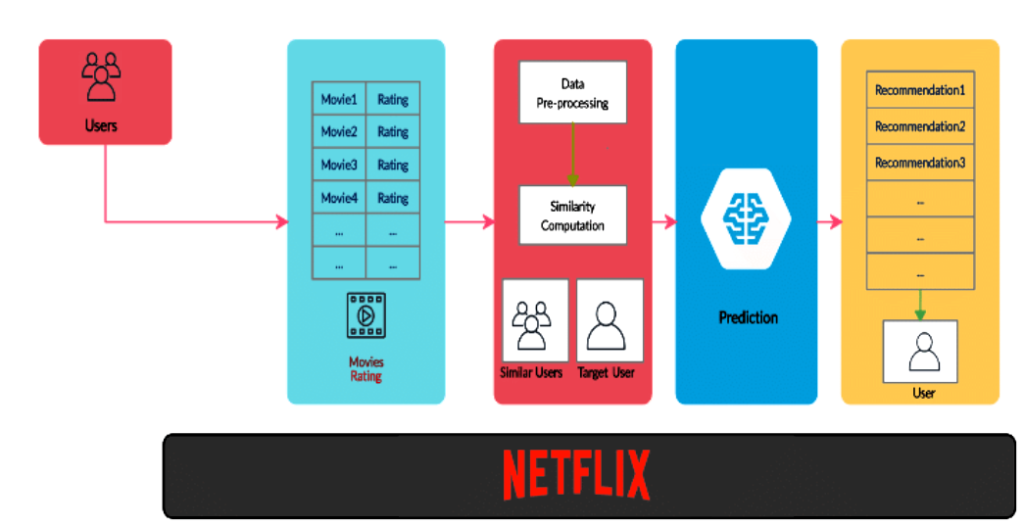
Collaborative filtering forms the bedrock of Netflix’s recommendation prowess, navigating through vast data oceans to link similar user behaviors and preferences. The model operates on two pivotal frameworks: User-User and Item-Item collaborative filtering. While the former pairs users with analogous viewing habits, the latter aligns items that have been similarly rated or interacted with, ensuring that the content nudged towards a viewer is reflective of their intrinsic and evolving tastes.

Dive into Deep Learning

Further refinement of content suggestions is manifested through deep learning techniques that scrutinize viewing patterns with astonishing precision. By implementing neural networks, Netflix deciphers subtle patterns and nuanced preferences that might elude traditional predictive models, orchestrating a content symphony that aligns with both overt and covert user desires.

Contextual Bandit Balancing Exploration and Exploitation

Netflix negotiates a delicate balancing act between offering tried-and-true favorites and introducing viewers to novel content through a method known as the contextual bandit algorithm. This mechanism strives to optimize a fine balance between exploiting known viewer preferences and exploring uncharted content territories, ensuring that the user experience is a harmonious blend of comfort and curiosity.

The Art and Science of Thumbnails

The recommendation engine’s wizardry extends beyond mere content suggestions to encompass aesthetic appeals through dynamic thumbnails. By analyzing which images, a user is more inclined to click on, Netflix optimizes thumbnail presentations to augment appeal and, by extension, engagement.

Results A Symphony of Science and Satisfaction

The tangible impact of Netflix’s recommendation engine isn’t merely speculative. A staggering 80% of hours streamed are from automated recommendations, a testament to the engine’s efficacy in curating content that resonates and retains. Moreover, personalized content curations have substantially mitigated churn, safeguarding Netflix’s position as a streaming titan amidst a sea of burgeoning competitors.

Conclusion

Netflix has harmoniously blended technology and viewer psychology to orchestrate a recommendation engine that not only understands but anticipates user preferences. This intricate dance of data, algorithms, and user experience forms a lustrous tapestry that enchants viewers and secures unwavering loyalty in a fluctuating digital landscape. For marketers and technologists alike, Netflix’s saga of personalization underscores the boundless potentials of marrying data, technology, and an unerring commitment to user satisfaction.

This succinct exploration into Netflix’s recommendation engine underscores the expansive and intricate technological frameworks that underpin its globally renowned personalization capabilities, offering insights and inspiration for marketing and technology professionals navigating the complex terrains of user engagement and content delivery in the digital age.

Oh hi there 👋
It’s nice to meet you.

Sign up to receive awesome content in your inbox, every week.

We don’t spam! Read our privacy policy for more info.

Check your inbox or spam folder to confirm your subscription.

You Might Also Like

Prediction Markets Under Fire as Former Trump Official Launches New Coalition

Burger King AI Assistant Patty Signals a New Era in Fast Food Automation

Google Intrinsic AI Robotics Strategy Marks New Phase for Automation

S26 Ultra Official: Samsung Unveils Its Most Advanced Galaxy AI Phone Yet

Ailias Hologram Avatars: The AI Startup Reimagining Human Presence

Share This Article
Facebook LinkedIn Email Copy Link Print
Share
What do you think?
Love0
Sad0
Happy0
Sleepy0
Angry0
Dead0
Wink0
Previous Article The Metaverse Revolution How Marketers Can Dive In
Next Article Eco-friendly Practices in Modern E-commerce
Leave a comment

Leave a Reply Cancel reply

Your email address will not be published. Required fields are marked *

Latest News

  • You could be an influencer without even realizing it

    In late February, Puck reported on a strange case: An influencer with more than a million followers was inadvertently promoting products on Instagram. On some of Julia Berolzheimer's posts, a "Shop the look" button hovered in the corner. When followers clicked it, they were fed similar items to what Berolzheimer was wearing. Her job is

  • Donut Lab’s solid-state battery can handle the (extreme) heat, test says

    Finnish startup Donut Lab is out to prove that its solid-state battery is all that it claims to be. Last week, the test was about fast charging. This week is where things get hot. Like the first test, this one was also conducted by state-owned VTT Technical Research Centre of Finland. The team set out

  • AI-generated art can’t be copyrighted after Supreme Court declines to review the rule

    The US Supreme Court has declined to hear a case over whether AI-generated art can obtain a copyright, as reported earlier by Reuters. The Monday decision comes after Stephen Thaler, a computer scientist from Missouri, appealed a court's decision to uphold a ruling that found AI-generated art can't be copyrighted. In 2019, the US Copyright

  • Here’s the upgrade to my favorite phone camera of last year

    Vivo rarely has a presence at MWC, but this year it bucked that trend in a big way, with the reveal of its next flagship phone, the X300 Ultra, alongside an upgraded telephoto extender lens and professional camera cage. The company isn't ready to launch the handset just yet - or even reveal very many

  • Nvidia’s spending $4 billion on photonics to stay ahead of the curve in AI

    Nvidia announced on Monday that it's investing $2 billion each into Lumentum and Coherent, which are both developing photonics technology for data centers, like optical transceivers, circuit switches, and lasers, which are used to move data at high speeds over long distances. Their tech could improve energy efficiency, data transfer speeds, and bandwidth in future

- Advertisement -
about us

We influence 20 million users and is the number one business and technology news network on the planet.

Advertise

  • Advertise With Us
  • Newsletters
  • Partnerships
  • Brand Collaborations
  • Press Enquiries

Top Categories

  • Artificial Intelligence
  • Technology
  • Bussiness
  • Politics
  • Marketing
  • Science
  • Sports
  • White Paper

Legal

  • About Us
  • Contact Us
  • Privacy Policy
  • Affiliate Disclaimer
  • Legal

Find Us on Socials

The Tech MarketerThe Tech Marketer
© The Tech Marketer. All Rights Reserved.
Welcome Back!

Sign in to your account

Lost your password?
