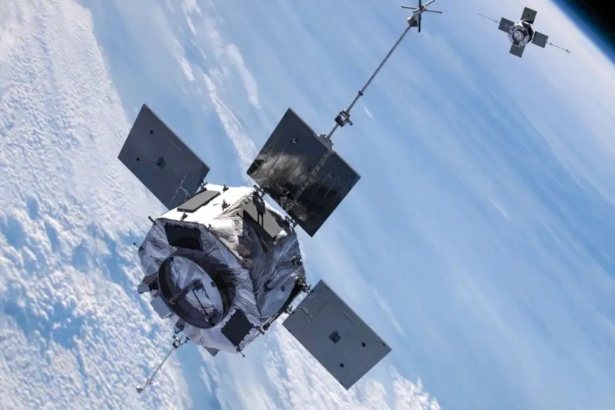
A retired 1,323-pound NASA spacecraft is expected to reenter Earth’s atmosphere — far sooner than anyone predicted when the mission ended in 2019. The Sun is to blame.
NASA satellite crashing headlines lit up search trends after the space agency confirmed that Van Allen Probe A is expected to plunge back into Earth’s atmosphere around 7:45 p.m. ET on Tuesday, March 10, 2026, give or take 24 hours either way. NASA expects most of the spacecraft to burn up as it travels through the atmosphere, but some components are expected to survive reentry. The risk of harm coming to anyone on Earth is low — approximately 1 in 4,200. creativebloq
That is not a zero probability, but it is a reassuringly small one. To put it in context, objects have reentered before carrying a 1-in-1,000 chance of harm and caused no damage. Nintendo Everything The real story here is not the risk. It is why the satellite is coming down now, nearly eight years ahead of the original schedule.
What Is Van Allen Probe A?
Van Allen Probe A and its twin, Van Allen Probe B, launched on August 30, 2012, and gathered unprecedented data on Earth’s two permanent radiation belts — named for scientist James Van Allen — for almost seven years. The belts shield Earth from cosmic radiation, solar storms, and the constantly streaming solar wind that are harmful to humans and can damage technology, so understanding them is important. creativebloq
Initially planned as a two-year mission, the probes exceeded expectations, operating for nearly seven years. Scientists are still using data from the mission to better understand the effects of space weather. 9to5Toys
The Van Allen Probes were the first spacecraft designed to operate and gather scientific data for many years within the belts, a region around our planet where most spacecraft and astronaut missions minimize time in order to avoid damaging radiation. creativebloq The mission, managed and operated by Johns Hopkins University Applied Physics Laboratory, made several major discoveries during its lifetime, including the first data showing the existence of a transient third radiation belt, which can form during times of intense solar activity. creativebloq
The mission officially ended in 2019, when both spacecraft exhausted their fuel supplies and could no longer orient themselves toward the Sun.
Why Is the NASA Satellite Crashing Now — Not in 2034?
This is the question scientists had to answer first. When the mission ended in 2019, analysis found that the spacecraft would reenter Earth’s atmosphere in 2034. However, those calculations were made before the current solar cycle, which has proven far more active than expected. In 2024, scientists confirmed the Sun had reached its solar maximum, triggering intense space weather events. These conditions increased atmospheric drag on the spacecraft beyond initial estimates, resulting in an earlier-than-expected reentry. creativebloq
In practical terms: a more active Sun heats Earth’s upper atmosphere, causing it to expand slightly. That expanded atmosphere reaches higher altitudes and exerts more drag on orbiting objects — slowing them down, lowering their orbits, and ultimately pulling them back toward Earth sooner than models built during quieter solar periods would have predicted.
Van Allen Probe B, the twin of the reentering spacecraft, is not expected to reenter before 2030. creativebloq
The Actual Risk: What NASA and Experts Say
The odds that a piece of debris will cause harm to a person is about 1 in 4,200, the space agency said. That is a low chance, according to NASA. Nintendo Everything
Dr. Darren McKnight, a senior technical fellow at space-tracking company LeoLabs, offered a straightforward read of the numbers. “We’ve had things that have reentered have a 1 in 1,000 chance, and nothing happened; if we have a few that are 1 in 4,000 or 5,000, it’s not a horrible day for mankind,” McKnight said. Nintendo Everything
The 1-in-4,200 probability is still notably higher than some past incidents. China’s Tiangong-1 space station, which reentered in 2018 and drew global attention, carried an estimated debris-hitting-a-human probability of less than one in a trillion. No one was harmed. Nintendo Everything
McKnight noted that satellite reentries actually happen with considerable regularity. “We get about one object a week — a dead rocket body, another payload that isn’t maybe as high a profile as this. So that happens about once a week that some mass will survive to the ground,” he said. Nintendo Everything
How End-of-Mission Planning Works — and What It Missed
From the outset, NASA intended to dispose of the radiation-studying spacecraft by allowing them to burn up in the atmosphere as they plummeted to Earth. Mission planners mapped out the probes’ return home when the spacecraft concluded its mission, conducting a few maneuvers designed to expel any remnants of fuel and confirm that the vehicles were in a position for atmospheric drag to slowly pull them out of orbit. That ensures the defunct spacecraft are not left to spend years flying uncontrolled through Earth orbit, where they could run the risk of colliding with active satellites or habitats such as the International Space Station. Nintendo Everything
NASA’s policies require that vehicles launched by the U.S. reenter or be safely disposed of within 25 years of the mission’s end. Safe disposal can include deorbiting the spacecraft or positioning it in a graveyard orbit, an area of space designated for abandoned spacecraft to linger. Nintendo Everything
In the case of the Van Allen Probes, a graveyard orbit was not chosen. It would have consumed fuel that was instead used to extend the science mission. The tradeoff was considered acceptable at the time — and a 2034 reentry prediction seemed comfortably distant. The Sun had other plans.
Marlon Sorge, a space debris expert with The Aerospace Corporation, observed that the calculus around reentry design has shifted considerably since 2012. “In that time there’s been increasingly more awareness of the need to try to mitigate what survives to the ground,” Sorge said, suggesting NASA may have designed the mission differently if it launched today — perhaps aiming to ensure no piece of the vehicle would survive reentry, as many modern satellite operators now do. Nintendo Everything
The Growing Space Debris Problem
The Van Allen Probe A reentry arrives as the space debris issue has grown sharply in scope and public awareness. Recent headline-grabbing incidents have included a piece of garbage jettisoned from the International Space Station that unexpectedly survived reentry and pierced the roof of a home in Florida in 2024. Pieces of hardware from private rocket companies, including SpaceX and Blue Origin, have also turned up on beaches and private property across the world. Nintendo Everything
Each incident prompts questions about who is responsible, how risk is communicated, and whether current standards are adequate. The Van Allen Probe A situation is different in that NASA planned for this outcome from day one — but the accelerated timeline, driven by an unusually active solar cycle, shows how difficult long-range predictions remain when the Sun does not cooperate with projections.
FAQ
Q1: What is the NASA satellite crashing to Earth? The spacecraft is Van Allen Probe A, part of NASA’s Van Allen Probes mission launched on August 30, 2012. It studied Earth’s two radiation belts for nearly seven years before the mission ended in 2019. The satellite weighs 1,323 pounds (600 kilograms) and is managed by Johns Hopkins University Applied Physics Laboratory.
Q2: Why is Van Allen Probe A reentering now instead of 2034? When the mission ended in 2019, NASA predicted reentry in 2034. Those calculations did not account for the current solar cycle. In 2024, the Sun reached its solar maximum — more active than expected — which heated and expanded Earth’s upper atmosphere, increased drag on the spacecraft, and pulled it out of orbit roughly eight years ahead of schedule.
Q3: What is the risk to people on the ground? NASA places the probability of debris causing harm to any person on Earth at approximately 1 in 4,200. Most of the spacecraft is expected to burn up during atmospheric reentry. NASA and the U.S. Space Force are tracking the descent in real time and updating predictions at space-track.org.
Q4: Will any pieces of the satellite survive reentry? NASA says most of the spacecraft will burn up, but some components are expected to survive. It has not specified which parts. Where surviving debris lands cannot be predicted until reentry is imminent, as the trajectory remains uncertain within a 24-hour window around the 7:45 p.m. ET Tuesday estimate.
Q5: What happens to Van Allen Probe B? Van Allen Probe B, the twin spacecraft, remains in orbit and is not expected to reenter before 2030, according to NASA. Like its counterpart, Probe B’s reentry timeline has also been accelerated by the active solar cycle, originally having been expected even later.