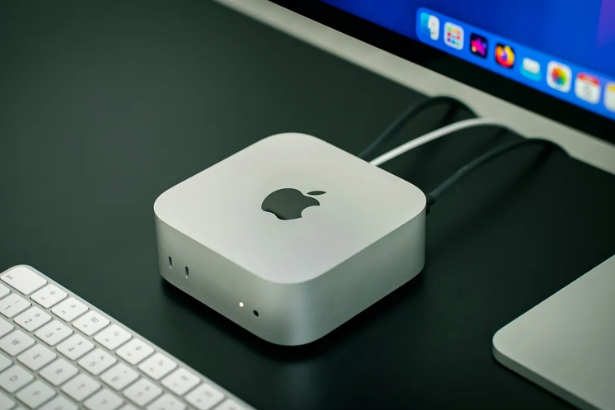
Apple’s smallest desktop just became a much more serious AI machine, with the new M6 Mac mini targeting developers, creators and users who want to run AI workloads locally.
The Mac mini has always been one of Apple’s strangest products in the best possible way. It is tiny, relatively affordable and easy to overlook next to the company’s glamorous laptops and iPhones. The 2026 refresh changes that equation by turning the compact desktop into a machine Apple is explicitly positioning for local AI and always-on agentic computing.
Apple announced the new Mac mini with the all-new M6 and an M5 Pro option on August 25, with the company claiming up to 4x faster AI performance, up to 2x faster graphics and storage, and 40% faster CPU performance for the M6 model compared with the previous generation.
The timing is telling.
The Google Trends screenshot supplied for this article shows repeated spikes in searches for “Mac mini,” with the strongest activity arriving around the latest Apple announcement. Search interest is being driven not just by a routine hardware refresh, but by a broader question: Can a tiny desktop become a practical local AI workstation?
Apple clearly thinks the answer is yes.
Background and Context
The Mac mini has historically occupied an unusual position in Apple’s lineup.
It is not a laptop. It has no built-in display, keyboard or trackpad. Instead, users bring their own accessories and connect the small aluminum computer to an existing monitor and peripherals.
That simplicity has made the Mac mini popular with developers, home users and small businesses.
The Apple silicon era made the machine more interesting.
With Apple’s CPU, GPU, Neural Engine and unified memory architecture working together, the Mac mini became capable of handling workloads that previously required substantially larger desktops.
Now Apple is leaning into another advantage: local AI inference.
The company says the new Mac mini can run AI models directly on the device, including local models and AI agents that automate tasks. The M6 version includes a 12-core CPU, a 12-core GPU with Neural Accelerators in every GPU core and a Dual 16-core Neural Engine.
That combination is less about making Word documents open slightly faster.
It is about changing what the Mac mini can be used for.
Why local AI matters
For years, the default model for generative AI has been cloud computing.
A user types a prompt. The request travels to a remote data center. Powerful GPUs process it. The response comes back.
That approach works, but it introduces costs, latency and privacy considerations.
Local inference flips the model.
The computer sitting on your desk performs more of the work itself.
Ars Technica notes that the Mac mini and Mac Studio have become popular for local AI inference and software development because Apple’s unified memory architecture and fast CPUs and GPUs are well suited to running models locally.
That emerging use case explains why Apple’s latest Mac mini announcement feels more significant than a normal specification bump.
Latest Update or News Breakdown
Apple’s new Mac mini lineup is built around two chips: the M6 and M5 Pro.
The M6 is the headline act.
Apple calls it its latest generation of silicon for the compact desktop and says it delivers up to 4x faster AI performance than the previous M4 model, along with twice the graphics performance and 40% faster CPU performance.
The M6 has a 12-core CPU and 12-core GPU. The GPU is particularly important because Apple has added Neural Accelerators to every GPU core for the first time in the Mac mini.
Apple says the design allows the machine to handle AI workloads more efficiently, while the Dual 16-core Neural Engine provides up to twice the performance of the previous generation.
The company is making some eye-catching claims around specific workloads.
Apple says M6 Mac mini can deliver:
- Up to 13.5x faster LLM prompt processing in LM Studio compared with the M1 Mac mini
- Up to 4.8x faster LLM prompt processing compared with M4
- Up to 2.3x faster spreadsheet calculations in Microsoft Excel compared with M1
- Up to 2x faster ray-traced gaming performance in Cyberpunk 2077: Ultimate Edition compared with M4
As always with manufacturer benchmarks, these figures should be viewed as Apple testing specific workloads under specific conditions, rather than universal performance guarantees.
Mac mini M5 Pro targets professionals
For users who need more than the standard M6 configuration, Apple is also offering the Mac mini with M5 Pro.
The M5 Pro configuration reaches up to an 18-core CPU and 20-core GPU. Apple says the machine is designed for demanding workloads including video production, app development, scientific simulations, 3D design and game development.
It also supports up to 64GB of unified memory with memory bandwidth reaching 307GB/s.
That memory capacity matters for AI.
Large models need large amounts of memory, and unified memory allows the CPU and GPU to access the same pool rather than maintaining separate memory resources.
Apple says the M5 Pro Mac mini can therefore handle larger local AI models, custom datasets and demanding creative applications.
Connectivity gets an upgrade too
The new Mac mini also gains Wi-Fi 7 and Bluetooth 6.
Apple is making 2.5Gb Ethernet standard, with a 10Gb Ethernet option available.
The M6 model has three Thunderbolt 4 ports on the rear, while the M5 Pro version moves to three Thunderbolt 5 ports.
The Thunderbolt 5 connection is particularly interesting for AI users.
Apple says multiple Mac mini systems can be clustered together through Thunderbolt 5 to run large AI models entirely on-device.
That is where the tiny desktop starts looking less like a conventional consumer computer and more like a building block for an unconventional AI workstation.
Price and availability
The new Mac mini is available to preorder starting August 25.
Apple says customer deliveries and store availability begin September 22.
Pricing starts at:
- Mac mini with M6: $899
- Mac mini with M5 Pro: $1,699
The education prices start at $799 and $1,599 respectively.
Apple’s official Mac mini announcement
Expert Insights and Analysis
The most important thing about this Mac mini refresh is not simply the M6.
It is Apple’s change in emphasis.
Apple is increasingly selling its desktops as AI infrastructure.
That is a notable shift from the way Macs were marketed only a few years ago.
The company now talks openly about “agentic AI workflows,” local models and always-on AI devices. The new Mac mini can sit on a desk and continuously perform tasks without relying entirely on a remote cloud service.
Ars Technica sees the same trend from a different angle.
According to its analysis, developers and researchers have been connecting multiple Mac minis and Mac Studios to run larger local models, creating an alternative to systems built around specialized Nvidia GPUs.
That does not mean a cluster of Mac minis suddenly replaces a high-end AI data center.
It does mean the definition of an AI workstation is changing.
The memory advantage
Apple’s unified memory architecture is one of the reasons these machines are attractive to local AI enthusiasts.
Traditional PC architectures often separate system RAM from GPU memory. Large AI workloads can therefore run into memory limitations quickly.
Apple’s architecture allows different parts of the system to work from the same memory pool.
That does not eliminate every bottleneck, but it can make high-memory configurations attractive for running larger models.
The M5 Pro Mac mini’s 64GB maximum is therefore more significant for AI developers than it might initially appear.
The Mac mini becomes an AI appliance
There is also a practical advantage.
A Mac mini is small, quiet and designed to stay on a desk.
Apple explicitly describes the new model as suitable for “always-on” agentic computing.
That opens up use cases beyond traditional desktop computing.
A Mac mini could act as:
- A private AI assistant
- A local coding-agent server
- A home automation brain
- A document and knowledge-processing machine
- A local image-generation workstation
- A development server
- A small business AI appliance
- Part of a multi-Mac inference cluster
That is a very different proposition from simply saying the computer is faster.
Broader Implications
Apple Is Betting on AI Moving Closer to the User
The biggest implication of the new Mac mini is that Apple is betting the next phase of AI will not happen entirely in the cloud.
Cloud AI will remain essential for the largest models and the most demanding workloads.
But smaller models are getting better.
Open-weight models are becoming more capable.
Developer tools are increasingly able to run AI agents locally.
And users are becoming more conscious of the cost and privacy implications of sending every request to a remote server.
That creates an opening for machines like the Mac mini.
For more coverage of Apple’s AI strategy and local computing, an internal link could point readers to The Tech Marketer’s AI and Apple coverage hub at thetechmarketer.com.
Privacy becomes part of the hardware pitch
Local AI also changes the privacy conversation.
When a model runs directly on a user’s computer, sensitive documents and data do not necessarily have to leave that machine for every task.
That does not automatically make every local AI application private. Software can still transmit information if configured to do so.
But the architecture gives developers another option.
For businesses handling sensitive documents, code or customer information, that option could become increasingly valuable.
The economics of AI computing are changing
There is also a cost argument.
Running AI through a cloud provider means paying for compute, often through usage-based pricing.
Running a model locally means the user pays for hardware, electricity and maintenance instead.
For occasional users, cloud AI can remain more convenient.
For developers who run models constantly, local hardware can become more attractive.
Ars Technica highlights precisely this tension, noting that developers are increasingly using AI coding agents while questioning the cost of repeatedly running powerful cloud models.
That creates a potential market for compact AI machines.
And Apple wants the Mac mini to occupy that space.
Related History or Comparable Technologies
The Mac mini has never been Apple’s flagship desktop.
That has always been part of its appeal.
The product began as a small, relatively inexpensive gateway into the Mac ecosystem. Users supplied their own screen and accessories, reducing the upfront cost of entry.
Apple silicon changed its role.
Suddenly, the same small box could handle serious development, creative work and increasingly sophisticated AI workloads.
The 2026 generation pushes that evolution further.
From personal computer to local AI node
The new Mac mini can be thought of as a small computing node rather than simply a desktop.
That distinction matters.
A traditional desktop is designed around one person sitting in front of it.
A local AI node can work in the background.
It can process data, run models, host services and support other devices.
Apple’s support for clustering multiple Mac mini systems over Thunderbolt 5 reinforces that idea.
It is an unusually ambitious concept for a machine that still fits comfortably on a desk.
Mac mini versus Mac Studio
Apple’s broader desktop lineup makes the strategy even clearer.
The Mac mini is the accessible end of the local AI spectrum.
The Mac Studio goes much further, with dramatically higher memory capacity and performance.
Ars Technica reports that the new Mac Studio lineup reaches enormous memory configurations specifically useful for local AI inference.
That creates a ladder:
Mac mini M6: mainstream local AI and development.
Mac mini M5 Pro: heavier professional workloads and larger models.
Mac Studio: serious local AI, production and professional compute.
The strategy is obvious.
Apple wants its silicon architecture to scale from ordinary desktop users all the way up to users building sophisticated local AI systems.
What Happens Next
The new Mac mini is available for preorder now, but the more interesting story will begin once developers get their hands on the hardware.
September 22: First deliveries
Apple says the new machines begin arriving September 22.
That is when independent benchmarks will start to reveal whether Apple’s AI performance claims translate into meaningful real-world gains.
Local AI testing
Expect developers to test the M6 Mac mini with local language models, coding agents, image-generation tools and other inference workloads.
The important metrics will not simply be CPU benchmark scores.
They will include:
- Model size
- Tokens per second
- Memory consumption
- Power efficiency
- Sustained performance
- Temperature
- Noise
- Cost per inference
- Performance across different quantization levels
Those tests will determine whether the Mac mini is genuinely becoming a practical local AI platform.
Multi-Mac clustering
The most intriguing experiment may involve multiple Mac minis working together.
Apple explicitly says Thunderbolt 5 can be used to cluster systems for large AI models.
That could produce an unusual new category of homegrown AI infrastructure.
Instead of buying one enormous workstation, users could build systems incrementally.
Start with one Mac mini.
Add another.
Then another.
It is not the traditional Apple approach to computing, but it fits surprisingly well with the company’s move toward local AI.
Mac mini M6 Specifications at a Glance
| Feature | Mac mini M6 | Mac mini M5 Pro |
|---|---|---|
| CPU | 12-core | Up to 18-core |
| GPU | 12-core | Up to 20-core |
| Neural processing | Dual 16-core Neural Engine | Neural Accelerators + Neural Engine |
| Unified memory | Up to 32GB | Up to 64GB |
| Memory bandwidth | Up to 170GB/s | Up to 307GB/s |
| Ethernet | 2.5Gb, 10Gb option | 2.5Gb, 10Gb option |
| Wireless | Wi-Fi 7, Bluetooth 6 | Wi-Fi 7, Bluetooth 6 |
| Rear Thunderbolt | Thunderbolt 4 | Thunderbolt 5 |
| Starting price | $899 | $1,699 |
| Availability | September 22, 2026 | September 22, 2026 |
Specifications and pricing are based on Apple’s announcement.
Conclusion
The new Mac mini is not merely Apple’s smallest Mac getting another processor upgrade.
It is a signal about where Apple thinks desktop computing is heading.
With the M6, Apple is putting significantly more AI performance into a machine that remains small enough to disappear under a monitor. The company says the new model delivers up to 4x faster AI performance, while the M5 Pro version pushes memory and graphics capabilities much further for demanding professional workloads.
But the most important change is philosophical.
Apple is no longer talking about the Mac mini only as a computer for productivity, media and development.
It is talking about the machine as an always-on AI device.
That puts the Mac mini directly into one of the most interesting battles in computing: whether the future of AI belongs primarily to enormous cloud data centers, or whether increasingly capable models will migrate onto the devices sitting on our desks.
The answer will probably be both.
Cloud infrastructure will continue powering the biggest models.
But the new Mac mini suggests that Apple wants more AI work happening locally, privately and continuously.
For a product that was once dismissed as Apple’s little desktop box, that is a surprisingly big ambition.
FAQ
What is the new Mac mini?
The new Mac mini is Apple’s updated compact desktop computer for 2026. It is available with the new M6 chip or M5 Pro and is designed for everyday computing, professional workloads and local AI tasks.
How much does the Mac mini M6 cost?
The Mac mini M6 starts at $899 in the United States. The education price starts at $799.
When is the new Mac mini available?
Apple opened preorders on August 25, 2026. The new Mac mini begins arriving to customers and Apple Store locations on September 22.
How much faster is the M6 Mac mini?
Apple says the M6 Mac mini delivers up to 4x faster AI performance, up to 2x faster graphics and storage, and 40% faster CPU performance compared with the previous-generation M4 Mac mini.
Can the Mac mini run AI models locally?
Yes. Apple specifically promotes the new Mac mini for on-device AI, local models and agentic AI workflows. The M5 Pro model supports up to 64GB of unified memory, while Apple says multiple systems can also be clustered using Thunderbolt 5 for larger AI workloads.
What is the difference between the M6 and M5 Pro Mac mini?
The M6 model is designed as the mainstream option, with a 12-core CPU and 12-core GPU and up to 32GB of unified memory. The M5 Pro version is aimed at professional workloads, reaching up to an 18-core CPU, 20-core GPU and 64GB of unified memory.
Does the Mac mini support Wi-Fi 7?
Yes. Both the M6 and M5 Pro Mac mini support Wi-Fi 7 and Bluetooth 6. The machines also include 2.5Gb Ethernet, with a 10Gb option.
Is the Mac mini good for AI development?
The new hardware is clearly designed with AI development in mind. Apple specifically highlights local models, AI agents and workloads such as LLM processing. Independent benchmarks after launch will provide a better picture of how it compares with competing AI hardware in real-world development environments.
Can multiple Mac minis be connected for AI?
Yes. Apple says Thunderbolt 5 allows multiple Mac mini systems to be clustered for running large AI models entirely on-device.
Sources & References
- Apple, “Apple’s new Mac mini, featuring M6 and M5 Pro, delivers a massive leap in AI performance”
Read Apple’s official announcement - Ars Technica, “Apple’s new desktop computers are designed specifically for local AI development”
Read the Ars Technica analysis - Los Angeles Times, “Apple readies new Mac mini as it gears up for foldable iPhone and a wave of gadgets”
Read the Los Angeles Times report - Apple, “Apple introduces new Mac Studio with M5 Max and M5 Ultra”
Read Apple’s Mac Studio announcement