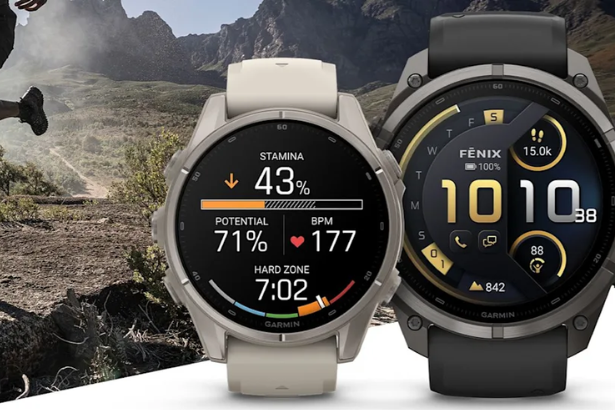
Garmin’s flagship adventure watch gets brighter displays, faster maps, smarter endurance tracking and a major connectivity upgrade with the new Fenix 9 Pro.
The Garmin Fenix 9 has officially arrived, ending months of speculation around Garmin’s next-generation flagship outdoor smartwatch. The company introduced both the Fenix 9 and Fenix 9 Pro on August 25, 2026, adding new training metrics, faster navigation and, on Pro models, built-in satellite and LTE connectivity.
The launch comes after a sharp jump in Google search interest for “Garmin Fenix 9.” The supplied Google Trends screenshot shows searches accelerating dramatically in the hours surrounding Garmin’s “Play Harder” launch event.
That spike makes sense.
The Fenix line sits at the center of Garmin’s high-end outdoor strategy, competing for the wrists of runners, cyclists, hikers, triathletes and adventurers who want more than basic smartwatch features.
And this generation is not simply about making the watch faster.
Garmin is trying to make it more useful when the phone stays in the backpack.
Background and Context
The Fenix series has long occupied Garmin’s premium multisport category.
Unlike mainstream smartwatches that emphasize notifications, apps and everyday convenience, Fenix watches are built around endurance sports, navigation, training data and outdoor durability.
The Fenix 9 continues that philosophy while adding several features that make the watch more capable as a standalone device.
Garmin says the standard Fenix 9 comes in 43mm, 47mm and 51mm sizes. It features an AMOLED display, sapphire lens, leakproof buttons and a dive rating of up to 40 meters.
The Pro models push the concept further.
Garmin has added a titanium case, a larger 1.5-inch AMOLED display on the 51mm version, solar charging options and inReach connectivity on all three Pro sizes.
That last point could be one of the most important changes for serious adventurers.
Latest Update: Garmin Fenix 9 Officially Launches
Before the launch, the Fenix 9 was the subject of weeks of leaks and speculation.
Garmin had announced its “Play Harder” event without initially naming the product. Garmin Rumors tracked the buildup ahead of the August 25 event, while Forbes reported that a major Garmin launch was expected.
Now the speculation is over.
Garmin has officially announced the Fenix 9 and Fenix 9 Pro.
Garmin’s official Fenix 9 announcement
The standard Fenix 9 gets a much brighter AMOLED display
Garmin says the Fenix 9’s AMOLED display is twice as bright as its predecessor.
That matters outdoors, where smartwatch screens can become difficult to read under direct sunlight.
The display is protected by a scratch-resistant sapphire lens, while the watch remains designed for demanding outdoor use.
The result is a watch that is trying to combine the visual appeal of AMOLED with the ruggedness traditionally associated with Fenix.
Navigation gets substantially faster
Garmin has also upgraded the mapping system.
The Fenix 9 includes 50% more RAM than the Fenix 8, along with a more powerful map engine.
Garmin says map panning can be up to 30% faster.
There is also a new perspective view intended to give users more context about terrain and what lies ahead on a route.
For hikers and trail runners, this may be more useful than another minor fitness metric.
A watch that redraws maps quickly and provides better route context can directly affect how confidently someone navigates unfamiliar terrain.
New stamina metrics
Garmin is adding stamina zones and a stamina curve.
The idea is to give athletes a better picture of how endurance changes over time based on fitness improvements and training history.
Instead of simply telling someone how much energy they appear to have left, Garmin wants the watch to help users understand the broader relationship between training and endurance.
That could be especially useful for endurance athletes trying to manage effort over long sessions.
Garmin Epic turns activities into a story
One of the more consumer-friendly additions is Garmin Epic.
The feature groups multiple activities into a single shareable story inside Garmin Connect.
A long hiking trip, cycling block or training period can therefore be collected into an “Epic” containing health data, performance information and photos.
It is an interesting change in emphasis.
Garmin has historically been very good at collecting data.
Now it is also trying to make that data easier to experience and share.
Rucking gets more serious
The Fenix 9 also expands its rucking capabilities.
Users can change pack weight during an activity, follow GORUCK workouts directly from the watch and set target metrics such as calories burned with up to 100kg of pack weight.
That gives the watch a more specialized role for military-style fitness, weighted hiking and endurance training.
Indoor rowing gets a bigger role
Garmin is also adding additional fitness insights to indoor rowing, including VO2 Max and a power curve.
That gives rowers more ways to evaluate fitness and training progress without relying exclusively on running or cycling data.
Independent endurance technology publication the5krunner also highlighted rowing VO2 Max as one of the notable new Fenix 9 features.
Fenix 9 Pro: The Bigger Upgrade
The Fenix 9 Pro is where Garmin’s new hardware strategy becomes more obvious.
It adds features that go beyond training and navigation.
Titanium construction
The Fenix 9 Pro is the first Fenix smartwatch with a titanium watch case.
Garmin says its manufacturing process combines metal and plastic at the molecular level, allowing the company to reduce thickness while maintaining durability.
For a watch designed to survive outdoor abuse, reducing weight without compromising strength is a meaningful upgrade.
A huge 1.5-inch AMOLED display
The 51mm Fenix 9 Pro gets Garmin’s first 1.5-inch AMOLED display.
The company says the screen is 15% larger than the Fenix 8’s display without increasing the case size.
The Pro AMOLED models can also reach up to 3,000 nits of brightness.
That could make maps and data considerably easier to read in harsh outdoor conditions.
Solar charging returns
Select Fenix 9 Pro models feature solar-charging displays.
Garmin claims up to 57 days of battery life in smartwatch mode for the largest solar model.
For people who spend days away from power outlets, that can matter more than almost any app or notification feature.
Built-in satellite and LTE connectivity
This is arguably the biggest Fenix 9 Pro upgrade.
Select Pro models include Garmin inReach connectivity, allowing users to send messages, make calls, send SOS communications and share their location without carrying a phone.
Garmin says inReach connectivity is available across the 43mm, 47mm and 51mm Fenix 9 Pro sizes.
The Pro models can also receive weather forecasts through satellite connectivity.
That turns the watch into something closer to a self-contained communications device for remote adventures.
Expert Insights and Analysis
The Fenix 9 is interesting because Garmin is not trying to beat Apple or Samsung at being a traditional smartwatch.
It is playing a different game.
The priority remains endurance, navigation and outdoor reliability.
But Garmin is gradually removing the reasons users need to carry a phone.
That is particularly obvious with the Fenix 9 Pro.
An adventurer can potentially leave the phone behind and still communicate, access navigation, share location and request emergency assistance.
The company’s strategy also reflects a broader trend in wearable technology.
The smartwatch is becoming less of a phone accessory and more of an independent computing device.
The data problem Garmin is trying to solve
Garmin already collects enormous amounts of fitness information.
Heart rate.
Training load.
Sleep.
Recovery.
VO2 Max.
GPS.
Elevation.
Power.
Pace.
The challenge is turning all of that information into something useful.
Stamina zones and Garmin Epic represent two different answers.
Stamina metrics attempt to make the data more actionable during training.
Garmin Epic attempts to make it more meaningful after the activity.
That is a subtle but important shift.
The watch is no longer only a sensor platform.
It is becoming an interpretation and storytelling platform.
The outdoor connectivity advantage
Apple Watch Ultra and other premium smartwatches have pushed deeper into outdoor sports, but Garmin retains an important advantage in endurance-focused ecosystems.
Garmin has spent years building tools around serious training and navigation.
The Fenix 9 Pro’s satellite and LTE capabilities reinforce that positioning.
For someone spending a weekend in remote terrain, the ability to leave the phone behind is not just a convenience feature.
It can become a safety feature.
Broader Implications
Garmin Is Turning the Watch Into an Adventure Computer
The Garmin Fenix 9 increasingly resembles a small computer for outdoor environments.
Its job is no longer simply to measure steps or display notifications.
It can map a route, track training, estimate endurance, communicate through satellite networks and document a multi-day adventure.
That is a much more ambitious role.
For The Tech Marketer, this also creates an internal-link opportunity to coverage of wearable AI, outdoor technology, fitness tracking and satellite communications at thetechmarketer.com.
Phone independence is becoming a premium feature
The Fenix 9 Pro’s inReach capabilities are particularly significant because they address a problem that conventional smartwatches cannot completely solve.
Cellular networks do not cover everywhere.
Satellite connectivity can.
For hikers, climbers, cyclists and other outdoor users, that makes satellite communication one of the few smartwatch features with a direct safety application.
It also strengthens Garmin’s differentiation from mainstream smartwatch manufacturers.
Garmin’s subscription ecosystem remains important
The hardware is only part of the experience.
Features such as Garmin Epic depend on Garmin Connect, while inReach connectivity involves an active plan.
That means the Fenix 9 is part of a broader hardware and software ecosystem rather than simply a standalone gadget.
The5krunner has also raised an open question about whether Garmin Epic could involve Connect+, although that had not been confirmed in its initial analysis.
That distinction is important.
Features that appear free at launch can sometimes develop into more complex subscription models over time.
Related History or Comparable Technologies
The Fenix 9 arrives into an increasingly crowded premium smartwatch market.
Apple’s Watch Ultra line has pushed harder into running, diving and outdoor activities.
Samsung has expanded its rugged smartwatch offering.
Coros has built a strong reputation among endurance athletes.
Suunto continues to focus on outdoor and adventure users.
Garmin’s answer is specialization.
Instead of trying to make the Fenix feel like a smartphone on your wrist, Garmin is building a device around the activities where a smartwatch can become genuinely useful.
Fenix 9 versus Fenix 8
The most obvious comparison is the previous Fenix generation.
The Fenix 9 brings:
- A brighter AMOLED display
- More RAM
- Faster map interaction
- New stamina metrics
- Garmin Epic
- Expanded rucking tools
- New indoor rowing metrics
- More storage
- New perspective map view
- New Pro titanium construction
- Satellite and LTE connectivity on select Pro models
Garmin says the standard Fenix 9 has 64GB of memory, enough for twice as many maps as the Fenix 8 and up to 7,000 songs.
That makes the upgrade more substantial than a simple screen refresh.
Garmin Fenix 9 Price and Battery Life
Garmin has positioned the Fenix 9 as a premium device.
| Model | Starting Price | Maximum Smartwatch Battery |
|---|---|---|
| Fenix 9 | $999.99 | Up to 29 days |
| Fenix 9 Pro | $1,099.99 | Up to 31 days |
| Fenix 9 Pro Solar | Higher depending on configuration | Up to 57 days |
Garmin says the standard Fenix 9 starts at $999.99 and can reach 29 days of smartwatch battery life in the largest size.
The Fenix 9 Pro starts at $1,099.99 and reaches up to 31 days, while select solar models can reach 57 days.
These figures are smartwatch-mode estimates, not necessarily continuous GPS or LTE usage.
That distinction matters.
GPS tracking, AMOLED brightness, music playback and satellite communications can all affect real-world endurance.
What Happens Next
The immediate question is no longer whether Garmin will launch the Fenix 9.
It has.
Now the important questions are about real-world performance.
Independent testing
The first major reviews should reveal how the Fenix 9 performs against the Fenix 8 and competing premium watches.
The key areas to watch will be:
- GPS accuracy
- Battery endurance
- AMOLED visibility
- Map performance
- Heart-rate accuracy
- Training metrics
- Satellite communication
- LTE reliability
- Comfort and weight
- Solar charging performance
The AI question
There is also an interesting question about where Garmin takes AI next.
The5krunner noted that additional developments may emerge around communications, AI and rescue functionality.
Garmin has not positioned the Fenix 9 as a generative AI watch in the way some consumer electronics companies are positioning their latest devices.
Instead, the company appears focused on using intelligence to improve training, navigation and safety.
That may ultimately be the more useful approach.
An athlete probably does not need a chatbot on their wrist during a 50-mile trail race.
They do need to know how hard they can push.
Garmin Fenix 9 Specifications at a Glance
| Feature | Fenix 9 | Fenix 9 Pro |
|---|---|---|
| Sizes | 43mm, 47mm, 51mm | 43mm, 47mm, 51mm |
| Display | AMOLED | AMOLED, solar options |
| Largest display | Standard Fenix 9 AMOLED | 1.5-inch AMOLED |
| Display brightness | 2x predecessor | Up to 3,000 nits |
| Case | Rugged construction | Titanium case |
| Lens | Sapphire | Sapphire |
| Maps | Built-in routable maps | Built-in routable maps |
| RAM | 50% more than Fenix 8 | Enhanced |
| Storage | 64GB | Up to 64GB |
| LTE | No | Select models |
| Satellite | No | inReach on select models |
| Solar | No | Select models |
| Battery | Up to 29 days | Up to 31 days, 57 days solar |
| Starting price | $999.99 | $1,099.99 |
Specifications are based primarily on Garmin’s official launch information.
Conclusion
The Garmin Fenix 9 is a substantial evolution of Garmin’s flagship outdoor watch rather than a radical redesign.
The standard model gets a brighter AMOLED display, faster navigation, more memory and new training tools.
The Fenix 9 Pro goes further, adding titanium construction, a larger display, solar charging options and phone-free satellite and LTE connectivity.
The most important change, however, is the direction Garmin is taking.
The company is building a watch that can increasingly function without a phone.
It can navigate.
It can track.
It can analyze.
It can communicate.
It can document an adventure.
And with Garmin Epic, it can even turn weeks of activity into a single story.
At $999.99, the Fenix 9 is firmly a premium product. The Fenix 9 Pro starts even higher at $1,099.99.
But for athletes and adventurers who spend serious time outdoors, the value proposition is not really about having another smartwatch.
It is about carrying a compact outdoor computer on the wrist.
That is what makes the Fenix 9 one of Garmin’s most important wearable launches of 2026.
FAQ
What is the Garmin Fenix 9?
The Garmin Fenix 9 is Garmin’s latest flagship multisport GPS smartwatch for athletes and outdoor adventurers. It adds brighter AMOLED displays, faster mapping, new stamina metrics, expanded rucking features and Garmin Epic.
How much does the Garmin Fenix 9 cost?
The Garmin Fenix 9 starts at $999.99 in the United States. The Fenix 9 Pro starts at $1,099.99.
When was the Garmin Fenix 9 released?
Garmin officially announced the Fenix 9 and Fenix 9 Pro on August 25, 2026. Garmin lists the watches as available now, with regional ordering and availability details varying by model.
What are the biggest new Fenix 9 features?
The biggest changes include faster maps, a brighter AMOLED display, stamina zones, a stamina curve, Garmin Epic, expanded rucking tools and new indoor rowing metrics.
Does the Fenix 9 have satellite connectivity?
The standard Fenix 9 does not offer the same built-in inReach connectivity as the Pro models. Select Fenix 9 Pro watches support LTE and satellite communication through Garmin’s inReach system.
How long does the Fenix 9 battery last?
Garmin says the largest Fenix 9 can reach up to 29 days in smartwatch mode. The Fenix 9 Pro can reach up to 31 days, while select solar models can reach up to 57 days.
Does the Fenix 9 have AMOLED?
Yes. The Fenix 9 uses an AMOLED display. Garmin says it is twice as bright as the previous generation. The Fenix 9 Pro 51mm has a 1.5-inch AMOLED display capable of up to 3,000 nits.
What is Garmin Epic?
Garmin Epic is a new Garmin Connect feature that combines multiple activities, photos, health information and performance data into a single shareable story covering a trip or training period.
Does Fenix 9 support rucking?
Yes. Garmin has expanded rucking features so users can adjust pack weight during an activity, follow GORUCK workouts and set targets such as calories burned with up to 100kg of pack weight.
Is the Fenix 9 worth upgrading from the Fenix 8?
For owners who mainly want basic fitness tracking, the Fenix 8 may remain capable. The Fenix 9 becomes more compelling for users who want faster maps, improved endurance metrics, Garmin Epic, expanded rucking and, in the Pro models, titanium construction and satellite or LTE connectivity.
Sources & References
- Garmin, “Garmin expands its flagship performance smartwatch lineup with fēnix 9 and fēnix 9 Pro”
Read Garmin’s official announcement - Garmin, “fēnix 9” product page
View the official Fenix 9 product page - the5krunner, “Fenix 9: Three New Features Explained”
Read the independent feature analysis - Garmin Rumors, “Live Blog: Garmin’s ‘Play Harder’ Event, Fenix 9 Launch Updates”
Read the launch live blog - Forbes, “Major Garmin Launch Coming Tomorrow: Garmin Fenix 9 Expected”
Read the pre-launch report