Introduction
iPhone Handoff is one of the quieter but potentially most useful features arriving with iOS 27. It lets supported users switch between two iPhones while keeping the same phone number, using a primary eSIM on one device and a companion eSIM on the other. Apple confirmed the feature as part of its September 2026 iPhone announcements.
The feature is particularly interesting because it solves a problem that has become more common as people use different phones for different jobs. One device might be a daily driver, while another could be a foldable, camera-focused phone or a larger secondary device.
There is, however, an important catch: iPhone Handoff requires carrier support, and the initial rollout is extremely limited.
Background and Context
Apple first quietly mentioned the ability to switch between two iPhones using the same phone number during WWDC 2026. It appeared among hundreds of iOS 27 changes without much explanation.
That left an obvious question: how would Apple make one cellular number work across two separate iPhones?
A subsequent iOS 27 beta provided the first meaningful look.
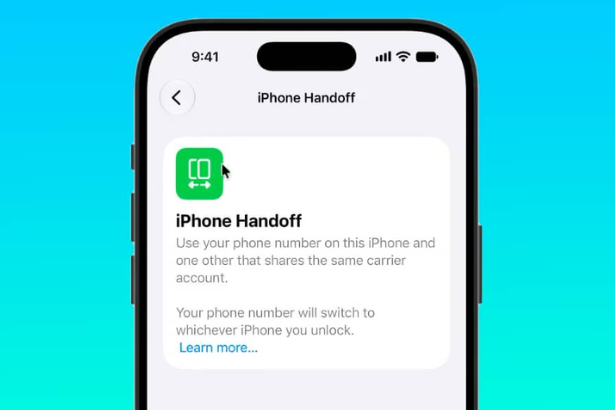
The feature, called iPhone Handoff, is configured through the Cellular section of Settings. One iPhone becomes the main device, retaining the user’s primary eSIM. The second device becomes the companion and receives a companion eSIM.
The result is different from Apple’s existing Continuity features.
Messages and calls can already move between Apple devices under certain conditions, but those systems generally depend on the primary device, Wi-Fi, Bluetooth or Apple’s broader Continuity infrastructure.
iPhone Handoff operates at the cellular and eSIM level, allowing the phone number itself to become active on whichever of the two iPhones the user is actively using.
Latest Update: iPhone Handoff Arrives With iOS 27
Apple has now confirmed the feature’s launch details.
With iPhone Handoff enabled, users can move between a main iPhone and a secondary iPhone. Unlocking one device automatically transfers the phone number to that device. Apple displays a confirmation indicating that the number has switched.
The important limitation is carrier support.
At launch, iPhone Handoff will work with T-Mobile in the United States and Deutsche Telekom in Germany. Apple says carrier support is required, and there may be carrier fees associated with setting up the service.
MacRumors’ iPhone Handoff coverage
Android Authority reports that Verizon and EE are expected to gain support later in 2026, although broader availability will depend on individual carriers.
iPhone Handoff coverage from Android Authority
Apple’s own iPhone Duo announcement also confirms that iOS 27 introduces iPhone Handoff for supported carriers.
Apple’s iPhone Duo announcement
How iPhone Handoff works
The setup is relatively straightforward:
- Both iPhones must run iOS 27 or later.
- Both devices must be connected to Wi-Fi.
- Both must be signed into the same Apple Account.
- FaceTime, iMessage and Messages in iCloud must be enabled.
- A supported carrier is required.
- One iPhone becomes the main device.
- The second becomes the companion device.
- Unlocking either phone transfers the active number to that device.
The number does not remain simultaneously active on both iPhones.
Instead, Apple transfers the active cellular identity between them.
Expert Insights or Analysis
The clever part of iPhone Handoff is that Apple is not simply duplicating a phone number.
It is creating a relationship between two eSIM profiles.
The primary iPhone remains the center of cellular account management, while the companion receives a linked eSIM. That allows Apple and participating carriers to treat the two devices as parts of one cellular setup rather than two independent lines.
That could make a major difference for people who regularly carry two phones.
Consider a user with an iPhone 18 Pro and Apple’s new foldable iPhone Duo. One device might be preferable for photography or durability, while the other offers a larger display for multitasking.
Without iPhone Handoff, maintaining the same number across both phones can involve awkward workarounds.
With Handoff, the user can simply pick up the phone they want to use.
That is a much more Apple-like experience.
The timing is also revealing.
Apple’s first foldable iPhone, the iPhone Duo, arrives with a large 7.6-inch internal display and a software experience designed around multitasking. Apple explicitly lists iPhone Handoff among its wireless capabilities.
That makes the feature look less like an isolated convenience and more like part of a broader strategy for people who own multiple premium devices.
Broader Implications
The arrival of iPhone Handoff could change the way consumers think about having a secondary smartphone.
Today, carrying two phones often means maintaining two cellular lines, using a carrier’s multi-device service or manually moving an eSIM.
Apple’s approach removes much of that friction, at least for supported carriers.
The bigger issue is whether carriers embrace it.
A carrier has to support the underlying system, provision the companion eSIM and decide whether to charge an additional fee. That means Apple’s software alone cannot determine how widely the feature spreads.
The initial launch with only T-Mobile in the U.S. and Deutsche Telekom in Germany shows how dependent the feature is on carrier cooperation.
If Verizon, AT&T, EE and other major carriers follow, iPhone Handoff could become a standard part of the iPhone ecosystem.
If carrier support remains fragmented, it may instead become a niche feature for power users.
Internal link suggestion: Add a related article on “How Apple Is Turning the iPhone Into a Multi-Device Platform” to thetechmarketer.com.
Related History or Comparable Technologies
Apple has spent years making its devices work together.
Continuity lets users move tasks between Macs, iPhones and iPads. Handoff, despite sharing the name, is conceptually different from that existing system.
Traditional Continuity features allow activities such as Safari sessions, calls and messages to move between devices. The devices generally remain independently provisioned for cellular service.
iPhone Handoff tackles a more fundamental problem: the phone number itself.
Android users have had various carrier-specific approaches to multi-device connectivity, but Android Authority argues that there has not been a comparable universal Android feature for seamlessly sharing one cellular number between two smartphones at the network level.
Apple’s approach could therefore create pressure on Google and Android manufacturers to build a similar system.
That competition could eventually benefit consumers regardless of which platform they use.
What Happens Next
iOS 27 is scheduled for release on September 14, 2026, with compatibility extending back to the iPhone 11 series and second-generation iPhone SE.
But owning a compatible iPhone is not enough to use Handoff.
Carrier support remains the deciding factor.
The next phase will therefore be watching which U.S. and international carriers activate the feature and what they charge for it.
Apple’s rollout could also become more important as its hardware lineup becomes more diverse.
The iPhone Duo gives customers a fundamentally different form factor. If consumers begin pairing a conventional iPhone with a foldable model, the ability to move one number between them becomes substantially more useful.
There is also room for future expansion into other device categories.
Apple could potentially use the same underlying carrier architecture to make cellular switching between additional personal devices easier, although Apple has not announced such plans.
For now, iPhone Handoff is specifically about two iPhones.
Conclusion
iPhone Handoff may not have received the attention of Apple’s new foldable iPhone or its AI-powered Siri, but it could prove to be one of iOS 27’s most practical changes.
The concept is simple: pair two iPhones, keep one phone number and automatically transfer the active cellular connection to whichever device you unlock.
The limitation is equally simple: your carrier has to support it.
T-Mobile in the United States and Deutsche Telekom in Germany are the initial launch partners, with additional carrier support expected.
If that support expands quickly, Apple could make carrying two iPhones feel less like managing two phones and more like using two faces of the same device.
FAQ
1. What is iPhone Handoff?
iPhone Handoff is an iOS 27 feature that allows supported users to switch between two iPhones while keeping the same phone number.
2. Can two iPhones use the same phone number at the same time?
No. The same number can be active on only one of the paired iPhones at a time. Unlocking the other device transfers the active number to it.
3. Which carriers support iPhone Handoff?
At launch, Apple says iPhone Handoff is supported by T-Mobile in the United States and Deutsche Telekom in Germany. Additional carriers are expected to follow.
4. Do both iPhones need iOS 27?
Yes. Apple requires both iPhones to run iOS 27 or later for iPhone Handoff. They must also be connected to Wi-Fi and signed into the same Apple Account.
5. Does iPhone Handoff work with eSIM?
Yes. The feature uses a primary eSIM on the main iPhone and a companion eSIM on the secondary iPhone.
6. Does iPhone Handoff move an Apple Watch between iPhones?
No. Apple says iPhone Handoff does not automatically move an Apple Watch from one iPhone to the other.
7. Will iPhone Handoff work with Dual SIM?
Yes, provided both eSIMs are from carriers that support iPhone Handoff. The supported eSIMs can switch together when the user unlocks the other iPhone.
Sources & References
- iOS 27 Introduces New ‘iPhone Handoff’ Feature
Read MacRumors - iOS 27’s ‘iPhone Handoff’ Feature Limited to T-Mobile and Deutsche Telekom at Launch
Read MacRumors - Two phones, one number: Apple just beat Android to a very handy feature
Read Android Authority - Apple unveils iPhone Duo
Read Apple Newsroom - iPhone Handoff Will Let You Use One Number on Two iPhones
Read CNET