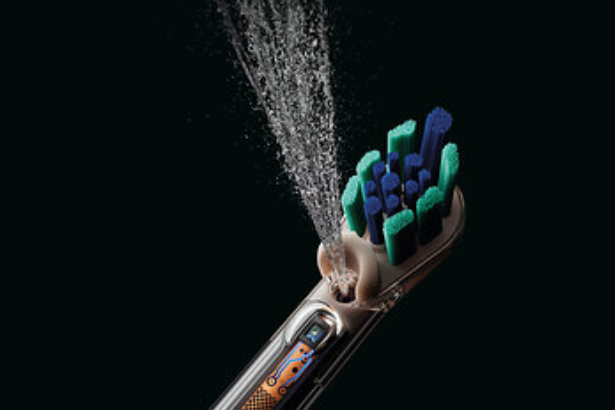
Dyson has entered oral care with a camera-equipped electric toothbrush that uses machine learning to detect gaps between teeth and fire a targeted mouthrinse jet while you brush.
The Dyson toothbrush has officially become a piece of computer vision hardware. The new Dyson CameraJet combines a 100,000-pixel macro camera, machine learning, sonic brushing and a precision liquid jet designed to clean between teeth automatically. Dyson launched the device September 1 at $499, positioning it well above conventional premium electric toothbrushes.
The basic idea sounds almost absurdly futuristic: a toothbrush looks inside your mouth, identifies an interdental gap, then decides where to spray.
But the engineering underneath is serious. Dyson says CameraJet analyzes 28 live images per second and can detect a gap and trigger a jet within 100 milliseconds.
Background and Context
Dyson has spent years turning ordinary household products into technology showcases. The company moved from vacuum cleaners into hair care, air treatment and other personal-care products. Oral care is its latest attempt to apply that engineering-first strategy to a category where the basic routine has changed very little.
According to Dyson, CameraJet is the result of six years of research, development and engineering. The company’s stated goal is to address one of the hardest parts of conventional oral care: cleaning the spaces between teeth.
That is where the CameraJet’s unusual hardware becomes important.
The brush contains a 1mm macro-lens camera with 100,000 pixels. Its machine-learning system, which Dyson calls Gap Optical Targeting, analyzes the camera feed to locate interdental gaps while the toothbrush is moving.
Dyson says the system was trained using 470,000 dental images and runs on 16 million lines of code.
This is less about turning your toothbrush into a tiny dentist and more about making the device aware of where it is in your mouth.
Latest Update: Dyson Toothbrush CameraJet Launches for $499
The headline feature is the camera.
The CameraJet watches the area around the teeth while you brush and uses its AI system to determine when a gap is in view. When it identifies one, a conical burst of mouthrinse is directed toward that location.
Dyson says the process takes place within 100 milliseconds of detecting the gap.
The company has also designed a specialized fluid system around that idea.
A Jet Instead of Traditional Flossing
Rather than using a narrow, needle-like stream, Dyson developed a broader conical jet.
The company says its engineers worked for five years with the National University of Singapore’s Faculty of Dentistry to develop a proprietary proxy plaque for testing different jet designs. Dyson says the broader cone can remove plaque while operating at lower pressure than a conventional narrow jet.
The CameraJet’s mouthrinse tank holds 12.5ml, enough for a cleaning session according to Dyson. Its docking station can refill the system and charge the toothbrush.
The dock is designed to refill the tank in about three seconds.
The Camera Is Also a Live Viewer
The camera is not only there for automatic jet targeting.
Through the MyDyson app, users can see a live view of their teeth, receive guided cleaning instructions, review coverage maps and get personalized brushing feedback. The device connects through Wi-Fi and Bluetooth.
Dyson says the camera is active only when needed for features such as live viewing or automatic jetting.
The company also says images are not stored on the toothbrush, in the cloud or by Dyson.
That privacy detail is likely to matter because a camera inside a bathroom appliance creates a very different kind of consumer-tech question.
Expert Insights or Analysis
The most interesting thing about the Dyson toothbrush is not that it has AI.
It is that Dyson is using AI for a very specific physical task.
Consumer AI has largely been associated with chatbots, image generation and software assistants. CameraJet represents another direction: machine learning embedded directly into a physical object that has to make a decision in real time.
The camera sees.
The algorithm interprets.
The mechanical system responds.
That closed loop is what makes CameraJet different from a normal connected toothbrush.
Bloomberg’s reporting, published through Yahoo Finance, places the launch within a broader movement toward cameras appearing in products that historically had no reason to contain them.
The bigger question is whether consumers actually want this level of intelligence in their bathroom.
Smart toothbrushes already exist. Premium models from Oral-B and Philips can track brushing time, coverage and pressure through connected apps. Dyson’s pitch is that those systems mostly measure what happened after the fact, while CameraJet attempts to actively change what the toothbrush does while you are using it.
That distinction could become important.
How the Dyson Toothbrush Actually Works
The CameraJet combines several technologies that would normally exist in separate devices.
1. Camera
The 100,000-pixel macro camera provides a close-range view of the teeth.
2. Gap Optical Targeting
Dyson’s machine-learning system analyzes the camera feed to identify interdental gaps.
3. Precision Jet
Once a gap is identified, the device releases a conical burst of mouthrinse.
4. Sonic Brushing
The brush uses variable sonic oscillation designed to keep the bristles moving across difficult surfaces.
5. MyDyson Connectivity
Wi-Fi and Bluetooth connect the toothbrush to the MyDyson app for live viewing, guidance, coverage mapping and feedback.
6. RFID Brush Heads
Each brush head includes an RFID tag that tracks usage and can alert the user when replacement is needed.
The result is essentially a miniature robotics system disguised as a toothbrush.
The $499 Question
Price is probably going to be the biggest obstacle.
At $499.99, the CameraJet is not merely another premium electric toothbrush. It is asking consumers to pay roughly the price of a high-end smartphone accessory, appliance or several years of conventional dental-care products for a single bathroom device.
Dyson is clearly betting that consumers will pay for engineering rather than simply brushing performance.
That strategy is familiar.
The company has previously used premium pricing to turn ordinary categories into technology products, particularly with its Supersonic hair dryer and Airwrap styling system.
Bloomberg notes that Dyson’s personal-care strategy has become an important part of its business, making oral care a logical extension rather than a random experiment.
The CameraJet therefore has two jobs.
It needs to clean teeth well.
It also needs to convince people that cleaning teeth should be a technology experience.
What About the Plaque-Removal Claims?
This is where some caution is necessary.
Dyson says CameraJet removes significantly more plaque in certain hard-to-reach areas than competing premium electric toothbrushes. Its current product information also references clinical and laboratory testing.
But the company’s specific comparisons need to be read in context.
Some results come from laboratory testing, including experiments involving Dyson’s proprietary proxy plaque. Others compare particular cleaning modes against manual brushing or premium electric toothbrushes under defined testing conditions.
That does not automatically mean the technology is ineffective.
It means consumers should distinguish between a company’s controlled test results and independent evidence about long-term dental outcomes in everyday use.
The strongest question for CameraJet will ultimately be whether people using it over months and years achieve measurably better oral-health outcomes than people using established electric toothbrushes and conventional interdental cleaning.
Broader Implications
Cameras Are Moving Into Unexpected Devices
The Dyson toothbrush is part of a larger consumer-tech trend.
Cameras have already moved beyond phones and laptops into glasses, cars, doorbells and wearable devices. CameraJet pushes that boundary into one of the most private environments imaginable.
That raises an interesting product-design principle:
Just because a device can see does not mean consumers automatically want it to see.
Dyson is attempting to address that concern by keeping the camera short-range and saying images are not stored or shared.
Still, trust will be part of the product’s value proposition.
AI Becomes More Useful When It Controls Hardware
The CameraJet also demonstrates a different model for consumer AI.
Instead of asking users to interact with a chatbot, the system makes a tiny decision continuously in the background.
That could become a major direction for AI-powered hardware.
A vacuum can decide where to clean.
A camera can decide what to record.
A thermostat can decide when to adjust temperature.
A toothbrush can decide where to spray.
The technology becomes invisible when it works well.
An Internal Story Opportunity
The launch also fits into a broader The Tech Marketer story about AI moving from software into everyday physical products.
Suggested internal link:
That angle could connect CameraJet with smart-home devices, AI wearables, connected appliances and consumer robotics.
Related History or Comparable Technologies
Smart toothbrushes are not new.
Oral-B and Philips have spent years adding Bluetooth, pressure sensors, brushing timers and app-based coverage tracking to premium models. Bloomberg notes that smart toothbrushes remain a relatively niche category despite those efforts.
Dyson’s approach is different because the company is trying to make the toothbrush physically react to what its camera sees.
That resembles the transition seen in other consumer products.
Early robot vacuums followed relatively simple movement patterns. Newer models use cameras, mapping and object recognition.
Early fitness trackers mostly counted steps. Newer wearables interpret heart rate, sleep and activity patterns.
CameraJet applies the same progression to oral care:
sensor → interpretation → automated response.
That could be the real significance of the product.
What Happens Next
The first test is commercial.
Can Dyson persuade consumers to spend $499 on a toothbrush when much cheaper electric brushes already perform the basic job?
The second test is technical.
CameraJet has to work consistently in a difficult environment involving water, toothpaste, saliva, changing angles and constantly moving teeth.
The third test is medical.
Independent researchers and dental professionals will have to determine how meaningful its performance claims are outside Dyson’s testing environments.
And there is a fourth test that may be even harder:
Will people actually use the technology?
A $499 toothbrush cannot fix poor brushing habits simply because it contains AI.
But if its automation genuinely makes interdental cleaning easier, it could address one of the biggest weaknesses in conventional oral-care routines.
Dyson is also planning additional dental products, including a low-foaming mouthrinse and non-foaming toothpaste designed to work with the camera system.
That points toward something larger than a single toothbrush.
Dyson appears to be building an oral-care ecosystem.
Conclusion
The Dyson toothbrush CameraJet is one of the stranger examples of AI entering everyday consumer hardware, and that is exactly what makes it interesting.
For $499, consumers get an electric toothbrush with a camera, machine learning, automatic precision-flossing, a mouthrinse tank, app connectivity and a charging/refill dock.
The technology is ambitious.
The price is ambitious too.
Whether CameraJet becomes a genuinely useful new category or an expensive engineering showcase will depend on real-world results, consumer adoption and independent evidence.
Either way, Dyson has made one thing clear: the humble toothbrush is no longer off-limits to the AI hardware race.
FAQ
1. What is the Dyson toothbrush CameraJet?
The Dyson CameraJet is a $499 electric toothbrush with a built-in camera, machine learning and a precision mouthrinse jet designed to automatically clean between teeth while brushing.
2. How much does the Dyson toothbrush cost?
The Dyson CameraJet costs $499.99 in the United States. Dyson offers it in Ceramic Ultra Blue and Ceramic Pink.
3. Does the Dyson toothbrush really have a camera?
Yes. It uses a 100,000-pixel macro camera designed to view the teeth at close range and identify interdental gaps.
4. How does the Dyson CameraJet floss?
The camera and Gap Optical Targeting system identify gaps between teeth. The toothbrush then fires a conical burst of mouthrinse toward the detected gap. Dyson says this happens within 100 milliseconds of detection.
5. Does Dyson store the camera images?
Dyson says the camera images are not stored on the device or in the cloud. The company says images viewed through the MyDyson app are deleted rather than stored or shared.
6. How many images per second does the camera analyze?
Dyson says Gap Optical Targeting analyzes 28 live images per second.
7. Is the Dyson CameraJet clinically tested?
Dyson’s product information says the CameraJet has undergone clinical testing, including a study involving 204 participants over six weeks for one cited comparison. Other performance claims are based on laboratory testing.
8. Is the Dyson toothbrush worth $499?
That depends on how much value a consumer places on automated interdental cleaning, camera-based feedback and the Dyson ecosystem. The price is substantially higher than conventional electric toothbrushes, so independent long-term testing will be important in determining whether the technology justifies the premium.
SOURCES & REFERENCES
- Dyson, “Dyson CameraJet: The first toothbrush with a camera and a jet, to target the gaps and remove plaque between your teeth.”
Read the Dyson CameraJet announcement - PR Newswire, “Dyson CameraJet: The first toothbrush with a camera and a jet, to target the gaps and remove plaque between your teeth.”
Read the full product release - Bloomberg via Yahoo Finance, “Dyson Debuts $499 AI-Powered Toothbrush With a Built-In Camera.”
Read the Bloomberg report - The Verge, “Dyson made a camera-equipped toothbrush that flosses for you.”
Read The Verge’s analysis - WIRED, “Dyson’s Next Act Is an Electric Toothbrush With a Camera.”
Read WIRED’s report