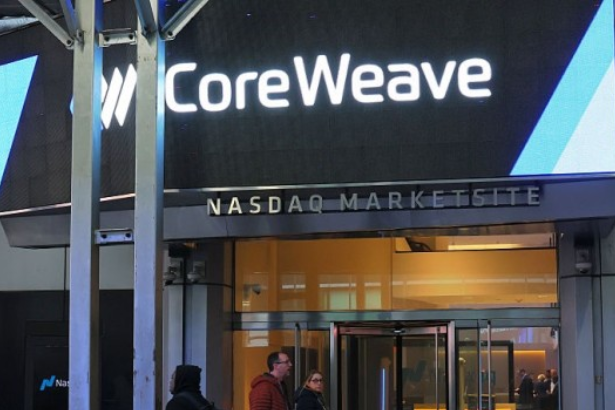
CoreWeave stock is back in the spotlight as investors reassess the debt financing behind the artificial intelligence infrastructure boom. After a steep sell-off on Wednesday, October 14, shares came under further pressure in premarket trading on Thursday, according to Yahoo Finance. The immediate concern is not simply whether demand for AI computing will keep growing. It is whether CoreWeave can finance its rapid expansion on terms that make economic sense.
The pressure has spread beyond its shares. Investors have also been selling the company’s bonds, pushing yields on some debt due in 2032 toward 15%. That move has intensified scrutiny of CoreWeave’s borrowing costs, its spending commitments, and the financial risks that can emerge when a fast-growing technology company depends heavily on external funding.
The episode does not prove that the AI infrastructure boom is ending. It does show that investors are becoming more demanding about how that boom gets financed.
Background and Context: What CoreWeave Does
CoreWeave is an AI-focused cloud computing company that supplies access to powerful computing infrastructure, including Nvidia graphics processing units, to organizations developing and running AI workloads.
Training and operating advanced AI models requires substantial computing capacity. Building that capacity means acquiring expensive chips, securing electricity, constructing or leasing data center space, and maintaining the networking and cooling systems that keep equipment running. CoreWeave’s business is built around providing this infrastructure to customers that need it without building every part of the system themselves.
The opportunity is substantial, but so are the capital requirements. Data centers and specialized computing hardware cost large sums before the resulting capacity can generate revenue. Companies that expand quickly may therefore need to borrow, issue shares, or arrange other financing well ahead of receiving the full financial return on their investments.
That is the central tension facing CoreWeave. Strong customer demand can support growth, but demand alone does not guarantee that the business will generate enough cash to cover its investments, interest payments, and other obligations.
Latest Update: Why CoreWeave Stock Is Falling
Bond yields have become a warning signal
According to Yahoo Finance’s October 14 report, the yield on a CoreWeave bond due in 2032 reached roughly 15% during recent trading before closing at an elevated level. Investors have been paying closer attention to that figure because it reflects the price the market is putting on the company’s credit risk.
Bond yields and prices generally move in opposite directions. When a bond’s market price falls, its yield rises. A yield approaching 15% is therefore a sign that investors are demanding a substantial return to hold that debt. It is not, by itself, proof that a company will default, but it can signal that lenders see meaningful risks.
Higher market yields can also complicate future borrowing. Existing bonds do not automatically reset to the latest market yield, but if a company needs to issue new debt or refinance maturing obligations, the cost of doing so may become more expensive.
The stock sell-off has continued
Yahoo Finance reported that CoreWeave shares fell about 15% on Wednesday and were down another 6% in premarket trading on Thursday. Those figures describe separate trading periods, rather than a single combined daily return.
The market reaction reflects more than one concern. Investors are weighing the company’s debt burden against the possibility that AI infrastructure demand, financing conditions, and the competitive landscape may not develop as optimistically as expected.
In the same report, Yahoo Finance cited Bernstein analyst Madison Rezaei, who maintained an Underperform rating and argued that the company’s long-term business model remained economically challenged. That is an analyst’s assessment, not a settled verdict on CoreWeave’s future.
Investors are questioning the broader AI financing model
The pressure has extended beyond CoreWeave. Barron’s coverage of the bond sell-off points to wider investor concerns about the debt required to build AI infrastructure. When the financing costs of one high-profile provider rise sharply, investors may begin reassessing other companies that rely on similar spending and funding strategies.
CNBC’s October 14 report also focused on CoreWeave’s bond yields and the concerns surrounding AI-related debt.
The key distinction is between confidence in AI as a technology and confidence in every company investing heavily in it. Investors can believe that AI adoption will continue while remaining skeptical that every infrastructure provider will earn attractive returns on its capital.
Expert Insights and Analysis: Growth Is Not the Same as Profitability
CoreWeave’s latest market troubles expose three questions investors will likely keep asking.
First, how much does growth cost? Revenue growth matters, but it has to be weighed against the cost of acquiring hardware, building capacity, operating facilities, and financing those investments. If costs rise faster than revenue or cash generation, a growing business can still face financial strain.
Second, how dependable is customer demand? Long-term contracts and committed customer spending can provide visibility, but investors also need to consider customer concentration, contract terms, payment schedules, and the possibility that customers could change their plans. A large backlog is valuable, but it is not identical to cash already collected.
Third, what happens when financing gets more expensive? Companies that need repeated access to debt markets are particularly exposed when lenders demand higher returns. Expensive financing can squeeze margins, force spending changes, or make new projects less attractive. Issuing shares may provide another source of capital, but it can dilute existing shareholders.
These questions are not unique to CoreWeave. They are becoming increasingly relevant across the AI infrastructure market, where demand forecasts have encouraged large investments in computing capacity.
Broader Implications: A Stress Test for the AI Boom
The CoreWeave stock decline matters because it puts the financial structure of AI expansion under the microscope.
For years, the central technology-sector debate has focused on whether AI tools will become powerful and useful enough to justify major investment. That question remains important. But the next phase of scrutiny is increasingly financial: which companies can turn AI demand into durable cash flow, and which might struggle to cover the cost of meeting that demand?
For chipmakers, cloud providers, data center operators, and investors, the answer could affect how quickly new facilities are built and how those projects are funded. If borrowing remains expensive, some companies may slow expansion, seek strategic financing partners, or prioritize projects with clearer near-term returns.
For shareholders, the distinction between a promising industry and an attractive individual investment is critical. Even if AI computing demand continues to expand, a company’s shares can suffer if its debt costs, capital requirements, or competitive pressures undermine expected returns.
The story also offers a useful comparison for readers following the wider AI economy. The Tech Marketer could connect this coverage with an internal explainer on the economics of AI infrastructure and data center investment, using the article to examine the difference between rising AI adoption and sustainable business economics.
Related History: The Difference Between Building Capacity and Making Money
Technology markets have seen similar tensions before. During earlier infrastructure booms, investors funded rapid expansion based on expectations that future demand would justify the upfront expense. In some cases, demand eventually caught up with capacity. In others, companies discovered that building the infrastructure was easier than earning an adequate return on it.
AI infrastructure has its own characteristics. Advanced accelerators are expensive, power availability can constrain expansion, and data centers require substantial planning and capital. At the same time, AI services could support significant long-term demand across industries.
That makes a simple comparison with past technology bubbles incomplete. The relevant lesson is not that today’s AI investment must end in a crash. It is that infrastructure spending, customer demand, financing costs, and shareholder returns need to be evaluated separately.
CoreWeave’s bond-market pressure is a reminder that lenders and shareholders can reach different conclusions from customers. Customers may want more computing capacity, while investors still question whether the provider can finance that capacity profitably.
What Happens Next: What Investors Should Watch
Several developments could shape the next chapter for CoreWeave.
- Bond prices and yields: A sustained improvement in the company’s debt market could ease immediate financing concerns. Continued weakness would suggest investors remain wary of its credit risk.
- Cash flow and capital spending: Financial results should help show whether operating performance is keeping pace with the cost of expanding infrastructure.
- Customer commitments: Investors will want to see whether contracted demand translates into revenue and cash receipts on a reliable schedule.
- Access to new financing: The terms of future borrowing or equity issuance could reveal how much flexibility CoreWeave has as it funds expansion.
- The wider AI cloud market: Conditions at competing providers may help establish whether the sell-off reflects company-specific concerns or a broader reassessment of AI infrastructure economics.
A recovery in the share price alone would not settle these questions. The more durable test will be whether CoreWeave can demonstrate a credible path from large infrastructure commitments to sustainable cash generation.
Conclusion: CoreWeave Stock Reflects a New Phase of AI Scrutiny
CoreWeave stock has become a focal point for a wider debate over the cost of the AI boom. The sharp share-price decline and the rise in bond yields show that investors are taking a closer look at the financing required to build and operate large-scale AI computing infrastructure.
That does not mean AI demand is disappearing, nor does it establish that CoreWeave is headed for default. It means that expectations for growth are increasingly being tested against borrowing costs, cash flow, and the returns generated by new infrastructure.
For the AI industry, the next challenge may be less about proving that more computing power is needed and more about proving that supplying it can be profitable.
FAQ
1. Why is CoreWeave stock falling?
CoreWeave stock has faced pressure as investors react to falling bond prices, elevated borrowing costs, and concerns about whether the company’s capital-intensive AI infrastructure model can generate sustainable returns.
2. What does a 15% bond yield mean for CoreWeave?
A yield near 15% indicates that investors are demanding a high return to hold the relevant debt at its current market price. It can signal elevated perceived credit risk and may make future borrowing or refinancing more expensive. It does not automatically mean the company will default.
3. What does CoreWeave do?
CoreWeave provides cloud computing infrastructure for AI and other demanding workloads, including access to specialized computing hardware such as Nvidia GPUs.
4. Is the CoreWeave sell-off proof that the AI boom is over?
No. The sell-off reflects concerns about debt, financing costs, and the economics of AI infrastructure providers. AI demand can continue growing even if investors become more selective about which companies can profit from that growth.
5. How could higher borrowing costs affect CoreWeave?
Higher borrowing costs could raise the expense of new debt or refinancing, reduce financial flexibility, and force the company to reconsider the pace or scale of its infrastructure investments.
6. What should investors watch before evaluating CRWV stock?
Investors may want to examine cash flow, debt maturities, bond-market conditions, capital spending, customer concentration, contract quality, and the company’s ability to convert demand into collected revenue. This is general information, not personalized investment advice.
Sources & References
- CoreWeave Is Getting Drilled Again the Day After a Panic-Filled Rout, Yahoo Finance, October 15, 2026.
- CoreWeave Stock Sinks After Its Bond Yield Touched 15%, Yahoo Finance, October 14, 2026.
- CoreWeave Stock, AI Debt and Nvidia-Related Financing Concerns, Barron’s.
- CoreWeave Stock and Bond Yields Put AI Debt in Focus, CNBC, October 14, 2026.
- Tech Stocks Sink as Investors Reassess AI-Linked Borrowing, Reuters, October 15, 2026.