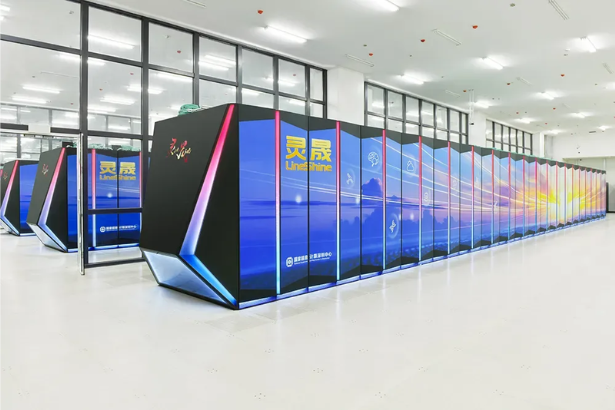
China’s domestically powered machine reshapes the global high-performance computing landscape
A new China supercomputer has reportedly claimed the title of the world’s fastest computing system, ending years of U.S. dominance in high-performance computing and highlighting Beijing’s accelerating push toward technological self-sufficiency.
The achievement has quickly become one of the most discussed technology stories globally, generating a sharp spike in Google search activity as analysts evaluate what the development means for artificial intelligence, scientific research, national security, and the future of semiconductor competition.
Background and Context
Supercomputers represent the pinnacle of computational performance.
These systems are used for:
- Artificial intelligence training
- Climate modeling
- Drug discovery
- Aerospace simulations
- Advanced materials research
- Defense applications
For decades, the United States maintained leadership in the global supercomputing race through systems developed by national laboratories and major technology vendors.
China, however, has steadily invested billions of dollars into domestic semiconductor development and high-performance computing infrastructure as part of broader efforts to reduce dependence on foreign technology.
Latest Update: China Takes the Crown
According to multiple reports, a new Chinese supercomputer powered primarily by domestically developed processors has surpassed leading U.S. systems in benchmark performance.
The achievement marks the first time in years that China has secured the top position in the global supercomputing rankings.
What makes the breakthrough particularly significant is that the machine reportedly relies heavily on Chinese-designed chips rather than advanced processors sourced from American companies.
The result demonstrates how Chinese semiconductor development continues advancing despite export restrictions imposed by the United States.
Why This Matters
Artificial Intelligence Leadership
Modern AI development increasingly depends on massive computing resources.
Training frontier AI models requires enormous processing power, making supercomputers critical national assets.
The new China supercomputer could provide researchers with:
- Faster AI training
- Larger model development
- Advanced simulation capabilities
- Improved scientific computing infrastructure
Semiconductor Independence
Perhaps the most important aspect of the announcement is the use of domestic hardware.
For several years, U.S. export controls have attempted to limit China’s access to advanced computing technologies.
The latest milestone suggests Chinese companies are making significant progress in developing alternatives internally.
Strategic Competition
The supercomputer race has become closely tied to broader geopolitical competition.
Leadership in high-performance computing often translates into advantages across:
- Defense technologies
- Scientific research
- Quantum computing
- Artificial intelligence
- Economic competitiveness
Expert Analysis
The achievement should not be viewed solely as a benchmark victory.
Industry experts increasingly see high-performance computing as foundational infrastructure for the AI era.
Just as data centers became critical during the cloud computing revolution, supercomputers are becoming strategic assets for nations seeking leadership in artificial intelligence.
China’s ability to produce world-class systems using homegrown technology could reduce the effectiveness of external technology restrictions over the long term.
At the same time, U.S. institutions continue investing heavily in next-generation computing systems, suggesting the competition is far from over.
Broader Implications
For AI Development
More computing power generally accelerates AI innovation.
Organizations with access to advanced supercomputers can train larger and more sophisticated models while reducing development timelines.
For Global Semiconductor Markets
The development highlights ongoing efforts to diversify semiconductor supply chains and reduce technological dependencies.
Investors are closely monitoring how domestic Chinese chip manufacturers evolve in response to export controls and growing demand for AI infrastructure.
For Scientific Research
High-performance computing powers breakthroughs across medicine, climate science, physics, and engineering.
Greater computing capabilities often translate directly into faster scientific discovery.
Related History
China has long viewed supercomputing as a strategic priority.
Previous Chinese systems such as Sunway TaihuLight and Tianhe-2 ranked among the world’s fastest computers and helped establish the country’s position as a serious competitor in advanced computing.
Meanwhile, the United States responded with exascale computing projects including Frontier and Aurora.
The latest ranking represents another chapter in a technology rivalry increasingly centered on computing power and AI capability.
What Happens Next?
Several key developments will be closely watched:
- Independent validation of benchmark results
- Future U.S. responses to China’s computing advances
- Next-generation AI infrastructure investments
- Semiconductor manufacturing breakthroughs
- Expansion of domestic Chinese chip ecosystems
Analysts expect competition between the world’s two largest economies to intensify as AI becomes increasingly dependent on advanced computing resources.
Conclusion
The emergence of a new China supercomputer at the top of global performance rankings represents more than a technological achievement.
It reflects the growing importance of computing power as a strategic national resource and highlights China’s accelerating progress toward semiconductor independence.
As the AI race continues, leadership in supercomputing is likely to become one of the most important indicators of future technological influence.
For policymakers, investors, and technology companies alike, the message is clear: the battle for computing supremacy is entering a new phase.
FAQ
What is the new China supercomputer?
Reports indicate it is a domestically powered high-performance computing system that has achieved the highest benchmark ranking globally.
Why is the China supercomputer important?
It demonstrates China’s growing ability to develop advanced computing systems using domestic technology.
How does supercomputing impact AI?
Supercomputers provide the processing power needed to train large AI models and run complex simulations.
Has China led supercomputer rankings before?
Yes. China previously held top positions with systems such as Sunway TaihuLight and Tianhe-2.
What does this mean for the United States?
The achievement intensifies competition in AI, semiconductors, and high-performance computing infrastructure.
Sources & References
- CNN – Chinese supercomputer powered by homegrown chips tops world rankings
- The New York Times – China Takes Supercomputer Crown From U.S. for First Time Since 2019
- ABC News – Chinese supercomputer displaces U.S. machines as world’s fastest
- TOP500 High Performance Computing Rankings