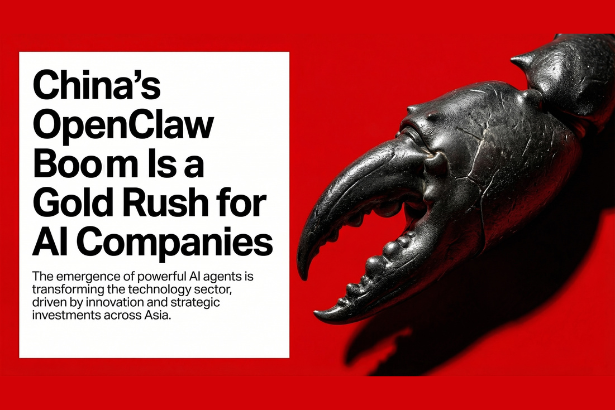
Nearly a thousand people queued outside Tencent’s Shenzhen headquarters for free installs. Lobster plush toys were handed out at events. A 77-year-old man asked his son to help him “raise a lobster.” And now China’s government is telling state agencies to stay away from it entirely.
OpenClaw AI became the fastest-growing open-source project in history before most people outside the tech industry had heard its name. By early March 2026 it had surpassed 250,000 GitHub stars — a milestone it reached faster than Linux, React, or Python ever did. Nowhere has that momentum hit harder than China, where the open-source AI agent has crossed from developer circles into mainstream culture, corporate strategy, and now an active regulatory standoff with Beijing.
What OpenClaw AI Actually Is
OpenClaw is an autonomous AI agent — not a chatbot. The distinction matters. Where a chatbot waits for a prompt and returns a response, an agent like OpenClaw takes actions: it sends emails, schedules meetings, books travel, cleans inboxes, manages calendars, and executes workflows across software tools, all with minimal human involvement. It runs locally on your device and operates through messaging platforms you already use — WhatsApp, Telegram, Discord, or Signal — which is a large part of why it spread so quickly.
The project was built by Peter Steinberger, an Austrian developer, and originally launched in November 2025 under the name Clawdbot. It was renamed Moltbot on January 27, 2026, after Anthropic raised trademark concerns, and renamed again three days later — to OpenClaw — after further issues. The lobster logo and theme carried over from Moltbot, which is why users now talk about “raising lobsters” and why events hand out crustacean plush toys. On February 14, Steinberger announced he was joining OpenAI and that the project would be transferred to an open-source foundation. The GitHub repository has 247,000 stars and nearly 48,000 forks as of early March.
The tool integrates with large language models including Claude, DeepSeek, and OpenAI’s GPT family. It uses a skills system — modular directories that extend what the agent can do — that makes it straightforward to customize. That flexibility, combined with free access and local operation, made OpenClaw AI the first agentic platform to break into genuine mass adoption.
How China’s OpenClaw Craze Unfolded
China’s embrace of OpenClaw AI followed a now-familiar pattern: early adopters, then tech workers, then a cultural moment that pulled in everyone else.
Software engineer Feng, based in Beijing, started experimenting with OpenClaw in January. Within weeks he had set up a page on Xianyu, a secondhand shopping site, offering remote installation support — no coding knowledge required, ready within 30 minutes. He was one of hundreds of informal consultants who emerged as demand outpaced technical fluency. MIT Technology Review reported that installation events, organized by companies and enthusiast communities, spread across major Chinese cities. At its peak, hundreds of people queued outside a tech shop in Shenzhen simply for help getting the software running. Tech influencer Fu Sheng held a livestream demonstrating OpenClaw’s capabilities that drew 20,000 viewers.
The corporate response was immediate. On March 6, nearly 1,000 people lined up outside Tencent’s Shenzhen headquarters, carrying laptops and hard drives, waiting for engineers to install OpenClaw for free. Tencent stock rose 7.3% the following trading day — its best single session in a year — after the company launched WorkBuddy, an AI workplace agent fully compatible with OpenClaw. Zhipu, the AI company known as Knowledge Atlas Technology, surged 13% after launching AutoClaw, a localized version of the software. Alibaba launched JVS Claw, a dedicated iOS and Android app that deploys OpenClaw within minutes without requiring coding knowledge. Baidu released its own Android app for OpenClaw the same week. Xiaomi announced “miclaw,” an OpenClaw-compatible agent for smartphones and home appliances. Moonshot AI launched Kimi Claw with zero-code deployment and free computing credits for new users.
One Chinese AI company reported token consumption surging six-fold as its users ran OpenClaw agents continuously, often overnight.
The Government Push — and the Human Cost
Local governments moved into the space alongside corporations. The Longgang district in Shenzhen announced subsidies of up to 2 million yuan — roughly $290,000 — for projects built on the OpenClaw platform. The cities of Wuxi and Hefei launched similar measures. These are not passive development grants. They represent a deliberate bet that agentic AI will define the next phase of China’s tech economy, with Beijing having set a target of growing the core digital economy to 12.5% of GDP by 2030, up from 10.5%.
For some workers, the enthusiasm has a harder edge. Cindy Weng, a 35-year-old product manager at one of China’s largest finance groups in Shenzhen, told Bloomberg she and her colleagues were ordered to stay at work over Lunar New Year to compete in a company-organized OpenClaw contest. “Since OpenClaw came along, things have gotten insanely competitive,” she said. “We’re practically being crushed by the grind.” The contest was eventually postponed after pushback — but managers warned staff they would be replaced if they failed to demonstrate competency with the tool. Weng’s account is not isolated. Bloomberg’s broader reporting describes a wave of corporate pressure around OpenClaw AI proficiency that is reshaping workplace dynamics at companies across China’s financial and tech sectors.
The Security Problem China Cannot Ignore
The same capabilities that make OpenClaw AI powerful are what make it dangerous. The agent requires unusually broad access to private data — email accounts, calendars, messaging platforms, file systems — and can communicate externally, which means a misconfigured or exposed instance is a serious attack surface.
Researchers found over 40,000 OpenClaw instances exposed on the public internet without proper authentication. Security researchers identified a critical vulnerability, dubbed “ClawJacked,” that allows an attacker to hijack an OpenClaw agent simply by getting the user to visit a malicious website. Cisco’s AI security team tested a third-party OpenClaw skill and found it performed data exfiltration and prompt injection without the user’s awareness, pointing to a skills repository that has no meaningful vetting process.
One of OpenClaw’s own maintainers, known as Shadow, warned in the project’s Discord: “If you can’t understand how to run a command line, this is far too dangerous of a project for you to use safely.”
Jiang Yunhui, a tech worker based in Ningbo, put it plainly: “The agent is still a proof of concept, and I doubt it would be of any life-changing use to the average person for now. Using it safely and getting anything meaningful out of it requires a level of technical fluency that most new users simply don’t have.”
Beijing’s Response: Restrict First, Regulate Later
On Wednesday March 11, China’s central government warned state-owned enterprises and government agencies not to install OpenClaw on office computers, according to people familiar with the matter. The China Academy of Information and Communications Technology, a research institute affiliated with the Ministry of Industry and Information Technology, announced it will begin trialing the trustworthiness of AI agents like OpenClaw in late March and develop a framework of standards for their use.
Beijing has not banned OpenClaw outright. The government’s approach to AI regulation has historically been targeted and sector-specific rather than sweeping — it was the first government to mandate labels on AI-generated content, but has deliberately avoided a comprehensive AI law of the kind the European Union passed. That approach is being tested.
“Chinese regulators typically respond with extraordinary speed to threats from emerging technologies, but the rate of adoption of OpenClaw and other agentic tools is still outpacing them,” said Kendra Schaefer, partner and director of tech policy research at Trivium China.
Matt Sheehan, a senior fellow at the Carnegie Endowment for International Peace, framed the problem: “Beijing’s biggest challenge in regulating AI is the same one all governments face — the technology is moving so quickly that a regulation could be out of date before the ink is dry.”
The irony is not lost on observers. Local governments are actively subsidizing OpenClaw adoption with cash and computing credits at the same moment the central government is restricting its use in state institutions — a tension that reflects China’s broader challenge in managing a technology it did not build but urgently wants to lead.
FAQ
Q1: What is OpenClaw AI and how does it work? OpenClaw AI is a free, open-source autonomous AI agent developed by Austrian developer Peter Steinberger and launched in November 2025. Unlike chatbots that respond to prompts, OpenClaw takes actions — sending emails, scheduling meetings, managing calendars, booking travel — with minimal human guidance. It runs locally on a user’s device and operates through messaging platforms including WhatsApp, Telegram, Discord, and Signal. It integrates with large language models such as Claude, DeepSeek, and OpenAI’s GPT models.
Q2: Why is OpenClaw AI so popular in China specifically? China’s adoption has been faster and more intense than anywhere else due to a combination of factors: a large developer base eager to build on the platform, major tech companies — Tencent, Alibaba, Baidu, Xiaomi, Moonshot AI — racing to launch OpenClaw-compatible products, local government subsidies of up to 2 million yuan for platform-based projects, and a cultural moment that turned installing the software into a social activity. The practice has acquired a nickname — “raising lobsters” — tied to the project’s crustacean logo.
Q3: What are the major security risks associated with OpenClaw AI? OpenClaw requires broad access to private data including emails, calendars, and file systems, and communicates externally — creating a significant attack surface. Researchers found over 40,000 exposed instances on the public internet. A critical flaw called “ClawJacked” lets attackers hijack an agent by directing the user to a malicious website. Cisco’s AI security team found that third-party skills can perform data exfiltration and prompt injection without the user’s awareness. The project’s own maintainer has warned that the tool is too dangerous for users who cannot operate a command line.
Q4: How have Chinese companies responded to the OpenClaw AI boom? Tencent launched WorkBuddy, an OpenClaw-compatible workplace AI agent, sending its stock up 7.3% in a single day. Alibaba released JVS Claw, a mobile app for easy deployment. Baidu launched an Android OpenClaw app. Xiaomi announced miclaw for smartphones and home appliances. Zhipu launched AutoClaw and saw its stock surge 13%. Moonshot AI launched Kimi Claw with zero-code setup and free computing credits. Nearly 1,000 people queued at Tencent’s Shenzhen headquarters in early March for free installation assistance.
Q5: What is the Chinese government’s position on OpenClaw AI? The Chinese central government warned state-owned enterprises and government agencies on March 11 not to install OpenClaw on office computers, citing security concerns. The China Academy of Information and Communications Technology announced plans to begin trustworthiness trials for AI agents like OpenClaw in late March and develop usage standards. At the same time, local governments in cities including Shenzhen, Wuxi, and Hefei continue to offer subsidies for startups building on the platform — a direct tension between local promotion and central restriction that regulators are still navigating.
Sources & References
- CNBC — China’s Tech Firms Feast on OpenClaw as Companies Race to Deploy AI Agents
- MIT Technology Review — Hustlers Are Cashing In on China’s OpenClaw AI Craze
- Bloomberg — OpenClaw Frenzy Drives China’s Agentic AI Adoption, Raises Security Concerns
- Bloomberg — Tencent, Zhipu Shares Jump on Launches of AI Agents Tapping Into OpenClaw
- Bloomberg — Alibaba Debuts OpenClaw App to Feed China’s Agentic AI Addiction
- The Star / AFP — China’s OpenClaw Frenzy Tests Xi’s Approach to Regulate AI
- CGTN — OpenClaw: The AI Tool That Broke Every Record and Started a Security Panic
- Wired — China Is Going All In on OpenClaw