The Chargers vs Chiefs matchup on October 18 delivered another difficult afternoon for Los Angeles. Kansas City secured a 22-6 victory at Arrowhead Stadium, using a powerful rushing performance from Kenneth Walker III and a disciplined defensive effort to extend its unbeaten start to the 2026 NFL season.
For the Chargers, the loss was about much more than another entry in the defeat column. Los Angeles dropped to 0-6, its worst start since 2000, and failed to score a touchdown. The offense managed only 259 total yards, quarterback Justin Herbert threw an interception, and the team’s promising opportunities repeatedly ended without meaningful points.
Head coach Jim Harbaugh now faces a difficult evaluation period during the team’s bye week. His comments after the game suggested that every aspect of the offense, including its play-calling, could come under review.
Kansas City, meanwhile, continued to demonstrate why it belongs among the league’s early-season contenders. Walker supplied the touchdowns, Patrick Mahomes controlled the passing game, and the Chiefs defense consistently made life difficult for Herbert.
Background and Context: Why Chargers vs Chiefs Mattered
The AFC West rivalry entered this game with the teams moving in sharply different directions.
Kansas City arrived looking to protect its unbeaten record and maintain momentum in the division. Los Angeles needed a breakthrough after a disappointing opening stretch that had left the team searching for its first victory.
The Chargers had entered the season with considerable expectations surrounding Herbert and the arrival of offensive coordinator Mike McDaniel. His appointment raised hopes that a creative offensive system could unlock more consistent production from the quarterback and receiving group.
Instead, the early results had been frustrating. Injuries along the offensive line and at receiver complicated the situation, but execution errors and an inability to convert promising drives into touchdowns became recurring problems.
The Chiefs also had injury concerns of their own. Even without several receiving options, Kansas City found an effective formula through Walker’s rushing production and Mahomes’ ability to distribute the football.
That contrast shaped the game. Kansas City capitalized on its opportunities, while Los Angeles repeatedly left points on the field.
Latest Update: How the Chiefs Beat the Chargers
The final score was 22-6, but several moments explain how the contest developed.
Kenneth Walker III supplied the decisive touchdowns
Walker was the most important offensive difference-maker. He rushed for 128 yards on 19 carries and scored twice, providing Kansas City with a reliable way to move the chains and finish drives.
His first touchdown came on a 33-yard run that extended the Chiefs’ early lead. Later, he added a two-yard scoring run, helping Kansas City establish a 19-3 advantage by halftime.
The performance illustrated the value of a dependable ground game. With Walker creating explosive plays and converting a short-yardage opportunity, the Chiefs did not need Mahomes to produce a touchdown pass to control the contest.
Patrick Mahomes controlled the passing game
Mahomes completed 23 of 30 passes for 272 yards. He did not throw a touchdown, but his efficiency helped Kansas City maintain possession and put pressure on the Chargers defense.
Xavier Worthy led the Chiefs’ receivers with 73 yards on seven catches, while Travis Kelce added five receptions for 53 yards.
The passing attack complemented Walker rather than competing with it. That balance made Kansas City’s offense difficult to contain, particularly as the Chargers struggled to generate enough pressure and keep the game within reach.
Justin Herbert and the Chargers offense stalled
Herbert completed 22 of 37 passes for 204 yards and threw an interception. He also led Los Angeles in rushing with 26 yards.
The Chargers finished with 259 total yards and did not score a touchdown. Their best opportunity to narrow the gap came in the third quarter, when a 57-yard reception by Quentin Johnston moved the offense to the Kansas City one-yard line.
A holding penalty pushed Los Angeles backward, however, and the ensuing plays failed to produce a touchdown. The Chargers settled for a field goal instead.
That sequence captured the broader problem. Even when the offense generated a significant gain, penalties and unsuccessful plays undermined the drive.
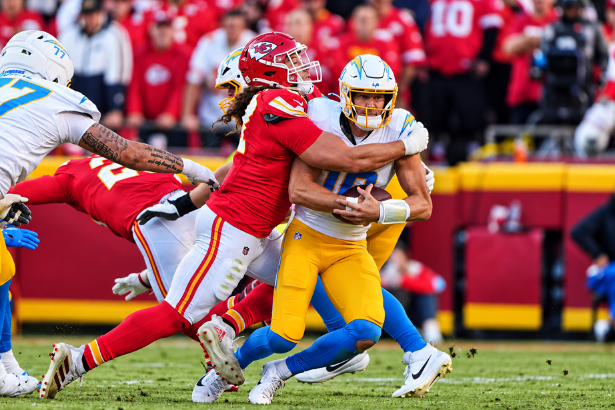
The Chiefs defense also recorded four sacks and forced two turnovers on downs, keeping Herbert under pressure throughout the afternoon.
For the official game recap and box score, see CBS Sports’ Chargers vs Chiefs recap.
The Chargers enter their bye week without answers
After the loss, Harbaugh said the team needed to address everything, particularly on offense. He did not definitively confirm whether McDaniel would continue calling plays when the Chargers returned to action.
That uncertainty immediately became a major storyline.
The Chargers’ official Week 6 takeaways highlighted the offense’s scoring struggles and the need to turn preparation into better on-field execution.
The bye week gives the coaching staff time to examine the system, personnel, protection schemes and decision-making without the immediate pressure of another Sunday game.
Expert Analysis: Three Lessons From Chargers vs Chiefs
1. The Chargers need more than a play-calling adjustment
Changing the person calling plays could become part of the discussion, but it would not automatically resolve every problem.
Los Angeles has struggled with penalties, turnovers, protection breakdowns and red-zone execution. Those issues involve several layers of the offense, from coaching and personnel decisions to communication and individual performance.
Herbert also needs more consistent support from his offensive line and receiving group. Injuries have limited the team’s options, while mistakes have prevented available players from making the most of their opportunities.
Harbaugh’s decision to evaluate the entire operation reflects the scale of the challenge.
2. Kansas City’s ground game created control
Walker gave the Chiefs a dependable source of production that reduced pressure on the passing game.
His 128 rushing yards and two touchdowns forced Los Angeles to account for the run while Mahomes worked through the passing options. The result was a balanced approach that produced points without requiring an explosive passing performance.
For Kansas City, the performance was a reminder that controlling the game does not always require spectacular quarterback statistics. A productive running back, efficient quarterback play and timely defense can be enough.
3. Momentum means little without execution
Los Angeles had opportunities to change the game’s direction, but could not capitalize.
The failed goal-line sequence was especially costly. A potentially important touchdown drive became a field goal, and subsequent possessions failed to generate the momentum needed for a comeback.
The lesson is straightforward: explosive plays create opportunities, but disciplined execution determines whether those opportunities become points.
Broader Implications: What the Result Means for Both Teams
The Chargers face an early-season crossroads
An 0-6 start creates pressure across an organization. Coaches must identify what is broken, players need to restore confidence, and management has to determine whether the current approach can produce meaningful improvement.
The offensive coordinator question will attract attention, but the more important measure will be whether the Chargers can build a repeatable scoring process after the bye.
That means protecting Herbert, reducing turnovers, eliminating avoidable penalties and finishing drives in the end zone.
For more coverage of technology, business and digital trends in sports, The Tech Marketer could connect this story to a broader feature on how NFL teams use analytics and video analysis to evaluate offensive performance.
The Chiefs strengthen their early-season position
Kansas City’s 22-6 victory improved its record to 5-0. The Chiefs demonstrated that they could control a divisional opponent even without a touchdown pass from Mahomes.
Walker’s performance also gave the offense another dimension. A strong rushing game can help manage tempo, reduce pressure on the quarterback and make defensive adjustments more difficult.
The challenge now is maintaining that balance as the schedule becomes more demanding.
NFL fans are watching the coaching questions
The Chargers’ offensive struggles have created a story that extends beyond one game. Harbaugh’s comments have shifted attention toward McDaniel’s future, the team’s system and the possibility of changes during the bye week.
For fans, the next development may be as important as the final score. The question is no longer simply whether Los Angeles can compete with Kansas City. It is whether the Chargers can make the structural adjustments needed to become competitive again.
Related History and Comparable Technologies
Chargers vs Chiefs is a long-running AFC West rivalry, but this result carries additional significance because of Los Angeles’ winless start and Kansas City’s strong opening record.
The Chargers have experienced difficult seasons before, yet expectations surrounding Herbert and Harbaugh made the 2026 start particularly striking. The contrast between the team’s ambitions and its results has intensified scrutiny of the coaching staff.
There is also a growing analytics angle to modern NFL coverage. Teams increasingly examine expected points added, success rate, pressure rate, red-zone efficiency and turnover frequency to distinguish between isolated mistakes and recurring weaknesses.
The Chargers’ official postgame analysis reported that the offense ranked last in EPA per play through six games. That figure provides a more systematic view of the problem than the final score alone.
These metrics do not explain every failure, but they help teams identify where drives are breaking down and which adjustments may have the greatest impact.
What Happens Next?
The Chargers enter their bye week at 0-6, giving Harbaugh and his staff additional time to assess the offense before their next game.
Three questions will dominate the discussion:
- Who will call the plays? Harbaugh has not publicly committed to keeping McDaniel in that role, leaving room for changes.
- Can Herbert receive better protection? Injuries and pressure have complicated the passing game, and improved protection could help stabilize the offense.
- Can the Chargers finish drives? The team needs to turn promising possessions into touchdowns rather than settling for field goals or giving the ball away.
Los Angeles is scheduled to face the Rams next, with the matchup set for November 1 following the bye. That game will provide another opportunity to demonstrate whether the team has made tangible progress.
Kansas City will look to continue its unbeaten start and maintain its position in the AFC West. Walker’s performance offers a promising foundation, while Mahomes and the defense give the Chiefs several ways to control games.
Conclusion
The Chargers vs Chiefs matchup ended in a 22-6 Kansas City victory, but the bigger story is what the result revealed about the two teams.
The Chiefs leaned on Walker’s explosive rushing performance, efficient quarterback play and a defense that consistently disrupted Herbert. Los Angeles, meanwhile, failed to score a touchdown and left Arrowhead Stadium still searching for its first win of the season.
Harbaugh’s promise to review everything places the Chargers’ offense firmly under the spotlight. Whether that leads to changes in play-calling, personnel or scheme remains to be seen.
The bye week offers a valuable chance to regroup, but time alone will not fix the team’s problems. The Chargers must translate their preparation into cleaner execution and more consistent scoring.
For Kansas City, the immediate objective is simpler: keep winning. For Los Angeles, the next two weeks could help determine the direction of the rest of its season.
Frequently Asked Questions
1. What was the Chargers vs Chiefs score on October 18, 2026?
The Kansas City Chiefs defeated the Los Angeles Chargers 22-6 at Arrowhead Stadium.
2. How did Kenneth Walker III perform against the Chargers?
Walker rushed for 128 yards on 19 carries and scored two touchdowns, leading Kansas City’s ground attack.
3. How did Patrick Mahomes perform?
Mahomes completed 23 of 30 passes for 272 yards. He did not throw a touchdown pass, as Walker scored both of Kansas City’s rushing touchdowns.
4. Why did the Chargers lose to the Chiefs?
Los Angeles struggled to finish drives, committed turnovers and penalties, and allowed four sacks. The offense recorded 259 total yards without scoring a touchdown.
5. Is Mike McDaniel still the Chargers’ offensive coordinator?
Following the loss, Harbaugh said the team would evaluate everything, including the offense. He did not definitively confirm whether McDaniel would continue calling plays.
6. What is the Chargers’ record after the game?
Los Angeles fell to 0-6, while Kansas City improved to 5-0.
7. When do the Chargers play next?
The Chargers are scheduled to face the Los Angeles Rams on November 1, 2026, after their bye week.
8. Where can fans find the Chargers vs Chiefs highlights and stats?
Fans can review the CBS Sports game recap and the Chargers’ official postgame analysis.
Sources and References
- ESPN, Harbaugh Mum on McDaniel, Says Chargers Need ‘to Address Everything’.
- CBS Sports, Los Angeles Chargers vs. Kansas City Chiefs Live Score and Stats, October 18, 2026.
- Los Angeles Chargers, 5 Takeaways: Harbaugh Vows to ‘Look at Everything’ Offensively After Chargers 0-6 Start.
- Reuters, Chiefs Remain Unbeaten, Control Winless Chargers.
- Los Angeles Times, Chargers Fall to 0-6 After Another Woeful Offensive Effort in Loss to Chiefs.
- Yahoo Sports, Jim Harbaugh to Address Offense During Bye Week After Chargers’ 0-6 Start.