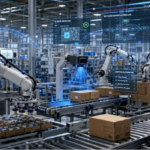
AI in supply chain management is moving into one of the most consequential areas of business operations: planning what to make, where to store it, how much inventory to hold and when to move products. The promise is straightforward. AI can analyze more information than a human planner can reasonably process, identify patterns across complex datasets and help companies respond faster when demand or supply conditions change.
But there is a harder question behind the enthusiasm: does more data actually lead to better decisions?
In its October 16, 2026, episode, AI in Supply Chain Planning: Impact, Promise and Limits, SupplyChainBrain explores that question with Nicholas Wegman, senior director of artificial intelligence science at Zebra Technologies. Hosted by SupplyChainBrain Editor-in-Chief Bob Bowman, the episode examines AI’s current role in planning, its future potential, its limitations and the continuing role of human judgment.

SupplyChainBrain
The timing matters. Manufacturers, distributors and retailers face growing expectations around product availability, delivery speed and service quality. At the same time, supply chains must deal with changing demand, supplier uncertainty, transportation delays and the costs of holding too much inventory.
AI can help planners navigate those competing demands. Yet the technology does not eliminate uncertainty, guarantee accurate forecasts or automatically choose the right business trade-off.
The real opportunity is not to generate more predictions. It is to help supply chain teams make better decisions, faster, while understanding when the data is incomplete and when human intervention is necessary.
Background and Context: Why Supply Chain Planning Is Becoming More Complex
Supply chain planning connects decisions that are often handled by different teams. Sales forecasts influence production schedules. Production schedules determine material requirements. Inventory decisions affect warehouse capacity and working capital. Transportation plans determine whether products reach customers when promised.
When these decisions are disconnected, small errors can spread through the network.
A retailer that overestimates demand may accumulate excess inventory. A manufacturer that underestimates demand may run short of materials or miss delivery commitments. A distributor that relies on outdated lead times may promise stock that cannot arrive on schedule.
Traditional planning systems help organizations manage these processes, but they often depend on historical data, manually maintained assumptions and periodic updates. Those methods can become less effective when conditions change rapidly.
AI offers another approach. By analyzing historical transactions alongside more recent operational signals, AI-enabled planning tools can help teams detect demand changes, examine alternative scenarios and identify exceptions that deserve attention.
SupplyChainBrain’s broader coverage of AI and advanced analytics in supply chain planning reflects this shift toward more data-driven planning. The goal is to move beyond static forecasts and give planners better information for decisions that affect the whole operation.
SupplyChainBrain
However, complexity is not solved simply by adding an AI model. The quality of the result still depends on the information available, the business rules applied and the way people use the output.
Latest Update: What SupplyChainBrain’s AI Planning Discussion Reveals
The October 16 SupplyChainBrain podcast focuses on the current impact of AI in planning, its future promise and its limitations. Nicholas Wegman of Zebra Technologies discusses the technology in the context of manufacturers, distributors and retailers trying to meet increasingly demanding customer expectations.
SupplyChainBrain
Three themes stand out for businesses evaluating AI planning tools.
1. AI can process signals that traditional planning may miss
Demand planning involves more than calculating an average from past sales. A planner may need to consider promotions, seasonal shifts, product availability, changing customer behavior, supplier lead times and operational constraints.
AI can help analyze multiple signals at once and identify patterns that may be difficult to detect manually. It can also help planners explore scenarios, such as what happens if demand rises unexpectedly or a key supplier misses a shipment.
That does not mean every signal is reliable or that every pattern predicts future behavior. A model may identify a correlation that does not hold when conditions change. Planners still need to evaluate whether the pattern makes operational sense.
2. Better forecasts must lead to better decisions
A forecast is an input into a business decision, not the final result.
If a system predicts higher demand for a product, the company still needs to decide whether to increase production, order more materials, shift inventory between locations or accept a temporary shortage.
Each choice has different costs and risks. Producing more may increase inventory carrying costs. Ordering extra materials may tie up cash. Moving stock between warehouses may raise transportation costs. Holding back inventory may reduce service levels.
The value of AI depends on whether it helps the organization compare these trade-offs and choose a response that fits its business priorities.
3. Human judgment remains part of the planning process
The SupplyChainBrain episode explicitly addresses the role of humans in an increasingly AI-driven planning environment.
SupplyChainBrain
That question is especially important when the data does not reflect an unusual event. A new product launch, a supplier shutdown, a major customer contract or a sudden regulatory change may have limited historical precedent.
An AI system can help analyze the available information, but people may need to interpret the event, question the assumptions and decide how much risk the company should accept.
The most practical model is therefore not necessarily fully automated planning. It is a system that gives planners stronger analytical support while preserving human oversight for important, uncertain or high-impact decisions.
Expert Insights and Analysis: Can AI Deliver Better Forecasts?
AI can improve planning, but its success depends on more than model sophistication. Supply chain leaders need to understand the difference between forecast accuracy, operational performance and business value.
1. Forecast accuracy is only one part of the equation
Imagine a retailer whose AI system predicts demand for a popular product more accurately than its previous forecasting method. That is useful, but the company still needs to translate the forecast into purchasing, inventory allocation and replenishment decisions.
If suppliers cannot deliver quickly enough, better forecasting may not prevent a stockout. If the company responds by ordering too much inventory, it could increase storage costs and tie up working capital.
This is why businesses should measure forecasting improvements alongside outcomes such as product availability, inventory turnover, excess stock, service levels and replenishment costs.
A model can improve a statistical metric without improving the overall operation. The business outcome is what matters.
2. Poor data can undermine sophisticated AI
Supply chain data is often spread across enterprise resource planning systems, warehouse platforms, supplier portals, transportation software and spreadsheets.
These systems may use different product identifiers, inconsistent units of measurement or outdated lead-time assumptions. Some records may be incomplete or arrive too late to support a timely decision.
AI cannot reliably compensate for every gap in the underlying information.
Before deploying an AI planning tool, companies should establish which systems are authoritative, improve data consistency and make sure the model can distinguish actual events from missing or delayed information.
This is especially important when a model recommends changes to inventory or purchasing. A confident recommendation based on stale data can be more dangerous than a clearly identified information gap.
3. Inventory optimization requires business trade-offs
Inventory planning is not simply about minimizing stock. A company that holds too little inventory may lose sales or fail to meet customer commitments. A company that holds too much may face higher storage costs, waste, obsolescence and reduced cash flexibility.
AI can help analyze these competing pressures and compare alternative inventory policies. But the right answer depends on the company’s priorities.
For example, a manufacturer supplying a critical component may accept higher safety stock to protect production continuity. A retailer selling seasonal goods may prioritize avoiding excess stock after the season ends.
A useful AI system needs to reflect those differences rather than applying a generic recommendation across every product and location.
4. Scenario planning can be more useful than a single forecast
Supply chains rarely follow a single predictable path. Demand may rise or fall, a supplier may miss a delivery, or transportation capacity may become constrained.
Instead of treating one forecast as the answer, planners can use AI-assisted analysis to compare possible scenarios.
A company might evaluate what happens if demand increases by 15%, a supplier’s lead time doubles or a distribution center becomes unavailable. The model can help estimate the effects on inventory, production schedules and customer service.
These scenarios are not guarantees about what will happen. They are tools for understanding exposure and preparing a response before a disruption occurs.
5. Automation needs clear limits
AI tools are increasingly capable of recommending actions, and some systems can execute decisions through connected business software. But not every planning decision should be automated to the same degree.
A low-risk recommendation to adjust a replenishment parameter may be suitable for automated execution under defined rules. A decision that could halt production, commit substantial capital or affect a critical customer may need human approval.
Organizations should establish decision limits, approval requirements, audit trails and procedures for handling uncertain outputs.
The more consequential the action, the more important it becomes to understand how the recommendation was produced, which data informed it and who is accountable for the result.
Broader Implications: AI Could Change How Supply Chains Make Decisions
AI in supply chain management has implications beyond the forecasting team. Better planning can influence purchasing, production, warehousing, transportation, customer service and finance.
When these functions use different assumptions, one team’s optimization can create a problem for another. Purchasing may order in bulk to reduce unit costs, for example, while warehouse teams struggle with capacity and finance faces higher inventory investment.
A connected planning process can help teams evaluate those trade-offs together. AI may accelerate the analysis, but organizations still need shared objectives and clear decision-making responsibilities.
The shift from reporting to action
Traditional analytics often explain what happened. More advanced planning systems aim to help teams understand what might happen next and which actions could produce a better outcome.
That shift can make planning more responsive. A system might flag a likely shortage, identify alternative supply options and estimate the cost of each response.
But recommendations are only useful if the organization can act on them. Supplier contracts, production constraints, transportation capacity and internal approval processes can all limit the available choices.
The workforce impact
AI may reduce some repetitive analysis and give planners more time to investigate exceptions, evaluate scenarios and coordinate with suppliers. It may also change the skills required for planning roles.
Employees will increasingly need to interpret model outputs, question assumptions, understand data limitations and explain trade-offs to other teams.
That makes training important. Employees should know not only how to use the software, but also when not to trust its recommendation.
What business leaders should measure
Executives evaluating AI planning investments should look beyond the number of forecasts generated or recommendations accepted. Useful indicators include:
- Forecast error and bias by product and location.
- Product availability and order fill rates.
- Inventory turnover and excess or obsolete stock.
- Supplier lead-time variability.
- Planning cycle time and the number of manual interventions.
- Cost of expedites, shortages and last-minute schedule changes.
- Total cost of implementation, integration, training and ongoing support.
These measures should be compared against a baseline, with enough time to account for seasonality and changing market conditions.
For related reporting on business technology, logistics and operational innovation, consider an internal link to The Tech Marketer’s technology and supply chain coverage.
Related History: From Spreadsheet Forecasts to AI-Assisted Planning
Supply chain planning has evolved through several waves of technology.
Many organizations began with spreadsheets and historical sales reports. Enterprise resource planning systems later helped centralize transactions and coordinate purchasing, production and inventory. Specialized planning software introduced more structured forecasting, optimization and scenario analysis.
AI adds capabilities for identifying patterns across large datasets, generating predictions and supporting more adaptive decisions. But it does not make the earlier systems obsolete overnight.
The underlying records, constraints and business processes still matter. AI planning tools often need to work alongside ERP systems, warehouse management platforms, supplier data and transportation applications.
The transition is therefore less about replacing every existing planning tool and more about improving how information flows between them and how decisions are made.
It is also worth distinguishing AI-assisted planning from fully autonomous supply chain management. A tool that recommends a replenishment quantity is not the same as one that can place an order, negotiate a change and update production schedules without human intervention.
Companies should be clear about which level of capability they are buying and what controls are required.
What Happens Next?
For companies considering AI in supply chain management, the next step should be a practical evaluation of where the technology can improve decisions.
- Identify a measurable planning problem. Choose an issue such as recurring stockouts, excess inventory or unreliable lead-time estimates.
- Establish a baseline. Measure current forecast performance, inventory costs, service levels and manual planning effort.
- Check data readiness. Review data quality, system integration, update frequency and ownership.
- Run a controlled pilot. Test the model against the existing planning approach and include representative products, locations and demand conditions.
- Keep planners involved. Ask users to review recommendations, record exceptions and explain when the system’s assumptions do not match reality.
- Measure business outcomes. Evaluate total costs and service improvements, not just model accuracy.
- Scale with appropriate controls. Expand only after the system demonstrates reliable performance, and set clear rules for automated actions.
The industry will also need to resolve broader questions around AI governance, data sharing, model transparency and accountability when automated recommendations affect multiple supply chain partners.
The companies most likely to benefit will be those that treat AI as part of an operating process, not as a standalone forecasting feature.
Conclusion
AI in supply chain management offers a promising way to analyze demand, evaluate supply constraints and help planners respond to changing conditions. But more data and more sophisticated forecasts do not automatically produce better business outcomes.
The real value comes when companies turn useful predictions into sound inventory, purchasing and fulfillment decisions. That requires reliable data, clear operational objectives, well-defined decision rules and people who understand when to challenge the model.
The October 16 SupplyChainBrain discussion highlights both the potential of AI planning and the importance of understanding its limitations.
SupplyChainBrain
For manufacturers, distributors and retailers, the goal should not be to remove human judgment from planning. It should be to give planners better information, more useful scenarios and more time to focus on the decisions that matter.
The future of supply chain planning will depend not on who generates the most data, but on who converts that data into more reliable decisions.
FAQ
1. How is AI used in supply chain management?
AI can support demand forecasting, inventory planning, supplier risk analysis, replenishment, logistics planning and scenario evaluation. Its value depends on the quality of the data, the use case and how recommendations are incorporated into business decisions.
2. Can AI improve supply chain forecasts?
AI can identify patterns across historical and current data that may improve forecasts. However, performance depends on data quality, changing conditions and the type of demand being predicted. Better forecasts also need to translate into better operational decisions.
3. What are the biggest limitations of AI in supply chain planning?
Common limitations include incomplete or inconsistent data, changing demand patterns, poor integration with existing systems, difficulty explaining recommendations and the risk of acting on incorrect predictions. Human judgment remains important when circumstances fall outside the model’s assumptions.
4. How does AI help with inventory optimization?
AI can help estimate demand, compare inventory policies and identify potential shortages or excess stock. Businesses still need to balance service levels, storage costs, working capital, supplier lead times and the risk of obsolescence.
5. Will AI replace supply chain planners?
AI may automate parts of data analysis and routine planning, but planners remain important for interpreting exceptions, balancing competing objectives, coordinating with suppliers and making decisions under uncertainty. The impact will vary by role and organization.
6. How can a company measure the ROI of supply chain AI?
Companies should compare implementation and operating costs with measurable changes in forecast accuracy, stockouts, excess inventory, service levels, expedited freight and planning effort. A baseline and controlled pilot help distinguish AI’s contribution from other operational changes.
7. What data is needed for AI supply chain planning?
Depending on the use case, relevant data may include sales history, orders, inventory levels, supplier lead times, production capacity, transportation status, promotions and external demand signals. Data must be sufficiently accurate, timely and consistent to support the intended decisions.
8. Should supply chain decisions be fully automated?
Not all decisions should be automated. Routine, low-risk actions may be suitable for automation under defined rules, while decisions involving large financial commitments, major disruptions or critical service risks may require human review and approval.
Sources & References
- Podcast | AI in Supply Chain Planning: Impact, Promise and Limits, SupplyChainBrain, October 16, 2026. The primary source for the discussion with Nicholas Wegman of Zebra Technologies on AI’s current role, potential and limitations in planning.
- Forecasting & Demand Planning, SupplyChainBrain. Industry coverage of forecasting, demand planning, advanced analytics and AI-assisted planning.
- Artificial Intelligence in Supply Chain Management, SupplyChainBrain. Reporting and analysis on AI applications and adoption in supply chain operations.
- How AI Is Reshaping Supply Chain Decision-Making, SupplyChainBrain, October 1, 2026. Further context on how AI can affect planning decisions and the balance between automated analysis and human judgment.
- The SupplyChainBrain Podcast, SupplyChainBrain. Podcast archive covering AI, visibility, lead-time planning and supply chain disruption.